Constantine I
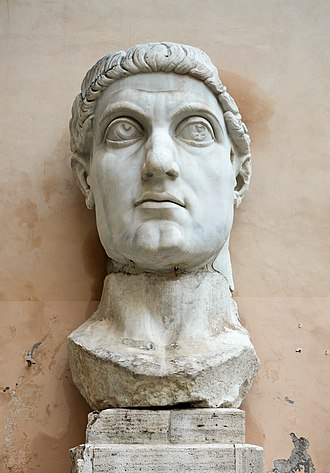
Nickname/Alias: Constantine the Great; Flavius Valerius Aurelius Constantinus
Achievements: The first Christian Roman Emperor
Born: February 27, c. 280; Naissus, Upper Moesia (now Nish, Serbia)
Died: May 22, 337; Nicomedia (now Izmit, Turkey) (Aged around 57)
Field & Discipline: Royalty; Emperor
Language: Latin; Greek
Father: Flavius Valerius Constantius (aka Constantius I Chlorus, c. 250-306)
Mother: Flavia Helena (c. 255-330; later St. Helena)
Siblings: None
Spouse: Fausta (daughter of Maximian, m. 307)
Children: Crispus (d. 326); Constantius (317-61); Constantine II (d. 340); Flavius Julius Constans I (c. 320-50)
Education: Court of Diocletian, Nicomedia
Life & Times:
In 305, the two emperors, Diocletian and Maximian, abdicated, and were succeeded by their respective deputies, Galerius and Constantine’s father Constantius who now became sole ruler of the West. Father and son crossed the Channel to Britain in order to fight a campaign against the Picts in the north.
Before Constantius's death at York in 306, he proclaimed his son his successor, and Constantine was accepted as emperor by the army. Constantine then led a successful campaign against the Franks on the Rhine, and was acknowledged as Caesar (but not Emperor) in Gaul and Britain by Galerius.
By 308 there were as many as six emperors at once - Galerius, Valerius Licinius and Maximian in the East; and Maximian, Maxentius his son, and Constantine in the West. However Maxentius drove his father from Rome, and Maximian, now in Constantine's camp, was either murdered or forced to commit suicide in 310.
In 311, Maxentius, Constantine's brother-in-law and now his greatest enemy, was threatening Gaul with a large army, and the following year Constantine crossed the Alps into Italy with 30,000 soldiers and defeated his rival at the great Battle of Milvian Bridge, near Rome. According to the historian Eusebius, at noon before the battle, while praying, Constantine saw a vision of a flaming cross above the sun inscribed with the words "By this sign you will conquer", to which he later attributed his conversion to Christianity around 312. Whatever the inspiration, on the following day Constantine was victorious, killing both Maxentius and his son.
After the defeat of Maxentius, Constantine travelled to Rome where he was proclaimed senior emperor (Augustus) by the Roman Senate, and a truimphal arch and statue of Constantine holding the Christian cross was erected in his honour. In 313 he then met with Licinius at Milan (Galerius having died in 311), to whom he gave his sister, Constantia, in marriage, and with whom he confirmed an alliance in which he was declared Western emperor, while Licinius shared the East with his rival Maximinus Daia.
Constantine and Licinius also issued conjointly the Edict of Milan (313), which gave civil rights and toleration to Christians throughout the empire, and restored any personal and corporate property that had been confiscated during the persecution.
Constantine went much further, donating to the Bishop of Rome the imperial property of the Lateran, where a new cathedral, the Basilica Constantiniana (now St John Lateran) was then constructed, and he commissioned the Church of St. Sebastian. He began issuing laws conveying on the church and its clergy fiscal and legal privileges
and immunities.
By 313 Licinius had defeated Maximinus and become sole emperor of the East and in 314 Constantine and Licinius fought a war in which Constantine again won, and Licinius was forced to hand over Illyricum, Pannonia and Greece. Constantine finally attacked Licineus in 323, allegedly because of Licinius's persecution of the Christians, defeating and killing him. Constantine became sole emperor of East and West, and to commemorate the great victory he decided to rebuild Byzantium, rename it Constantinople, and (324) make Christianity the state religion.
In 326, during celebrations in Rome of his 20th year in power, a serious crisis developed in Constantinople, as a result of which he ordered the execution of both his wife, Fausta, and his eldest son, the deputy emperor Crispus. In atonement for this family tragedy, Constantine's mother, Helena, herself a devoted Christian, embarked on a pilgrimage to the Holy Land, during which she founded churches at Jerusalem and Bethlehem.
On his return from the West, in 327, Constantine began the rebuilding of Constantinople on a greatly enlarged pattern. In May 330 he dedicated his new city in honour of the Christian martyrs, gave it a senate, and placed it at the centre of his empire. During this final decade of his reign, Constantine continued the emperor cult, but it was increasingly surrounded by Christian ceremony.
In later years he built several more Christian churches like the Church of Holy Wisdom (Hagia Sophia), commissioned new copies of the Bible for the growing congregations at Constantinople. He issued numerous laws relating to Christian practice, abolishing the penalty of crucifixion and the practice of branding certain criminals, ordering the observance of Sunday (in 321) and saints' days as public holidays, and extending privileges to the clergy, while continuing a toleration of paganism.
Meanwhile, on the discovery of the Holy Sepulchre at Jerusalem, he instigated the building of a great new basilica at the spot, and at Rome the great church of St. Peter was begun (late 320s) and lavishly endowed by Constantine with plate and property.
Although Constantine had originally hoped to be baptized in the Jordan River, the ceremony was delayed until the end of his life. He fell ill at Helenopolis in 337, while preparing for a campaign against Persia, and, realizing the seriousness of his condition, he attempted to return to Constantinople. Forced to rest at Nicomedia, he was baptized there, and died.
The famous 'Donation of Constantine' (with which the emperor was supposed to have given Pope Sylvester I primacy over Antioch, Constantinople, Alexandria, and Jerusalem, and political control of Italy, and made the Pope supreme judge of the clergy) was in fact an 8th-century forgery from the reign of [fake Donation by] Charlemagne*, as proved in the 15th century by the humanist scholar [Fake Donation revealed by] Valla*.
Donation of Constantine
Main article: Donation of Constantine
Latin Rite Catholics considered it inappropriate that Constantine was baptized only on his death bed by an unorthodox bishop, and a legend emerged by the early 4th century that Pope Sylvester I had cured the pagan emperor from leprosy. According to this legend, Constantine was baptized and began the construction of a church in the Lateran Basilica.[338][339]
The Donation of Constantine appeared in the 8th century, most likely during the pontificate of Pope Stephen II, in which the freshly converted Constantine gives "the city of Rome and all the provinces, districts, and cities of Italy and the Western regions" to Sylvester and his successors.[340] In the High Middle Ages, this document was used and accepted as the basis for the pope's temporal power, though it was denounced as a forgery by Emperor Otto III[341] and lamented as the root of papal worldliness by Dante Alighieri.[342] Philologist and Catholic priest Lorenzo Valla proved in 1440 that the document was indeed a forgery.[343]
Assessment: Overall, he provided the impulse for a distinctively Christian culture that prepared the way for the growth of Byzantine and Western medieval culture.
Oneliner: Constantine, Roman Emperor (of the fake “Donation”)
Bibliography:
- Collier's Encyclopedia.
- Encyclopedia Britannica.
- Smith, John Holland, Constantine the Great, London: Hamish Hamilton, 1971.