Robotics
A robot is a machine—especially one programmable by a computer—capable of carrying out a complex series of actions automatically.[2] A robot can be guided by an external control device, or the control may be embedded within. Robots may be constructed to evoke human form, but most robots are task-performing machines, designed with an emphasis on stark functionality, rather than expressive aesthetics.
Robots can be autonomous or semi-autonomous and range from humanoids such as Honda's Advanced Step in Innovative Mobility (ASIMO) and TOSY's TOSY Ping Pong Playing Robot (TOPIO) to industrial robots, medical operating robots, patient assist robots, dog therapy robots, collectively programmed *swarm* robots, UAV drones such as General Atomics MQ-1 Predator, and even microscopic nano robots. By mimicking a lifelike appearance or automating movements, a robot may convey a sense of intelligence or thought of its own. Autonomous things are expected to proliferate in the future, with home robotics and the autonomous car as some of the main drivers.[3]
The branch of technology that deals with the design, construction, operation, and application of robots,[4] as well as computer systems for their control, sensory feedback, and information processing is robotics. These technologies deal with automated machines that can take the place of humans in dangerous environments or manufacturing processes, or resemble humans in appearance, behavior, or cognition. Many of today's robots are inspired by nature contributing to the field of bio-inspired robotics. These robots have also created a newer branch of robotics: soft robotics.
From the time of ancient civilization, there have been many accounts of user-configurable automated devices and even automata resembling humans and other animals, such as animatronics, designed primarily as entertainment. As mechanical techniques developed through the Industrial age, there appeared more practical applications such as automated machines, remote-control and wireless remote-control.
The term comes from a Slavic root, robot-, with meanings associated with labor. The word 'robot' was first used to denote a fictional humanoid in a 1920 Czech-language play R.U.R. (Rossumovi Univerzální Roboti – Rossum's Universal Robots) by Karel Čapek, though it was Karel's brother Josef Čapek who was the word's true inventor.[5][6][7] Electronics evolved into the driving force of development with the advent of the first electronic autonomous robots created by William Grey Walter in Bristol, England in 1948, as well as Computer Numerical Control (CNC) machine tools in the late 1940s by John T. Parsons and Frank L. Stulen.
The first modern digital and programmable robot was invented by George Devol in 1954 and spawned his seminal robotics company, Unimation. The first Unimate was sold to General Motors in 1961 where it lifted pieces of hot metal from die casting machines at the Inland Fisher Guide Plant in the West Trenton section of Ewing Township, New Jersey.[8]
Robots have replaced humans[9] in performing repetitive and dangerous tasks which humans prefer not to do, or are unable to do because of size limitations, or which take place in extreme environments such as outer space or the bottom of the sea. There are concerns about the increasing use of robots and their role in society. Robots are blamed for rising technological unemployment as they replace workers in increasing numbers of functions.[10] The use of robots in military combat raises ethical concerns. The possibilities of robot autonomy and potential repercussions have been addressed in fiction and may be a realistic concern in the future.
Summary
Anthropomorphism in robots:

KITT (a fictional robot) is mentally anthropomorphic; it thinks like a human.

iCub is physically anthropomorphic; it looks like a human.
The word robot can refer to both physical robots and virtual software agents, but the latter are usually referred to as bots.[11] There is no consensus on which machines qualify as robots but there is general agreement among experts, and the public, that robots tend to possess some or all of the following abilities and functions: accept electronic programming, process data or physical perceptions electronically, operate autonomously to some degree, move around, operate physical parts of itself or physical processes, sense and manipulate their environment, and exhibit intelligent behavior, especially behavior which mimics humans or other animals.[12][13] Related to the concept of a robot is the field of synthetic biology, which studies entities whose nature is more comparable to living things than to machines.
History
Main article: History of robots
The idea of automata originates in the mythologies of many cultures around the world. Engineers and inventors from ancient civilizations, including Ancient China,[14] Ancient Greece, and Ptolemaic Egypt,[15] attempted to build self-operating machines, some resembling animals and humans. Early descriptions of automata include the artificial doves of Archytas,[16] the artificial birds of Mozi and Lu Ban,[17] a "speaking" automaton by Hero of Alexandria, a washstand automaton by Philo of Byzantium, and a human automaton described in the Lie Zi.[14]
Early beginnings
Many ancient mythologies, and most modern religions include artificial people, such as the mechanical servants built by the Greek god Hephaestus[18] (Vulcan to the Romans), the clay golems of Jewish legend and clay giants of Norse legend, and Galatea, the mythical statue of Pygmalion that came to life. Since circa 400 BC, myths of Crete include Talos, a man of bronze who guarded the island from pirates.
In ancient Greece, the Greek engineer Ctesibius (c. 270 BC) "applied a knowledge of pneumatics and hydraulics to produce the first organ and water clocks with moving figures."[19]: 2 [20] In the 4th century BC, the Greek mathematician Archytas of Tarentum postulated a mechanical steam-operated bird he called "The Pigeon". Hero of Alexandria (10–70 AD), a Greek mathematician and inventor, created numerous user-configurable automated devices, and described machines powered by air pressure, steam and water.[21]
[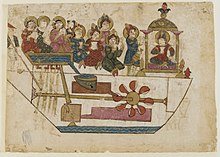
Musical toy
The 11th century Lokapannatti tells of how the Buddha's relics were protected by mechanical robots (bhuta vahana yanta), from the kingdom of Roma visaya (Rome); until they were disarmed by King Ashoka.[22]
In ancient China, the 3rd-century text of the Lie Zi describes an account of humanoid automata, involving a much earlier encounter between Chinese emperor King Mu of Zhou and a mechanical engineer known as Yan Shi, an 'artificer'. Yan Shi proudly presented the king with a life-size, human-shaped figure of his mechanical 'handiwork' made of leather, wood, and artificial organs.[14] There are also accounts of flying automata in the Han Fei Zi and other texts, which attributes the 5th century BC Mohist philosopher Mozi and his contemporary Lu Ban with the invention of artificial wooden birds (ma yuan) that could successfully fly.[17]
[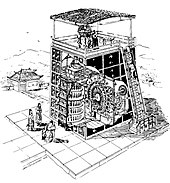
Su Song's astronomical clock tower showing the mechanical figurines which chimed the hours
In 1066, the Chinese inventor Su Song built a water clock in the form of a tower which featured mechanical figurines which chimed the hours.[23][24][25] His mechanism had a programmable drum machine with pegs (cams) that bumped into little levers that operated percussion instruments. The drummer could be made to play different rhythms and different drum patterns by moving the pegs to different locations.[25]
Samarangana Sutradhara, a Sanskrit treatise by Bhoja (11th century), includes a chapter about the construction of mechanical contrivances (automata), including mechanical bees and birds, fountains shaped like humans and animals, and male and female dolls that refilled oil lamps, danced, played instruments, and re-enacted scenes from Hindu mythology.[26][27][28]
13th century Muslim Scientist Ismail al-Jazari created several automated devices. He built automated moving peacocks driven by hydropower.[29] He also invented the earliest known automatic gates, which were driven by hydropower,[30] created automatic doors as part of one of his elaborate water clocks.[31]
One of al-Jazari's humanoid automata was a waitress that could serve water, tea or drinks. The drink was stored in a tank with a reservoir from where the drink drips into a bucket and, after seven minutes, into a cup, after which the waitress appears out of an automatic door serving the drink.[32] Al-Jazari invented a hand washing automaton incorporating a flush mechanism now used in modern flush toilets. It features a female humanoid automaton standing by a basin filled with water. When the user pulls the lever, the water drains and the female automaton refills the basin.[19]
Mark E. Rosheim summarizes the advances in robotics made by Muslim engineers, especially al-Jazari, as follows:
Unlike the Greek designs, these Arab examples reveal an interest, not only in dramatic illusion, but in manipulating the environment for human comfort. Thus, the greatest contribution the Arabs made, besides preserving, disseminating and building on the work of the Greeks, was the concept of practical application. This was the key element that was missing in Greek robotic science.[19]: 9

Model of Leonardo's robot with inner workings. Possibly constructed by Leonardo da Vinci around 1495.[33]
In the 14th century, the coronation of Richard II of England featured an automata angel.[34]
In Renaissance Italy, Leonardo da Vinci (1452–1519) sketched plans for a humanoid robot around 1495. Da Vinci's notebooks, rediscovered in the 1950s, contained detailed drawings of a mechanical knight now known as Leonardo's robot, able to sit up, wave its arms and move its head and jaw.[35] The design was probably based on anatomical research recorded in his Vitruvian Man. It is not known whether he attempted to build it. According to Encyclopædia Britannica, Leonardo da Vinci may have been influenced by the classic automata of al-Jazari.[29]
In Japan, complex animal and human automata were built between the 17th to 19th centuries, with many described in the 18th century Karakuri zui (Illustrated Machinery, 1796). One such automaton was the karakuri ningyō, a mechanized puppet.[36] Different variations of the karakuri existed: the Butai karakuri, which were used in theatre, the Zashiki karakuri, which were small and used in homes, and the Dashi karakuri which were used in religious festivals, where the puppets were used to perform reenactments of traditional myths and legends.
In France, between 1738 and 1739, **:{Jacques de Vaucanson}: exhibited several life-sized automatons: a flute player, a pipe player and a duck. The mechanical duck could flap its wings, crane its neck, and swallow food from the exhibitor's hand, and it gave the illusion of digesting its food by excreting matter stored in a hidden compartment.[37] About 30 years later in Switzerland the clockmaker Pierre Jaquet-Droz made several complex mechanical figures that could write and play music. Several of these devices still exist and work.[38]
Remote-controlled Systems
Remotely operated vehicles were demonstrated in the late 19th century in the form of several types of remotely controlled torpedoes. The early 1870s saw remotely controlled torpedoes by John Ericsson (pneumatic), John Louis Lay (electric wire guided), and Victor von Scheliha (electric wire guided).[39]
The Brennan torpedo, invented by Louis Brennan in 1877, was powered by two contra-rotating propellers that were spun by rapidly pulling out wires from drums wound inside the torpedo. Differential speed on the wires connected to the shore station allowed the torpedo to be guided to its target, making it "the world's first practical guided missile".[40] In 1897 the British inventor Ernest Wilson was granted a patent for a torpedo remotely controlled by "Hertzian" (radio) waves[41][42] and in 1898 Nikola Tesla publicly demonstrated a wireless-controlled torpedo that he hoped to sell to the US Navy.[43][44]
In 1903, the Spanish engineer Leonardo Torres y Quevedo demonstrated a radio control system called "Telekino", which he wanted to use to control an airship of his own design. Unlike the previous systems, which carried out actions of the 'on/off' type, Torres device was able to memorize the signals received to execute the operations on its own and could carry out to 19 different orders.[45][46]
Archibald Low, known as the "father of radio guidance systems" for his pioneering work on guided rockets and planes during the First World War. In 1917, he demonstrated a remote controlled aircraft to the Royal Flying Corps and in the same year built the first wire-guided rocket.
Early Robots
[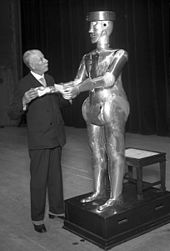
W. H. Richards with "George", 1932
In 1928, one of the first humanoid robots, Eric, was exhibited at the annual exhibition of the Model Engineers Society in London, where it delivered a speech. Invented by W. H. Richards, the robot's frame consisted of an aluminium body of armour with eleven electromagnets and one motor powered by a twelve-volt power source. The robot could move its hands and head and could be controlled through remote control or voice control.[47] Both Eric and his "brother" George toured the world.[48]
Westinghouse Electric Corporation built Televox in 1926; it was a cardboard cutout connected to various devices which users could turn on and off. In 1939, the humanoid robot known as Elektro was debuted at the 1939 New York World's Fair.[49][50] Seven feet tall (2.1 m) and weighing 265 pounds (120.2 kg), it could walk by voice command, speak about 700 words (using a 78-rpm record player), smoke cigarettes, blow up balloons, and move its head and arms. The body consisted of a steel gear, cam and motor skeleton covered by an aluminum skin. In 1928, Japan's first robot, Gakutensoku, was designed and constructed by biologist Makoto Nishimura.
Modern Autonomous Robots
The first electronic autonomous robots with complex behaviour were created by William Grey Walter of the Burden Neurological Institute at Bristol, England in 1948 and 1949. He wanted to prove that rich connections between a small number of brain cells could give rise to very complex behaviors – essentially that the secret of how the brain worked lay in how it was wired up. His first robots, named Elmer and Elsie, were constructed between 1948 and 1949 and were often described as tortoises due to their shape and slow rate of movement. The three-wheeled tortoise robots were capable of phototaxis, by which they could find their way to a recharging station when they ran low on battery power.
Walter stressed the importance of using purely analogue electronics to simulate brain processes at a time when his contemporaries such as Alan Turing and John von Neumann were all turning towards a view of mental processes in terms of digital computation. His work inspired subsequent generations of robotics researchers such as Rodney Brooks, Hans Moravec and Mark Tilden. Modern incarnations of Walter's turtles may be found in the form of BEAM robotics.[51]

U.S. Patent 2,988,237, issued in 1961 to Devol
The first digitally operated and programmable robot was invented by George Devol in 1954 and was ultimately called the Unimate. This ultimately laid the foundations of the modern robotics industry.[52] Devol sold the first Unimate to General Motors in 1960, and it was installed in 1961 in a plant in Trenton, New Jersey to lift hot pieces of metal from a die casting machine and stack them.[53] Devol's patent for the first digitally operated programmable robotic arm represents the foundation of the modern robotics industry.[54]
The first palletizing robot was introduced in 1963 by the Fuji Yusoki Kogyo Company.[55] In 1973, a robot with six electromechanically driven axes was patented[56][57][58] by KUKA robotics in Germany, and the programmable universal manipulation arm was invented by Victor Scheinman in 1976, and the design was sold to Unimation.
Commercial and industrial robots are now in widespread use performing jobs more cheaply or with greater accuracy and reliability than humans. They are also employed for jobs which are too dirty, dangerous or dull to be suitable for humans. Robots are widely used in manufacturing, assembly and packing, transport, earth and space exploration, surgery, weaponry, laboratory research, and mass production of consumer and industrial goods.[59]
Future development and trends
| External video |
|---|
 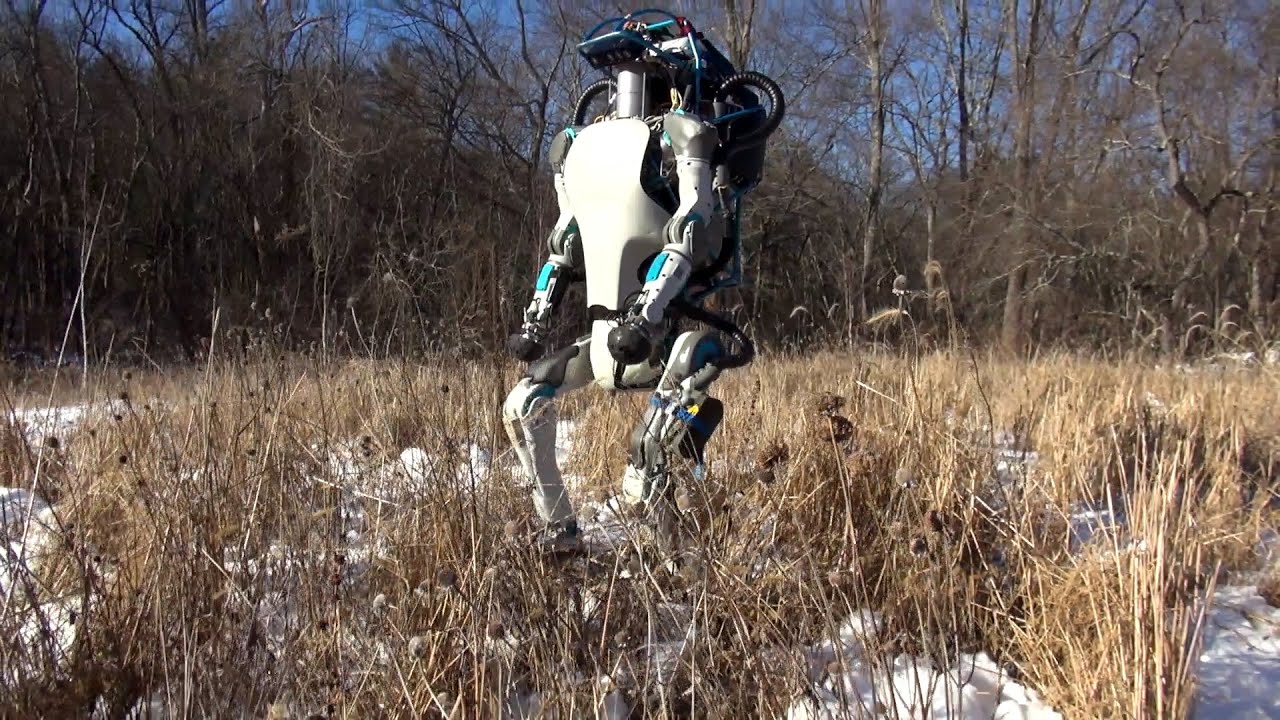 |
Further information: Robotics
...
Robots in society

TOPIO, a humanoid robot, played ping pong at Tokyo International Robot Exhibition (IREX) 2009.[102][103]
Roughly half of all the robots in the world are in Asia, 32% in Europe, and 16% in North America, 1% in Australasia and 1% in Africa.[104] 40% of all the robots in the world are in Japan,[105] making Japan the country with the highest number of robots.
Autonomy and Ethical Questions
Main articles: Roboethics and Ethics of artificial intelligence

An android, or robot designed to resemble a human, can appear comforting to some people and disturbing to others.[106]
As robots have become more advanced and sophisticated, experts and academics have increasingly explored the questions of what ethics might govern robots' behavior,[107][108] and whether robots might be able to claim any kind of social, cultural, ethical or legal rights.[109] One scientific team has said that it was possible that a robot brain would exist by 2019.[110] Others predict robot intelligence breakthroughs by 2050.[111] Recent advances have made robotic behavior more sophisticated.[112] The social impact of intelligent robots is subject of a 2010 documentary film called Plug & Pray.[113]
Vernor Vinge has suggested that a moment may come when computers and robots are smarter than humans. He calls this "the Singularity".[114] He suggests that it may be somewhat or possibly very dangerous for humans.[115] This is discussed by a philosophy called Singularitarianism.
In 2009, experts attended a conference hosted by the Association for the Advancement of Artificial Intelligence (AAAI) to discuss whether computers and robots might be able to acquire any autonomy, and how much these abilities might pose a threat or hazard. They noted that some robots have acquired various forms of semi-autonomy, including being able to find power sources on their own and being able to independently choose targets to attack with weapons. They also noted that some computer viruses can evade elimination and have achieved "cockroach intelligence." They noted that self-awareness as depicted in science-fiction is probably unlikely, but that there were other potential hazards and pitfalls.[114] Various media sources and scientific groups have noted separate trends in differing areas which might together result in greater robotic functionalities and autonomy, and which pose some inherent concerns.[116][117][118]
Military Robots
Some experts and academics have questioned the use of robots for military combat, especially when such robots are given some degree of autonomous functions.[119] There are also concerns about technology which might allow some armed robots to be controlled mainly by other robots.[120] The US Navy has funded a report which indicates that, as military robots become more complex, there should be greater attention to implications of their ability to make autonomous decisions.[121][122] One researcher states that autonomous robots might be more humane, as they could make decisions more effectively. However, other experts question this.[123]
One robot in particular, the EATR, has generated public concerns[124] over its fuel source, as it can continually refuel itself using organic substances.[125] Although the engine for the EATR is designed to run on biomass and vegetation[126] specifically selected by its sensors, which it can find on battlefields or other local environments, the project has stated that chicken fat can also be used.[127]
Manuel De Landa has noted that "smart missiles" and autonomous bombs equipped with artificial perception can be considered robots, as they make some of their decisions autonomously. He believes this represents an important and dangerous trend in which humans are handing over important decisions to machines.[128]
Relationship to unemployment
Main article: Technological unemployment
For centuries, people have predicted that machines would make workers obsolete and increase unemployment, although the causes of unemployment are usually thought to be due to social policy.[129][130][131]
A recent example of human replacement involves Taiwanese technology company Foxconn who, in July 2011, announced a three-year plan to replace workers with more robots. At present the company uses ten thousand robots but will increase them to a million robots over a three-year period.[132]
Lawyers have speculated that an increased prevalence of robots in the workplace could lead to the need to improve redundancy laws.[133]
Kevin J. Delaney said "Robots are taking human jobs. But Bill Gates believes that governments should tax companies’ use of them, as a way to at least temporarily slow the spread of automation and to fund other types of employment."[134] The robot tax would also help pay a guaranteed living wage to the displaced workers.
The World Bank's World Development Report 2019 puts forth evidence showing that while automation displaces workers, technological innovation creates more new industries and jobs on balance.[135]
Contemporary Uses...
Multimedia:
1o Most Advanced (2021)