Caruso, E
Name: Enrico Caruso
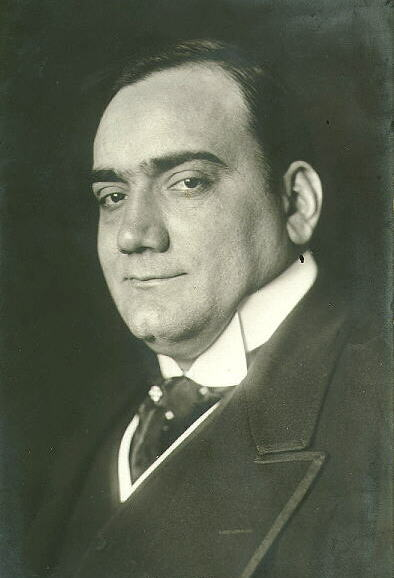
Achievements: Great tenor
Born: February 25, 1873; Naples, Italy.
Died: August 2, 1921; Naples, Italy (Aged 48)
Field & Discipline: Music; Operatic Tenor
Language: Italian
Father: Marcellino Caruso
Mother: Anna Baldini Caruso (d. 1888)
Siblings: One brother: Giovanni; one sister: Assunta.
Spouse: 1) Partner: soprano Ada Giachetti (1897 -1908); 2) Dorothy Park Benjamin on (married August 21, 1918)
Children: Two sons by Giachetti: Rodolfo (“Fofo,” born 1898) and Enrico Junior
(“Mimmi,” born 1904); one daughter by Benjamin, Gloria (born 1919)
Education: Bronzini Institute, 1883-86; vocal coaching from Guglielmo
Vergine, 1891-96
Major Work:
“Pagliacci”
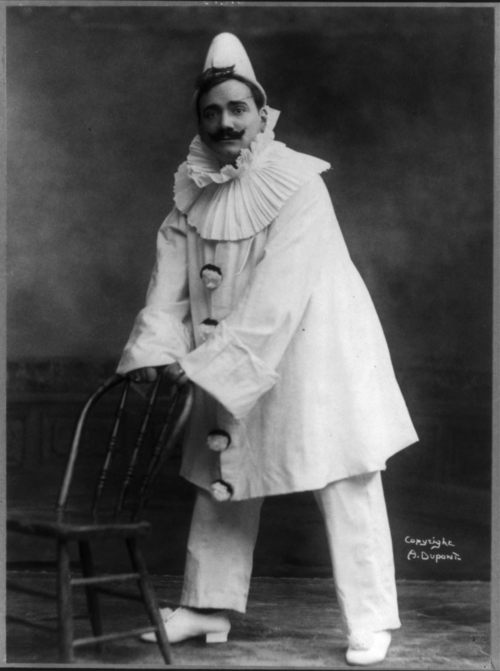
Caruso in his signature role as Canio in Pagliacci, 1908
Life & Times:
Enrico Caruso was born into a large Neapolitan family on February 25, 1873.
In 1890 Caruso's voice began to settle down to an extremely pleasing tenor and he began to sing in the famous “cafe-chantant” of Naples, where Neapolitan songs were sung accompanied by guitar, mandolin or piano for the entertainment of the customers.
He was an instant success and, in 1891, became a fixture at the well-known cafe, the Risorgimento, going there each evening after work at the factory. Here he met a young baritone, Eduardo Missiano, the son of a wealthy Neapolitan family, who was studying with one of the city's most distinguished teachers, Guglielmo Vergine. Vergine reluctantly took the untrained Caruso on and by early 1894, Vergine agreed that he was finally ready to make his operatic debut.
In the autumn he auditioned for and won the part of Wilhelm Meister in the French opera “Mignon,” to be performed at the Teatro Mercadante, but in the rehearsals he performed badly and was dismissed.
Eventually Caruso got the role of tenor in “Faust” at the Teatro Bellini, a distinguished opera house. His performance here was acclaimed in the press, and he was retained to sing in Verdi's “Rigoletto” and “La Traviata.”
For the autumn season of 1895 Caruso was invited to Alexandria and then Cairo, to sing at Egypt's leading opera house, where he performed in “La Gioconda” and “Manon Lescaut” On his return to Naples he was offered a contract to sing for a season at the Teatro Mercadante in late November.
In less than three months he sang in fifty performances, and began to gain a reputation beyond Naples for his expressive singing. His popularity was such that, at the end of January 1896, a special performance of “Faust” was given in his honour at the Mercadante.
In 1897, he was offered a season at the Teatro Massimo in Palermo, where he sang in “La Gioconda” and won over a discriminating audience of sophisticated music lovers. He next went to Livorno where, after auditioning for [auditioned for] Puccini* at his lakeside villa at Torre del Lago in Tuscany, he sang the part of Rodolfo “La Boheme” with soprano Ada Giachetti-Botti as Mimi.
During the production, Puccini and Caruso became great friends, and he and Ada fell in love, living together until 1908. Later in 1897 he made a hugely successful debut at the Teatro Lirico, Milan in Jules Massenet's, “La Navarraise” and created the role of Federico in the world premiere of Francesco Cilea's, “L'Arlesiana.”
On July 2, 1898, a son, Rodolfo, was born to Caruso and Ada and then in the autumn came the night he became a huge star. On 17th November 1898, he created the role of Loris in the latest opera by Umberto Giordano, “Fedora,” at the Teatro Lirico. His singing of the aria “Amor ti vieta” caused a sensation.
In 1899, as the now world-famous tenor, he was invited to sing everywhere: St Petersburg, Moscow and Buenos Aires, and his debut in Rome in “Iris.” In December 1900 he debuted at La Scala in “La Boheme.” Caruso was feverish and the debut was a flop. Triumph came on 17th February 1901, in Donizetti's “L'Elisir d'Amore,” when the highly critical conductor, [a fan was] Toscanini*, was won over.
In Monte Carlo, in February 1902, he sang in “La Boheme” and “Rigoletto,” the former being the first time with the great Australian soprano, Nellie Melba, followed by a few performances at La Scala, where he met Fred Gaisberg, the manager of The Gramophone and Typewriter Company, who had been sent to Milan by his boss [recorded by] Berliner* in search of artists for a series of records.
The result of their meeting was a recording session of ten songs, held on 11th April 1902, at Gaisberg's suite at the Grand Hotel di Milano. It was an historic occasion and the birth of a new industry. The release of the record was timed to coincide with Caruso's first performance at London's Covent Garden on 14th October 1902, in “Rigoletto,” with Nellie Melba.
On 23rd November 1903, he debuted at the opening night of the highly prestigious Metropolitan Opera House in New York, in Verdi's “Rigoletto,” which was a huge success, opening each season there for the next seventeen years.
The following year he sang in Monte Carlo, Paris, Barcelona, Prague, Berlin, and London, followed by a full season at the Metropolitan Opera House and a tour of America.
In 1905, in New York, he made five more recordings, this time with the Victor Talking Machine Company. In all he made almost five hundred recordings, issued by Pathe, Zonophone, The Gramophone Company, and Victor.
In 1908 in New York for the role of Manrico in Verdi's “Il Trovatore,” he first met [met] Gustav Mahler*, the new Metropolitan conductor, his wife Alma and their daughter [met] Anna Mahler*. That year his father died and Ada Giachetti left him for Cesare Romati, the family chauffeur.
Despite all, he remained the most famous and popular tenor in the world, but illness increasingly plagued him. In December 1910, he created the role of Dick Johnson in Puccini's “La Fanciulla del West” at the Metropolitan, though a bout of influenza and laryngitis forced him to leave New York the following February, cancelling the rest of his engagements there.
In his last decade, Caruso again visited Covent Garden, giving his last performance there in 1914. He also made two South American tours in 1915 and 1917 and made an important debut on the opening night of the Metropolitan, as a dramatic tenor in the role of Samson in Saint-Saens', “Samson et Dalila.”
In 1918, he married the American Dorothy Park Benjamin, and later triumphed as Eleazar in Jacques Halevy's, “La Juive,” at the Metropolitan. He saw the birth of his only daughter, Gloria, in December 1919. He made his last recording in September 1920, and his six hundred and seventh performance in “La Juive,” on 24th December 1920, at the Metropolitan, which turned out to be his last performance.
In June 1921, he returned to Sorrento, Italy, where his health worsened and where he died at the Hotel Vesuvio in Naples, on 2nd August 1921.
Extra Connections: He was broadcast by [broadcast by] De Forest*
[contemporary was] Chaliapin* was a contemporary.
He attended the jubilee of [attended jubilee of] Ellen Terry*
In 1917, the United States entered the First World War. Caruso did extensive patriotic charity work during the conflict, raising money for many war-related causes by giving concerts and participating enthusiastically in Liberty Bond drives.
Assessment: The most celebrated Italian tenor at the beginning of the twentieth century, who became one of the highest paid operatic singers of his time.
Oneliner: Enrico Caruso, great tenor
Bibliography:
- Greenfeld, Howard S., Caruso: An Illustrated Life, London: Collins & Brown, 1991.