Liberty Ship
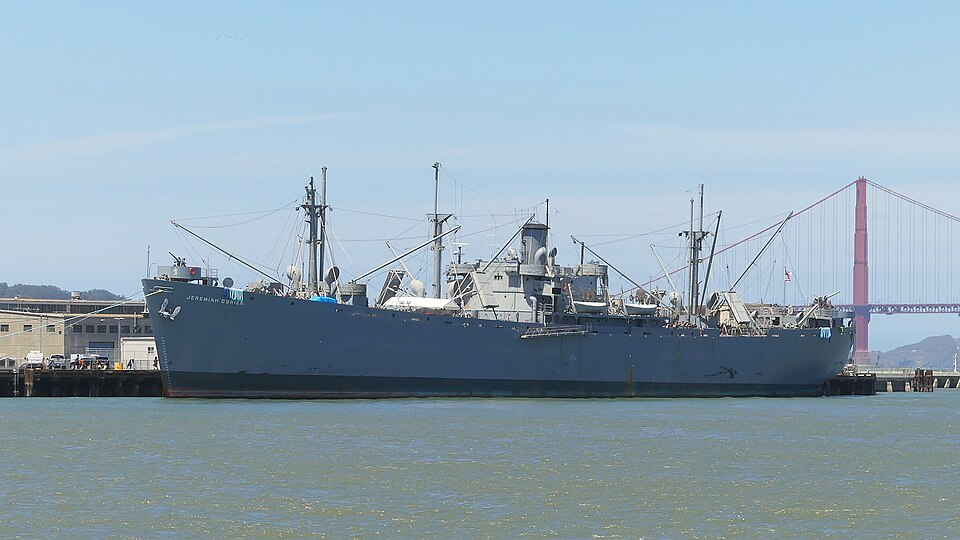
Liberty ships are a class of cargo ship built in the United States during World War II under the Emergency Shipbuilding Program. Although British in concept,[3] the design was adopted by the United States for its simple, low-cost construction. Mass-produced on an unprecedented scale, the Liberty ship came to symbolize U.S. wartime industrial output.[4]
The class was developed to meet British orders for transports to replace ships that had been lost. Eighteen American shipyards built 2,710 Liberty ships between 1941 and 1945 (an average of three ships every two days),[5] easily the largest number of ships ever produced to a single design.
The Liberty ship was effectively superseded by the Victory ship, a somewhat larger, materially faster, more modern-powered vessel of generally similar design. A total of 531 Victory ships were built between 1944 and 1946.[6][7]
Liberty ship production mirrored (albeit on a much larger scale) the manufacture of "Hog Islander" and similar standardized ship types during World War I. The immensity of the effort, the number of ships built, the role of female workers in their construction, and the survival of some far longer than their original five-year design life combine to make them the subject of much continued interest.
History
Design

Profile plan of a Liberty ship

A colored diagram of compartments on a Liberty ship, from the right side, front to the right
Machinery spaces
Command and control
Liquid stores
Dry cargo
Engine room
Misc
Dry stores
Habitation
In 1936, the American Merchant Marine Act was passed to subsidize the annual construction of 50 commercial merchant vessels which could be used in wartime by the United States Navy as naval auxiliaries, crewed by U.S. Merchant Mariners. The number was doubled in 1939 and again in 1940 to 200 ships a year. Ship types included two tankers and three types of merchant vessel, all to be powered by steam turbines. Limited industrial capacity, especially for reduction gears, meant that relatively few of these designs of ships were built.
However, in 1940, the British government ordered 60 Ocean-class freighters from American yards to replace war losses and boost the merchant fleet. These were simple but fairly large (for the time) with a single 2,500 horsepower (1,900 kW) compound steam engine of outdated but reliable design. Britain specified coal-fired plants, because it then had extensive coal mines and no significant domestic oil production.[9]
...
The design was modified by the United States Maritime Commission, in part to increase conformity to American construction practices, but more importantly to make it even quicker and cheaper to build. The US version was designated 'EC2-S-C1': 'EC' for Emergency Cargo, '2' for a ship between 400 and 450 feet (120 and 140 m) long (Load Waterline Length), 'S' for steam engines, and 'C1' for design C1. The new design replaced much riveting (which accounted for one-third of previous designs labor costs) with welding,[11] and had oil-fired boilers.
It was adopted as a Merchant Marine Act design, and production awarded to a conglomerate of West Coast engineering and construction companies headed by Henry J. Kaiser known as the Six Companies. Liberty ships were designed to carry 10,000 long tons (10,200 t) of cargo, usually one type per ship, but, during wartime, generally carried loads far exceeding this.[12]
On 27 March 1941, the number of lend-lease ships was increased to 200 by the Defense Aid Supplemental Appropriations Act and increased again in April to 306, of which 117 would be Liberty ships.
...
The ships initially had a poor public image owing to their appearance. In a speech announcing the emergency shipbuilding program President Franklin D. Roosevelt had referred to the ship as "a dreadful looking object", and Time called it an "Ugly Duckling". 27 September 1941 was dubbed Liberty Fleet Day to try to assuage public opinion, since the first 14 "Emergency" vessels were launched that day. The first of these was SS *Patrick Henry*, launched by President Roosevelt. In remarks at the launch ceremony FDR cited Patrick Henry's 1775 speech that finished "Give me liberty or give me death!". Roosevelt said that this new class of ship would bring liberty to Europe, which gave rise to the name Liberty ship.
The first ships required about 230 days to build (Patrick Henry took 244 days), but the median production time per ship dropped to 39 days by 1943.[18] The record was set by SS *Robert E. Peary, which was launched 4 days and 151⁄2 hours after the keel had been laid, although this publicity stunt was not repeated: in fact much fitting-out and other work remained to be done after the *Peary was launched. The ships were made assembly-line style, from prefabricated sections.
In 1943 three Liberty ships were completed daily. They were usually named after famous Americans, starting with the signatories of the Declaration of Independence. Newsreel footage of the launching of the ship named for American author Jack London can be seen in the film Jack London. Seventeen of the Liberty ships were named in honor of outstanding African-Americans. The first, in honor of Booker T. Washington, was christened by Marian Anderson in 1942, and the SS *Harriet Tubman*, recognizing the only woman on the list, was christened on 3 June 1944.[19]
Any group that raised war bonds worth $2 million could propose a name. Most bore the names of deceased people. The only living namesake was Francis J. O'Gara, the purser of SS *Jean Nicolet, who was thought to have been killed in a submarine attack, but in fact survived the war in a Japanese prisoner of war camp; see USS *Outpost.
Not named after people were: SS *Stage Door Canteen, named after the USO club in New York; and SS *U.S.O., named after the United Service Organizations (USO).[20]
Another notable Liberty ship was SS *Stephen Hopkins, which sank the German commerce raider *Stier in a ship-to-ship gun battle in 1942 and became the first American ship to sink a German surface combatant.

Eastine Cowner, a former waitress, at work on the Liberty ship SS *George Washington Carver* at the Kaiser shipyards, Richmond, California, in 1943. One of a series taken by E. F. Joseph on behalf of the Office of War Information, documenting the work of African-Americans in the war effort.
The wreck of SS *Richard Montgomery* lies off the coast of Kent with 1,500 short tons (1,400 tonnes) of explosives still on board, enough to match a very small yield nuclear weapon should they ever go off.[21][22] SS *E. A. Bryan* detonated with the energy of 2,000 tons of TNT (8,400 GJ) in July 1944 as it was being loaded, killing 320 sailors and civilians in what was called the Port Chicago disaster. Another Liberty ship that exploded was the rechristened SS *Grandcamp*, which caused the Texas City Disaster on 16 April 1947, killing at least 581 people.