RMS Titanic
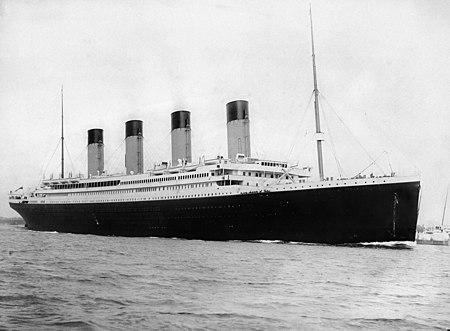
RMS Titanic was a British passenger liner operated by the White Star Line that sank in the North Atlantic Ocean in the early morning hours of 15 April 1912, after striking an iceberg during her maiden voyage from Southampton to New York City. Of the estimated 2,224 passengers and crew aboard, more than 1,500 died, making the sinking at the time the deadliest of a single ship in the West[4] and the deadliest peacetime sinking of a superliner or cruise ship to date.[5] With much public attention in the aftermath the disaster has since been the material of many artistic works and a founding material of the disaster film genre.
RMS Titanic was the largest ship afloat at the time she entered service and was the second of three *Olympic*-class ocean liners operated by the White Star Line. She was built by the Harland and Wolff shipyard in Belfast. Thomas Andrews, chief naval architect of the shipyard at the time, died in the disaster.[6]
Titanic was under the command of Captain Edward Smith, who also went down with the ship. The ocean liner carried some of the wealthiest people in the world, as well as hundreds of emigrants from Great Britain and Ireland, Scandinavia and elsewhere throughout Europe, who were seeking a new life in the United States. The first-class accommodation was designed to be the pinnacle of comfort and luxury, with a gymnasium, swimming pool, libraries, high-class restaurants, and opulent cabins.
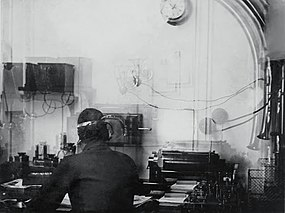
A high-powered radiotelegraph transmitter was available for sending passenger "marconigrams" and for the ship's operational use.[7] The Titanic had advanced safety features, such as watertight compartments and remotely activated watertight doors. The ship carried 16 lifeboat davits which could lower three lifeboats each, for a total of 48 boats. However, Titanic carried only a total of 20 lifeboats, four of which were collapsible and proved hard to launch during the sinking.[8] The carried lifeboats were enough for 1,178 people—about half the number on board, and one third of her total capacity—due to the maritime safety regulations of those days. Though at the time of the sinking the lowered lifeboats were only filled about half.
After leaving Southampton on 10 April 1912, Titanic called at Cherbourg in France and Queenstown (now Cobh) in Ireland, before heading west to New York.[9] On 14 April, four days into the crossing and about 375 miles (600 km) south of Newfoundland, she hit an iceberg at 11:40 p.m. ship's time. The collision caused the hull plates to buckle inwards along her starboard (right) side and opened five of her sixteen watertight compartments to the sea; she could only survive four flooding.
Meanwhile, passengers and some crew members were evacuated in lifeboats, many of which were launched only partially loaded. A disproportionate number of men were left aboard because of a "women and children first" protocol for loading lifeboats.[10] At 2:20 a.m., she broke apart and foundered with well over one thousand people still aboard. Just under two hours after Titanic sank, the Cunard liner RMS *Carpathia* arrived and brought aboard an estimated 705 survivors.
The disaster was met with worldwide shock and outrage at the huge loss of life, as well as the regulatory and operational failures that led to it. Public inquiries in Britain and the United States led to major improvements in maritime safety. One of their most important legacies was the establishment of the International Convention for the Safety of Life at Sea (SOLAS) in 1914, which still governs maritime safety. Several new wireless regulations were passed around the world in an effort to learn from the many missteps in wireless communications—which could have saved many more passengers.[11]
The wreck of *Titanic* was discovered in 1985 (73 years after the disaster) during a Franco-American expedition and United States Military mission.[12][13] The ship was split in two and is gradually disintegrating at a depth of 12,415 feet (2,069.2 fathoms; 3,784 m).
Thousands of artefacts have been recovered and displayed at museums around the world. Titanic has become one of the most famous ships in history, depicted in numerous works of popular culture, including books, folk songs, films, exhibits, and memorials. Titanic is the second largest ocean liner wreck in the world, only being surpassed by her sister ship HMHS *Britannic*, however, she is the largest sunk while in service as a liner, as Britannic was in use as a hospital ship at the time of her sinking. The final survivor of the sinking, Millvina Dean, aged two months at the time, died in 2009 at the age of 97.
Contents
- 1Background
- 2Dimensions and layout
- 3Features
- 4Building and preparing the ship
- 5Maiden voyage
- 6Aftermath of sinking
- 7Wreck
- 8Legacy
- 9Appendix
- 10Replicas
- 11See also
- 12Notes
- 13References
- 14Bibliography
- 15External links
Background
The White Star Line faced an increasing challenge from its main rivals Cunard, which had recently launched the *Lusitania* and the *Mauretania*—the fastest passenger ships then in service—and the German lines Hamburg America and Norddeutscher Lloyd. Ismay preferred to compete on size rather than speed and proposed to commission a new class of liners that would be larger than anything that had gone before as well as being the last word in comfort and luxury.[17]
The company sought an upgrade in their fleet primarily in response to the Cunard giants but also to replace their oldest pair of passenger ships still in service, being the SS *Teutonic* of 1889 and SS *Majestic* of 1890. Teutonic was replaced by Olympic while Majestic was replaced by Titanic. Majestic would be brought back into her old spot on White Star Line's New York service after Titanic's loss.[18]
The name Titanic derives from the Titans of Greek mythology. Built in Belfast, Ireland, in the United Kingdom of Great Britain and Ireland (as it was then known), the RMS Titanic was the second of the three *Olympic*-class ocean liners—the first was the RMS *Olympic* and the third was the HMHS *Britannic*.[14] Britannic was originally to be called Gigantic and was to be over 1,000 feet (300 m) long.[15] They were by far the largest vessels of the British shipping company White Star Line's fleet, which comprised 29 steamers and tenders in 1912.[16] The three ships had their genesis in a discussion in mid-1907 between the White Star Line's chairman, J. Bruce Ismay, and the American financier J. P. Morgan, who controlled the White Star Line's parent corporation, the International Mercantile Marine Co. (IMM).
The ships were constructed by the Belfast shipbuilders Harland and Wolff, who had a long-established relationship with the White Star Line dating back to 1867.[19] Harland and Wolff were given a great deal of latitude in designing ships for the White Star Line; the usual approach was for the latter to sketch out a general concept which the former would take away and turn into a ship design. Cost considerations were relatively low on the agenda and Harland and Wolff was authorised to spend what it needed on the ships, plus a five percent profit margin.[19] In the case of the Olympic-class ships, a cost of £3 million (approximately £290 million in 2016) for the first two ships was agreed plus "extras to contract" and the usual five percent fee.[20]
...
Construction, launch and fitting-out
[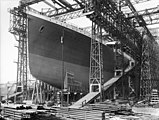
Construction in gantry, 1909–11

Launch, 1911 (unfinished superstructure)

Fitting-out, 1911–12
The sheer size of Titanic and her sister ships posed a major engineering challenge for Harland and Wolff; no shipbuilder had ever before attempted to construct vessels this size.[78] The ships were constructed on Queen's Island, now known as the Titanic Quarter, in Belfast Harbour. Harland and Wolff had to demolish three existing slipways and build two new ones, the largest ever constructed up to that time, to accommodate both ships.[13] Their construction was facilitated by an enormous gantry built by Sir William Arrol & Co., a Scottish firm responsible for the building of the Forth Bridge and London's Tower Bridge. The Arrol Gantry stood 228 feet (69 m) high, was 270 feet (82 m) wide and 840 feet (260 m) long, and weighed more than 6,000 tons. It accommodated a number of mobile cranes. A separate floating crane, capable of lifting 200 tons, was brought in from Germany.[79]...The work of constructing the ships was difficult and dangerous. For the 15,000 men who worked at Harland and Wolff at the time,[90] safety precautions were rudimentary at best; a lot of the work was carried out without equipment like hard hats or hand guards on machinery. As a result, during Titanic's construction, 246 injuries were recorded, 28 of them "severe", such as arms severed by machines or legs crushed under falling pieces of steel. Six people died on the ship herself while she was being constructed and fitted out, and another two died in the shipyard workshops and sheds.[91] Just before the launch a worker was killed when a piece of wood fell on him.[92]
Titanic was launched at 12:15 pm on 31 May 1911 in the presence of Lord Pirrie, J. Pierpont Morgan, J. Bruce Ismay and 100,000 onlookers.[93][94] Twenty-two tons of soap and tallow were spread on the slipway to lubricate the ship's passage into the River Lagan.[92] In keeping with the White Star Line's traditional policy, the ship was not formally named or christened with champagne.[93] The ship was towed to a fitting-out berth where, over the course of the next year, her engines, funnels and superstructure were installed and her interior was fitted out.[95]
Although Titanic was virtually identical to the class's lead ship Olympic, a few changes were made to distinguish both ships. The most noticeable exterior difference was that Titanic (and the third vessel in class, *Britannic*) had a steel screen with sliding windows installed along the forward half of the A Deck promenade. This was installed as a last minute change at the personal request of Bruce Ismay, and was intended to provide additional shelter to First Class passengers.[96] Extensive changes were made to B Deck on Titanic as the promenade space in this deck, which had proven unpopular on Olympic, was converted into additional First Class cabins, including two opulent parlour suites with their own private promenade spaces. The À la Carte restaurant was also enlarged and the Café Parisien, an entirely new feature which did not exist on Olympic, was added. These changes made Titanic slightly heavier than her sister, and thus she could claim to be the largest ship afloat. The work took longer than expected due to design changes requested by Ismay and a temporary pause in work occasioned by the need to repair Olympic, which had been in a collision in September 1911. Had Titanic been finished earlier, she might well have missed her collision with an iceberg.[92]
Sea trials

Titanic leaving Belfast for her sea trials on 2 April 1912
Titanic's sea trials began at 6 am on Tuesday, 2 April 1912, just two days after her fitting out was finished and eight days before she was due to leave Southampton on her maiden voyage.[97] The trials were delayed for a day due to bad weather, but by Monday morning it was clear and fair.[98] Aboard were 78 stokers, greasers and firemen, and 41 members of crew. No domestic staff appear to have been aboard. Representatives of various companies travelled on Titanic's sea trials: Thomas Andrews and Edward Wilding of Harland and Wolff, and Harold A. Sanderson of IMM. Bruce Ismay and Lord Pirrie were too ill to attend. Jack Phillips and Harold Bride served as radio operators and performed fine-tuning of the Marconi equipment. Francis Carruthers, a surveyor from the Board of Trade, was also present to see that everything worked and that the ship was fit to carry passengers.[99]
The sea trials consisted of a number of tests of her handling characteristics, carried out first in Belfast Lough and then in the open waters of the Irish Sea. Over the course of about 12 hours, Titanic was driven at different speeds, her turning ability was tested and a "crash stop" was performed in which the engines were reversed full ahead to full astern, bringing her to a stop in 850 yd (777 m) or 3 minutes and 15 seconds.[100] The ship covered a distance of about 80 nautical miles (92 mi; 150 km), averaging 18 knots (21 mph; 33 km/h) and reaching a maximum speed of just under 21 knots (24 mph; 39 km/h).[101]
On returning to Belfast at about 7 pm, the surveyor signed an "Agreement and Account of Voyages and Crew", valid for 12 months, which declared the ship seaworthy. An hour later, Titanic departed Belfast to head to Southampton, a voyage of about 570 nautical miles (660 mi; 1,060 km). After a journey lasting about 28 hours, she arrived about midnight on 4 April and was towed to the port's Berth 44, ready for the arrival of her passengers and the remainder of her crew.[102]
Maiden voyage

Titanic at Southampton docks, prior to departure

Titanic in Cork harbour, 11 April 1912
Both Olympic and Titanic registered Liverpool as their home port. The offices of the White Star Line, as well as Cunard, were in Liverpool, and up until the introduction of the Olympic, most British ocean liners for both Cunard and White Star, such as Lusitania and Mauretania, sailed from Liverpool followed by a port of call in Queenstown, Ireland. Since the company's founding in 1845, a vast majority of their operations had taken place from Liverpool. However, in 1907 White Star Line established another service from Southampton on England's south coast, which became known as White Star's "Express Service". Southampton had many advantages over Liverpool, the first being its proximity to London.[103]
In addition, Southampton, being on the south coast, allowed ships to easily cross the English Channel and make a port of call on the northern coast of France, usually at Cherbourg. This allowed British ships to pick up clientele from continental Europe before recrossing the channel and picking up passengers at Queenstown. The Southampton-Cherbourg-New York run would become so popular that most British ocean liners began using the port after World War I. Out of respect for Liverpool, ships continued to be registered there until the early 1960s. Queen Elizabeth 2 was one of the first ships registered in Southampton when introduced into service by Cunard in 1969.[103]
Titanic's maiden voyage was intended to be the first of many trans-Atlantic crossings between Southampton and New York via Cherbourg and Queenstown on westbound runs, returning via Plymouth in England while eastbound. Indeed, her entire schedule of voyages through to December 1912 still exists.[104] When the route was established, four ships were assigned to the service. In addition to Teutonic and Majestic, RMS *Oceanic* and the brand new RMS *Adriatic* sailed the route. When the Olympic entered service in June 1911, she replaced Teutonic, which after completing her last run on the service in late April was transferred to the Dominion Line's Canadian service. The following August, Adriatic was transferred to White Star Line's main Liverpool-New York service, and in November, Majestic was withdrawn from service impending the arrival of Titanic in the coming months, and was mothballed as a reserve ship.[105][106]
White Star Line's initial plans for Olympic and Titanic on the Southampton run followed the same routine as their predecessors had done before them. Each would sail once every three weeks from Southampton and New York, usually leaving at noon each Wednesday from Southampton and each Saturday from New York, thus enabling the White Star Line to offer weekly sailings in each direction. Special trains were scheduled from London and Paris to convey passengers to Southampton and Cherbourg respectively.[106] The deep-water dock at Southampton, then known as the "White Star Dock", had been specially constructed to accommodate the new Olympic-class liners, and had opened in 1911.[107]
Crew
Main article: Crew of *Titanic*

Edward Smith, captain of Titanic, in 1911
Titanic had around 885 crew members on board for her maiden voyage.[108] Like other vessels of her time, she did not have a permanent crew, and the vast majority of crew members were casual workers who only came aboard the ship a few hours before she sailed from Southampton.[109] The process of signing up recruits had begun on 23 March and some had been sent to Belfast, where they served as a skeleton crew during Titanic's sea trials and passage to England at the start of April.[110]
Captain Edward John Smith, the most senior of the White Star Line's captains, was transferred from Olympic to take command of Titanic.[111] Henry Tingle Wilde also came across from Olympic to take the post of chief mate. Titanic's previously designated chief mate and first officer, William McMaster Murdoch and Charles Lightoller, were bumped down to the ranks of first and second officer respectively. The original second officer, David Blair, was dropped altogether.[112][h] The third officer was Herbert Pitman MBE, the only deck officer who was not a member of the Royal Naval Reserve. Pitman was the second-to-last surviving officer....
Passengers
Main article: Passengers of *Titanic*
See also: Animals aboard *Titanic*

John Jacob Astor IV in 1909. He was the wealthiest person aboard Titanic; he did not survive.
Titanic's passengers numbered approximately 1,317 people: 324 in First Class, 284 in Second Class, and 709 in Third Class. Of these, 869 (66%) were male and 447 (34%) female. There were 107 children aboard, the largest number of whom were in Third Class.[118] The ship was considerably under-capacity on her maiden voyage, as she could accommodate 2,453 passengers—833 First Class, 614 Second Class, and 1,006 Third Class.[119]
Usually, a high-prestige vessel like Titanic could expect to be fully booked on its maiden voyage. However, a national coal strike in the UK had caused considerable disruption to shipping schedules in the spring of 1912, causing many crossings to be cancelled. Many would-be passengers chose to postpone their travel plans until the strike was over. The strike had finished a few days before Titanic sailed; however, that was too late to have much of an effect. Titanic was able to sail on the scheduled date only because coal was transferred from other vessels which were tied up at Southampton, such as SS *City of New York* and RMS *Oceanic*, as well as coal that Olympic had brought back from a previous voyage to New York, which had been stored at the White Star Dock.[96]
Some of the most prominent people of the day booked a passage aboard Titanic, travelling in First Class. Among them (with those who perished marked with a dagger†) were the American millionaire John Jacob Astor IV† and his wife Madeleine Force Astor (with John Jacob Astor VI in utero), industrialist Benjamin Guggenheim†, painter and sculptor Francis Davis Millet†, Macy's owner Isidor Straus† and his wife Ida†, Denver millionairess Margaret "Molly" Brown,[j]
Sir Cosmo Duff Gordon and his wife, couturière Lucy (Lady Duff-Gordon), Lieut. Col. Arthur Peuchen, writer and historian Archibald Gracie, cricketer and businessman John B. Thayer† with his wife Marian and son Jack, George Dunton Widener† with his wife Eleanor and son Harry†, Noël Leslie, Countess of Rothes, Mr.† and Mrs. Charles M. Hays, Mr. and Mrs. Henry S. Harper, Mr.† and Mrs. Walter D. Douglas,
Mr.† and Mrs. George D. Wick, Mr.† and Mrs. Henry B. Harris, Mr.† and Mrs. Arthur L. Ryerson, Mr.† and Mrs.† Hudson J. C. Allison, Mr. and Mrs. Dickinson Bishop, noted architect Edward Austin Kent†, brewery heir Harry Molson†, tennis players Karl Behr and Dick Williams, author and socialite Helen Churchill Candee, future lawyer and suffragette Elsie Bowerman and her mother Edith, journalist and social reformer William Thomas Stead†, journalist and fashion buyer Edith Rosenbaum, Philadelphia and New York socialite Edith Corse Evans†, wealthy divorcée Charlotte Drake Cardeza, French sculptor Paul Chevré [fr], author Jacques Futrelle† with his wife May, silent film actress Dorothy Gibson with her mother Pauline, President of the Swiss Bankverein Col. Alfons Simonius-Blumer,
James A. Hughes's daughter Eloise, banker Robert Williams Daniel, the chairman of the Holland America Line Johan Reuchlin [de], Arthur Wellington Ross's son John H. Ross, Washington Roebling's nephew Washington A. Roebling II, Andrew Saks's daughter Leila Saks Meyer with her husband Edgar Joseph Meyer† (son of Marc Eugene Meyer), William A. Clark's nephew Walter M. Clark with his wife Virginia, great-great-grandson of soap manufacturer Andrew Pears Thomas C. Pears with wife, John S. Pillsbury's honeymooning grandson John P. Snyder and wife Nelle, Dorothy Parker's New York manufacturer uncle Martin Rothschild with his wife, Elizabeth, among others.[120]
Titanic's owner J. P. Morgan was scheduled to travel on the maiden voyage but cancelled at the last minute.[121] Industrialist bastard Henry Clay Frick (Homestead Strike, Johnstown Flood, Emma Goldman) Frick and his wife Adelaide had booked tickets to travel back to New York on the inaugural trip of the Titanic in 1912, along withMorgan. The couple canceled their trip after Adelaide sprained her ankle in Italy and missed the disastrous voyage. They returned from a subsequent trip on the Lusitania. Late arrivals to the "Just Missed It Club" were George Washington Vanderbilt II, owner of the Biltmore Estate, and his wife, Edith Stuyvesant Vanderbilt, who were narrowly saved by pure superstition. News reports stated that Mrs. Vanderbilt's sister, Susan Dresser, vehemently opposed her sister and brother-in-law's trip aboard Titanic, declaring, "The first trip of any ship is dangerous." The Vanderbilts, whose luggage had already been stowed aboard in the care of their footman, Frederic Wheeler, canceled their tickets and rebooked for the Olympic. Their luggage was transferred, but tragically, the footman made the trip anyway, going down with the ship.
Other contemporaries of the "Just Missed It Club" members were not as lucky. John Jacob Astor II, scion of the legendary furrier and real estate fortune, and Benjamin Guggenheim, brother of art collector Solomon R. Guggenheim, perished in the disaster
Also aboard the ship were the White Star Line's managing director J. Bruce Ismay and Titanic's designer Thomas Andrews†, who was on board to observe any problems and assess the general performance of the new ship.[122]
The exact number of people aboard is not known, as not all of those who had booked tickets made it to the ship; about 50 people cancelled for various reasons,[123] and not all of those who boarded stayed aboard for the entire journey.[124] Fares varied depending on class and season. Third Class fares from London, Southampton, or Queenstown cost £7 5s (equivalent to £800 today) while the cheapest First Class fares cost £23 (£2,400 today).[106] The most expensive First Class suites were to have cost up to £870 in high season (£92,000 today).[119]
...
The first three days of the voyage from Queenstown had passed without apparent incident. A fire had begun in one of Titanic's coal bunkers approximately 10 days prior to the ship's departure, and continued to burn for several days into its voyage,[144] but passengers were unaware of this situation. Fires occurred frequently on board steamships at the time, due to spontaneous combustion of the coal.[145] The fires had to be extinguished with fire hoses by moving the coal on top to another bunker and by removing the burning coal and feeding it into the furnace.[146] The fire was finally extinguished on 14 April.[147][148] There has been some speculation and discussion as to whether this fire and attempts to extinguish it may have made the ship more vulnerable to its fate.[149][150]
Titanic received a series of warnings from other ships of drifting ice in the area of the Grand Banks of Newfoundland, but Captain Edward Smith ignored them.[151] One of the ships to warn Titanic was the Atlantic Line's *Mesaba*.[152] Nevertheless, the ship continued to steam at full speed, which was standard practice at the time.[153] Although the ship was not trying to set a speed record,[154] timekeeping was a priority, and under prevailing maritime practices, ships were often operated at close to full speed; ice warnings were seen as advisories, and reliance was placed upon lookouts and the watch on the bridge.[153]
It was generally believed that ice posed little danger to large vessels. Close calls with ice were not uncommon, and even head-on collisions had not been disastrous. In 1907, SS *Kronprinz Wilhelm*, a German liner, had rammed an iceberg but still had been able to complete her voyage, and Captain Smith himself had declared in 1907 that he "could not imagine any condition which would cause a ship to founder. Modern shipbuilding has gone beyond that."[155][k]
Sinking
Main article: Sinking of *Titanic*

The sinking, based on Jack Thayer's description. Sketched by L.P. Skidmore on board Carpathia

The iceberg thought to have been hit by Titanic, photographed on the morning of 15 April 1912. Note the dark spot just along the berg's waterline, which was described by onlookers as a smear of red paint.

"Untergang der Titanic", as conceived by Willy Stöwer, 1912
At 11:40 pm (ship's time) on 14 April, lookout Frederick Fleet spotted an iceberg immediately ahead of Titanic and alerted the bridge.[158] First Officer William Murdoch ordered the ship to be steered around the obstacle and the engines to be reversed,[159] but it was too late; the starboard side of Titanic struck the iceberg, creating a series of holes below the waterline.[l] The hull was not punctured by the iceberg, but rather dented such that the hull's seams buckled and separated, allowing water to rush in. Five of the ship's watertight compartments were breached. It soon became clear that the ship was doomed, as she could not survive more than four compartments being flooded. Titanic began sinking bow-first, with water spilling from compartment to compartment as her angle in the water became steeper.[161]
Those aboard Titanic were ill-prepared for such an emergency. In accordance with accepted practices of the time, as ships were seen as largely unsinkable and lifeboats were intended to transfer passengers to nearby rescue vessels,[162][m] Titanic only had enough lifeboats to carry about half of those on board; if the ship had carried her full complement of about 3,339 passengers and crew, only about a third could have been accommodated in the lifeboats.[164] The crew had not been trained adequately in carrying out an evacuation. The officers did not know how many they could safely put aboard the lifeboats and launched many of them barely half-full.[165]
Third-class passengers were largely left to fend for themselves, causing many of them to become trapped below decks as the ship filled with water.[166] The "women and children first" protocol was generally followed when loading the lifeboats,[166] and most of the male passengers and crew were left aboard. In 2022, Claes-Gõran Wetterholm, an author and expert on Titanic, argued it was "not true" that women and children survived thanks to the gallantry of men; of the last survivors escaping on the final lifeboats leaving the starboard side of the ship, he said, the majority were men.[167] However, women and children survived at rates of about 75 percent and 50 percent, respectively, while only 20 percent of men survived.[168]
Between 2:10 and 2:15 am, a little over two and a half hours after Titanic struck the iceberg, her rate of sinking suddenly increased as the boat deck dipped underwater, and the sea poured in through open hatches and grates.[169] As her unsupported stern rose out of the water, exposing the propellers, the ship broke in two main pieces between the second and third funnels, due to the immense forces on the keel. With the bow underwater, and air trapped in the stern, the stern remained afloat and buoyant for a few minutes longer, rising to a nearly vertical angle with hundreds of people still clinging to it,[170] before foundering at 2:20 am.[171]
It was long generally believed the ship sank in one piece; but the discovery of the wreck many years later revealed that the ship had broken fully in two. All remaining passengers and crew were immersed in lethally cold water with a temperature of −2 °C (28 °F). Sudden immersion into freezing water typically causes death within minutes, either from cardiac arrest, uncontrollable breathing of water, or cold incapacitation (not, as commonly believed, from hypothermia),[n] and almost all of those in the water died of cardiac arrest or other bodily reactions to freezing water, within 15–30 minutes.[174] Only five of them were helped into the lifeboats, though the lifeboats had room for almost 500 more people.[175]
Distress signals were sent by wireless, rockets, and lamp, but none of the ships that responded were near enough to reach Titanic before she sank.[176] A radio operator on board SS *Birma*, for instance, estimated that it would be 6 am before the liner could arrive at the scene. Meanwhile, SS *Californian*, which was the last to have been in contact before the collision, saw Titanic's flares but failed to assist.[177] Around 4 am, RMS *Carpathia* arrived on the scene in response to Titanic's earlier distress calls.[178]
706 people survived the disaster and were conveyed by Carpathia to New York, Titanic's original destination, and 1,517 people died.[108] Carpathia's captain described the place as an ice field that had included 20 large bergs measuring up to 200 feet (61 m) high and numerous smaller bergs, as well as ice floes and debris from Titanic; passengers described being in the middle of a vast white plain of ice, studded with icebergs.[179] This area is now known as Iceberg Alley.[180]
Aftermath of sinking
Immediate aftermath
[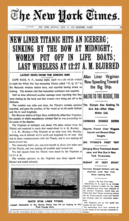
The New York Times had gone to press 15 April with knowledge of the collision but not the sinking.[181]
[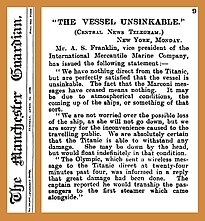
The International Mercantile Marine Company's statement on Monday 15 April assured that despite the lack of communication from the ship, it was "unsinkable".

London newsboy Ned Parfett with news of the disaster, as reported on Tuesday, 16 April
[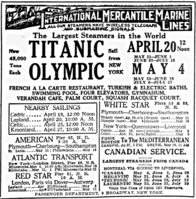
Titanic had been scheduled for a 20 April departure, seen in a New York Times ad apparently unable to be pulled, overnight, before this 15 April printing.[182]
RMS *Carpathia* took three days to reach New York after leaving the scene of the disaster. Her journey was slowed by pack ice, fog, thunderstorms and rough seas.[183] She was, however, able to pass news to the outside world by wireless about what had happened. The initial reports were confusing, leading the American press to report erroneously on 15 April that Titanic was being towed to port by SS *Virginian*.[184] Later that day, confirmation came through that Titanic had been lost and that most of her passengers and crew had died.[185] The news attracted crowds of people to the White Star Line's offices in London, New York, Montreal,[186] Southampton,[187] Liverpool and Belfast.[188] It hit hardest in Southampton, whose people suffered the greatest losses from the sinking;[189] four out of every five crew members came from this town.[190][o]
Carpathia docked at 9:30 pm on 18 April at New York's Pier 54 and was greeted by some 40,000 people waiting at the quayside in heavy rain.[193] Immediate relief in the form of clothing and transportation to shelters was provided by the Women's Relief Committee, the Travelers Aid Society of New York, and the Council of Jewish Women, among other organisations.[194]
Many of Titanic's surviving passengers did not linger in New York but headed onwards immediately to relatives' homes. Some of the wealthier survivors chartered private trains to take them home, and the Pennsylvania Railroad laid on a special train free of charge to take survivors to Philadelphia. Titanic's 214 surviving crew members were taken to the Red Star Line's steamer SS *Lapland*, where they were accommodated in passenger cabins.[195]...
Insurance, aid for survivors and lawsuits
[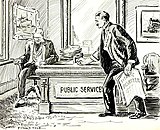 ])
Cartoon demanding better safety from shipping companies, 1912

Molly Brown presenting award to Carpathia Captain Arthur Rostron for his service in the rescue
In January 1912, the hulls and equipment of Titanic and Olympic had been insured through Lloyd's of London and London Marine Insurance. The total coverage was £1,000,000 (£102,000,000 today) per ship. The policy was to be "free from all average" under £150,000, meaning that the insurers would only pay for damage in excess of that sum. The premium, negotiated by brokers Willis Faber & Company (now Willis Group), was 15 s (75 p) per £100, or £7,500 (£790,000 today) for the term of one year. Lloyd's paid the White Star Line the full sum owed to them within 30 days.[200]
Many charities were set up to help the survivors and their families, many of whom lost their sole wage earner, or, in the case of many Third Class survivors, everything they owned. In New York City, for example, a joint committee of the American Red Cross and Charity Organization Society formed to disburse financial aid to survivors and dependents of those who died.[201] On 29 April, opera stars Enrico Caruso and Mary Garden and members of the Metropolitan Opera raised $12,000 ($300,000 in 2014)[202] in benefits for victims of the disaster by giving special concerts in which versions of "Autumn" and "Nearer My God To Thee" were part of the programme.[203] In Britain, relief funds were organised for the families of Titanic's lost crew members, raising nearly £450,000 (£47,000,000 today). One such fund was still in operation as late as the 1960s.[204]
In the United States and Britain, more than 60 survivors combined to sue the White Star Line for damages connected to loss of life and baggage.[205] The claims totalled $16,804,112 (appr. $419 million in 2018 USD), which was far in excess of what White Star argued it was responsible for as a limited liability company under American law.[206] Because the bulk of the litigants were in the United States, White Star petitioned the United States Supreme Court in 1914, which ruled in its favour that it qualified as an LLC and found that the causes of the ship's sinking were largely unforeseeable, rather than due to negligence.[207]
This sharply limited the scope of damages survivors and family members were entitled to, prompting them to reduce their claims to some $2.5 million. White Star only settled for $664,000 (appr. $16.56 million in 2018), about 27% of the original total sought by survivors. The settlement was agreed to by 44 of the claimants in December 1915, with $500,000 set aside for the American claimants, $50,000 for the British, and $114,000 to go towards interest and legal expenses.[205][206]
Investigations into the disaster
Main articles: United States Senate inquiry into the sinking of the *Titanic* and British Wreck Commissioner's inquiry into the sinking of the *Titanic*
[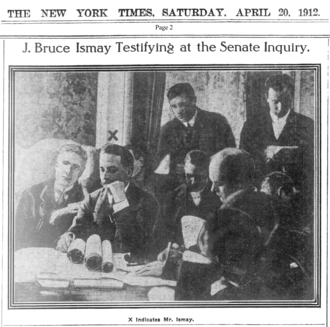
Senate Inquiry: Within five days of the sinking, The New York Times published several columns relating to Ismay's conduct—concerning which "there has been so much comment".[208] Columns included the statement of attorney Karl H. Behr indicating Ismay had helped supervise loading of passengers in lifeboats, and of William E. Carter stating that he and Ismay boarded a lifeboat only after there were no more women.[208]
Even before the survivors arrived in New York, investigations were being planned to discover what had happened, and what could be done to prevent a recurrence. Inquiries were held in both the United States and the United Kingdom, the former more robustly critical of traditions and practices, and scathing of the failures involved, and the latter broadly more technical and expert-orientated.[209]
The US Senate's inquiry into the disaster was initiated on 19 April, a day after Carpathia arrived in New York.[210] The chairman, Senator William Alden Smith, wanted to gather accounts from passengers and crew while the events were still fresh in their minds. Smith also needed to subpoena all surviving British passengers and crew while they were still on American soil, which prevented them from returning to the UK before the American inquiry was completed on 25 May.[211] The British press condemned Smith as an opportunist, insensitively forcing an inquiry as a means of gaining political prestige and seizing "his moment to stand on the world stage". Smith, however, already had a reputation as a campaigner for safety on US railroads, and wanted to investigate any possible malpractices by railroad tycoon J. P. Morgan, Titanic's ultimate owner.[212]
The British Board of Trade's inquiry into the disaster was headed by Lord Mersey, and took place between 2 May and 3 July. Being run by the Board of Trade, who had previously approved the ship, it was seen by some[like whom?] as having little interest in its own or White Star's conduct being found negligent.[213]
Each inquiry took testimony from both passengers and crew of Titanic, crew members of Leyland Line's Californian, Captain Arthur Rostron of Carpathia and other experts.[214] The British inquiry also took far greater expert testimony, making it the longest and most detailed court of inquiry in British history up to that time.[215] The two inquiries reached broadly similar conclusions: the regulations on the number of lifeboats that ships had to carry were out of date and inadequate,[216] Captain Smith had failed to take proper heed of ice warnings,[217] the lifeboats had not been properly filled or crewed, and the collision was the direct result of steaming into a dangerous area at too high a speed.[216]
Neither inquiry's findings listed negligence by IMM or the White Star Line as a factor. The American inquiry concluded that since those involved had followed standard practice, the disaster was an act of God.[218] The British inquiry concluded that Smith had followed long-standing practice that had not previously been shown to be unsafe,[219] noting that British ships alone had carried 3.5 million passengers over the previous decade with the loss of just 10 lives,[220] and concluded that Smith had done "only that which other skilled men would have done in the same position". Lord Mersey did, however, find fault with the "extremely high speed (twenty-two knots) which was maintained" following numerous ice warnings,[221] noting that "what was a mistake in the case of the Titanic would without doubt be negligence in any similar case in the future".[219]
The recommendations included strong suggestions for major changes in maritime regulations to implement new safety measures, such as ensuring that more lifeboats were provided, that lifeboat drills were properly carried out and that wireless equipment on passenger ships was manned around the clock.[222] An International Ice Patrol was set up to monitor the presence of icebergs in the North Atlantic, and maritime safety regulations were harmonised internationally through the International Convention for the Safety of Life at Sea; both measures are still in force today.[223]
On 18 June 1912, Guglielmo Marconi gave evidence to the Court of Inquiry regarding the telegraphy. Its final report recommended that all liners carry the system and that sufficient operators maintain a constant service.[224]
Role of the SS Californian

SS Californian, which had tried to warn Titanic of the danger from pack-ice
One of the most controversial issues examined by the inquiries was the role played by SS *Californian*, which had been only a few miles from Titanic but had not picked up her distress calls or responded to her signal rockets. Californian had warned Titanic by radio of the pack ice (that was the reason Californian had stopped for the night) but was rebuked by Titanic's senior wireless operator, Jack Phillips.[225]
Testimony before the British inquiry revealed that at 10:10 pm, Californian observed the lights of a ship to the south; it was later agreed between Captain Stanley Lord and Third Officer C.V. Groves (who had relieved Lord of duty at 11:10 pm) that this was a passenger liner.[225] At 11:50 pm, the officer had watched that ship's lights flash out, as if she had shut down or turned sharply, and that the port light was now visible.[225] Morse light signals to the ship, upon Lord's order, were made between 11:30 pm and 1:00 am, but were not acknowledged.[226] If Titanic was as far from the Californian as Lord claimed, then he knew, or should have known, that Morse signals would not be visible. A reasonable and prudent course of action would have been to awaken the wireless operator and to instruct him to attempt to contact Titanic by that method. Had Lord done so, it is possible he could have reached Titanic in time to save additional lives.[77]
Captain Lord had gone to the chartroom at 11:00 pm to spend the night;[227] however, Second Officer Herbert Stone, now on duty, notified Lord at 1:10 am that the ship had fired five rockets. Lord wanted to know if they were company signals, that is, coloured flares used for identification. Stone said that he did not know and that the rockets were all white.[clarification needed] Captain Lord instructed the crew to continue to signal the other vessel with the Morse lamp, and went back to sleep. Three more rockets were observed at 1:50 am and Stone noted that the ship looked strange in the water, as if she were listing. At 2:15 am, Lord was notified that the ship could no longer be seen. Lord asked again if the lights had had any colours in them, and he was informed that they were all white.[228]
Californian eventually responded. At around 5:30 am, Chief Officer George Stewart awakened wireless operator Cyril Furmstone Evans, informed him that rockets had been seen during the night, and asked that he try to communicate with any ship. He got news of Titanic's loss, Captain Lord was notified, and the ship set out to render assistance. She arrived well after Carpathia had already picked up all the survivors.[229]
The inquiries found that the ship seen by Californian was in fact Titanic and that it would have been possible for Californian to come to her rescue; therefore, Captain Lord had acted improperly in failing to do so.[230][q]
Survivors and victims
Main article: Passengers of the *Titanic*
The number of casualties of the sinking is unclear, due to a number of factors. These include confusion over the passenger list, which included some names of people who cancelled their trip at the last minute, and the fact that several passengers travelled under aliases for various reasons and were therefore double-counted on the casualty lists.[232] The death toll has been put at between 1,490 and 1,635 people.[233] The tables below use figures from the British Board of Trade report on the disaster.[108] While the use of the Marconi wireless system did not achieve the result of bringing a rescue ship to Titanic before it sank, the use of wireless did bring Carpathia in time to rescue some of the survivors who otherwise would have perished due to exposure.[6]
The water temperature was well below normal in the area where Titanic sank. It also contributed to the rapid death of many passengers during the sinking. Water temperature readings taken around the time of the accident were reported to be −2 °C (28 °F). Typical water temperatures were normally around 7 °C (45 °F) during mid-April.[234] The coldness of the water was a critical factor, often causing death within minutes for many of those in the water.
Fewer than a third of those aboard Titanic survived the disaster. Some survivors died shortly afterwards; injuries and the effects of exposure caused the deaths of several of those brought aboard Carpathia.[235] The figures show stark differences in the survival rates of the different classes aboard Titanic. Although only 3% of first-class women were lost, 54% of those in third-class died. Similarly, five of six first-class and all second-class children survived, but 52 of the 79 in third-class perished. The differences by gender were even bigger: nearly all female crew members, first- and second-class passengers were saved. Men from the First Class died at a higher rate than women from the Third Class.[236] In total, 50% of the children survived, 20% of the men and 75% of the women.
The last living survivor, Millvina Dean from England, who, at only nine weeks old, was the youngest passenger on board, died aged 97 on 31 May 2009.[237] Two special survivors were the stewardess Violet Jessop and the stoker Arthur John Priest,[238] who survived the sinkings of both Titanic and HMHS *Britannic* and were aboard RMS *Olympic* when she was rammed in 1911.[239][240][241]...
Wreck
Main article: Wreck of the *Titanic*

The bow of the wrecked Titanic, photographed in June 2004
Titanic was long thought to have sunk in one piece and, over the years, many schemes were put forward for raising the wreck. None came to fruition.[253] The fundamental problem was the sheer difficulty of finding and reaching a wreck that lies over 12,000 feet (3,700 m) below the surface, in a location where the water pressure is over 6,500 pounds per square inch (450 bar).[254] A number of expeditions were mounted to find Titanic but it was not until 1 September 1985 that a Franco-American expedition led by Jean-Louis Michel and Robert Ballard succeeded.[255][256][257]
The team discovered that Titanic had in fact split apart, probably near or at the surface, before sinking to the seabed. The separated bow and stern sections lie about a third of a mile (0.6 km) apart in Titanic Canyon off the coast of Newfoundland. They are located 13.2 miles (21.2 km) from the inaccurate coordinates given by Titanic's radio operators on the night of her sinking,[258] and approximately 715 miles (1,151 km) from Halifax and 1,250 miles (2,012 km) from New York....
Legacy
Safety
Main article: Changes in safety practices after the sinking of the *Titanic*

An ice patrol aircraft inspecting an iceberg
After the disaster, recommendations were made by both the British and American Boards of Inquiry stating that ships should carry enough lifeboats for all aboard, mandated lifeboat drills would be implemented, lifeboat inspections would be conducted, etc. Many of these recommendations were incorporated into the International Convention for the Safety of Life at Sea passed in 1914.[274] The convention has been updated by periodic amendments, with a completely new version adopted in 1974.[275] Signatories to the Convention followed up with national legislation to implement the new standards. For example, in Britain, new "Rules for Life Saving Appliances" were passed by the Board of Trade on 8 May 1914 and then applied at a meeting of British steamship companies in Liverpool in June 1914.[276]
Further, the United States government passed the Radio Act of 1912. This Act, along with the International Convention for the Safety of Life at Sea, stated that radio communications on passenger ships would be operated 24 hours a day, along with a secondary power supply, so as not to miss distress calls. Also, the Radio Act of 1912 required ships to maintain contact with vessels in their vicinity as well as coastal onshore radio stations.[277] In addition, it was agreed in the International Convention for the Safety of Life at Sea that the firing of red rockets from a ship must be interpreted as a sign of need for help. Once the Radio Act of 1912 was passed, it was agreed that rockets at sea would be interpreted as distress signals only, thus removing any possible misinterpretation from other ships.[277]
Finally, the disaster led to the formation and international funding of the International Ice Patrol, an agency of the United States Coast Guard that to the present day monitors and reports on the location of North Atlantic Ocean icebergs that could pose a threat to transatlantic sea traffic...
Cultural
Main article: Cultural legacy of *Titanic*
[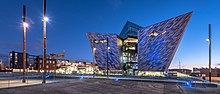 ](https://en.wikipedia.org/wiki/File:Exteriors-Titanic-Hotel-Belfast_%2838971357542%29.jpg)
*Titanic* Belfast, photographed in November 2017
Titanic has gone down in history as the ship that was called unsinkable.[t] For more than 100 years, she has been the inspiration of fiction and non-fiction. She is commemorated by monuments for the dead and by museums exhibiting artefacts from the wreck. Just after the sinking, memorial postcards sold in huge numbers[281] together with memorabilia ranging from tin candy boxes to plates, whiskey jiggers,[282] and even black mourning teddy bears.[283] The sinking inspired many ballads such as "The Titanic".[284] Several survivors wrote books about their experiences,[285] but it was not until 1955 that the first historically accurate book – A Night to Remember – was published.[286]
The first film about the disaster, Saved from the Titanic, was released only 29 days after the ship sank and had an actual survivor as its star—the silent film actress Dorothy Gibson. This film is considered lost.[287] The British film *A Night to Remember* (1958) is still widely regarded as the most historically accurate movie portrayal of the sinking.[288] The most financially successful by far has been James Cameron's Titanic (1997), which became the highest-grossing film in history up to that time,[289] as well as the winner of 11 Oscars at the 70th Academy Awards, including Best Picture and Best Director for Cameron.[290]
The Titanic disaster was commemorated through a variety of memorials and monuments to the victims, erected in several English-speaking countries and in particular in cities that had suffered notable losses. These included Southampton and Liverpool in England; New York and Washington, D.C. in the United States; and Belfast and Cobh (formerly Queenstown) in Ireland.[291] A number of museums around the world have displays on Titanic; the most prominent is in Belfast, the ship's birthplace (see below).
RMS Titanic Inc., which is authorised to salvage the wreck site, has a permanent Titanic exhibition at the Luxor Las Vegas hotel and casino in Nevada which features a 22-ton slab of the ship's hull. It also runs an exhibition which travels around the world.( also a replica in a Chinese resort) [292] In Nova Scotia, Halifax's Maritime Museum of the Atlantic displays items that were recovered from the sea a few days after the disaster. They include pieces of woodwork such as panelling from the ship's First Class Lounge and an original deckchair,[293] as well as objects removed from the victims.[294] In 2012 the centenary was marked by plays, radio programmes, parades, exhibitions and special trips to the site of the sinking together with commemorative stamps and coins.[189][295][296][297][298] Royal Mail (whose mail was carried by RMS (Royal Mail Ship) Titanic) issued ten 1st class UK postage stamps, each with the "crown seal", to mark the centenary of the disaster.[299]
In a frequently commented-on literary coincidence, Morgan Robertson authored a novel called Futility in 1898 about a fictional British passenger liner with the plot bearing a number of similarities to the Titanic disaster. In the novel, the ship is the SS Titan, a four-stacked liner, the largest in the world and considered unsinkable; like the Titanic, she sinks in April after hitting an iceberg and does not have enough lifeboats.[300]...
See also


- *Titanic* conspiracy theories
- *Titanic* in popular culture
- Seamen's Act
- Lists of shipwrecks
- The Wreck of the Titan: Or, Futility
Comparable disasters
- Eastland disaster, a ship capsizing in 1915 after being fitted with extra lifeboats
- MS *Estonia*
- RMS *Empress of Ireland*