Holst G
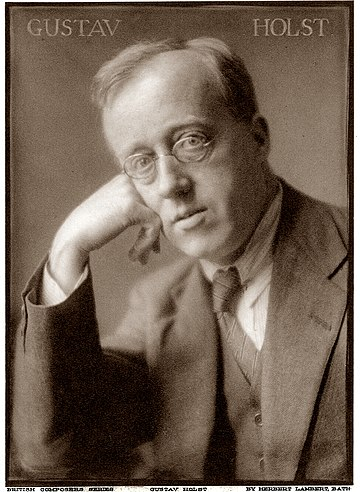
NAME: Holst, Gustav Theodore
ACHIEVEMENTS: One of the most prominent and popular English composers of the twentieth century.
NICKNAME/ALIAS: Von Holst, Gustavus Theodore
DATE AND PLACE OF BIRTH: 21st September 1874, in Cheltenham, England.
DATE/PLACE OF DEATH/AGE AT DEATH: 25th May 1934, in London, England. Aged 59.
DISCIPLINE: Musician.
FIELD: Composer, trombonist and music teacher.
LANGUAGE: English.
PARENTS: Father, Adolph von Holst, mother, Clara Lediard, stepmother, Mary Thorley Stone.
SIBLINGS: 1 brother, Emil (a.k.a. Ernest Cossart), 2 half brothers, Matthias and Evelyn.
SPOUSE: Isobel Harrison.
CHILDREN: 1 daughter, Imogen.
EDUCATION: Royal College of Music, London.
MAJOR WORKS: The Planets, Egdon Heath, Lyric Movement for viola and orchestra
LIFE AND TIMES: Gustav von Holst was born in 1874 into a musical family. His great-grandfather, a Russian political exile who fled to England in the late eighteenth century, was a composer, pianist, and music teacher. His grandfather and father were both pianists and teachers.
Gustav began by studying the piano, then took up the violin, finally settling on the trombone. Holst began his first attempts at composition in his early teens, and then applied to Trinity College of Music in London. He did not receive the scholarship he had hoped for, however, and instead his father arranged for him to study counterpoint for several months with George Frederick Sims, the organist of Merton College, Oxford. On his return to his hometown of Cheltenham, Holst found a job as an organist and choirmaster at a local church.
In 1893 he was delighted to be admitted to the Royal College of Music, but the composer <studied under> Sir Charles Stanford refused to accept him as a student until he had completed further studies in theory and counterpoint. He eventually gained admission to Stanford's class and was awarded a composition scholarship in 1895.
Holst greatly expanded his circle of friends and musical influences while at the RCM. In 1895 he met <a pal of> Vaughan Williams*, a fellow student who was destined to become one of the most important English composers of his time. The two became lifelong best friends.
Vaughan Williams was one of the pioneers of the English folk song revival, which would have a significant impact on Holst's mature style. Other important influences during his student years included the music of <influenced by> Wagner*, which he had heard conducted by Gustav Mahler in 1892, and <influenced by> Purcell*.
Both Holst and Vaughan Williams participated in the first modern performance of Purcell's Dido and Aeneas, conducted by <knew> Stanford*.
Holst's compositions were also influenced by the poetic ideas of <influenced by> Whitman*, whose texts he would set to music in The Mystic Trumpeter (1904) and Ode to Death (1919), and of Poet Laureate Robert Bridges, a close friend whose works inspired the Seven Part Songs (1925-26).
Holst was enthusiastic about Hindu literature and philosophy as well; he studied Sanskrit at University College, London, and worked Hindu themes into his later operas Sita and Savitri.
In 1896 Holst became conductor of the Hammersmith Socialist Choir, which rehearsed at the home of <colleague of> William Morris*. One of the members of the choir was Isobel Harrison, whom he married in 1901. Holst honored Morris with the "Elegy in Memoriam William Morris" from the Symphony The Cotswolds (1899).
Believing that he had little chance of a career as a composer, Holst took on freelance work as a trombonist. He played with the Queen's Hall Orchestra, Carl Rosa Opera Company, and the Scottish Orchestra, performing several times under the baton of composer/conductor <performed under> Strauss*.
Holst gave up his orchestral career in 1903 in the hope of finding a more steady position. He succeeded Vaughan Williams as a music teacher at James Allen's Girls' School in Dulwich. In 1905 he was appointed head of music at St. Paul's Girls' School, Hammersmith, where he remained until the end of his life.
He applied for emergency relief work during World War I but was continually turned down for health reasons. In 1918 he managed to secure an appointment with the <worked for> YMCA*, volunteering to work among the troops in Salonica and Constantinople as a music organizer.
Following the suggestion of the YMCA, Holst dropped the "von" from his name so that the soldiers would not think he was German.
Holst's seven-movement orchestral suite The Planets (1914-16) received its first (immediately successful) performance in 1918, leading to performances and publication of many of his early works. He held posts at University College, Reading and the Royal College of Music during the 1920s.
In 1923, however, he was forced to slow down after a whirlwind visit to the United States and a fall while conducting. By 1925 he had resigned all his teaching duties except at St. Paul's. In 1932 he accepted a visiting lectureship at Harvard, but was forced to cut it short due to illness.
The orchestral piece Egdon Heath (1927), one of his most unique and significant works, received a tepid response at its premiere. His other compositions, including works for orchestra, wind ensemble, strings, brass band, chorus and solo instruments, as well as chamber music, opera and even film music, suffered a similar fate.
Thanks to The Planets, however, Holst's position as an important figure in twentieth-century English music was secure; music festivals devoted to his work appeared as early as 1927.
During the last eighteen months of his life he suffered from poor health and could rarely leave his home—he was too ill to attend the first performance of his opera The Wandering Scholar in 1934 (a work which was later edited and revived by <work revived by> Britten*). Still he continued to compose, writing one of his most beautiful pieces, the Lyric Movement for viola and orchestra, in 1933.
ASSESSMENT: One of the most adventurous English composers of his generation, and also an accomplished music educator.
EXTRA CONNECTIONS:
As a composer Holst was frequently inspired by literature. He set poetry by Thomas Hardy and Robert Bridges and, a particular influence, Walt Whitman, whose words he set in "Dirge for Two Veterans" and The Mystic Trumpeter (1904). He wrote an orchestral Walt Whitman Overture in 1899.[4]
His works include the Choral Symphony to words by Keats (a Second Choral Symphony to words by George Meredith exists only in fragments). A short Shakespearian opera, At the Boar's Head, followed.
While on tour with the Carl Rosa company Holst had read some of Max Müller's books, which inspired in him a keen interest in Sanskrit texts, particularly the Rig Veda hymns.[59] He found the existing English versions of the texts unconvincing,[n 9] and decided to make his own translations, despite his lack of skills as a linguist. He enrolled in 1909 at University College, London, to study the language.
Holst's interest in Indian mythology, shared by many of his contemporaries, first became musically evident in the opera Sita (1901–06).[127] During the opera's long gestation, Holst worked on other Indian-themed pieces. These included Maya (1901) for violin and piano, regarded by the composer and writer Raymond Head as "an insipid salon-piece whose musical language is dangerously close to Stephen Adams".[127][n 13] Then, through Vaughan Williams, Holst discovered and became an admirer of the music of Ravel,[129] whom he considered a "model of purity" on the level with Haydn,[130] another composer he greatly admired.[131]
The combined influence of Ravel, Hindu spiritualism and English folk tunes[129] enabled Holst to get beyond the once all-consuming influences of Wagner and Richard Strauss and to forge his own style.
John Williams’ (in Lucas’ ) Star Wars score’s Imperial March’s underlying rhythm recalls another celestial score: Gustav Holst’s “The Planets.” The subjects of Holst’s suite, however, are more mythological than astronomical. “Mars,” which resembles Darth Vader’s march, is subtitled “The Bringer of War.” This wouldn’t be the only time “Mars” inspired a film composer; Hans Zimmer in “Gladiator.”
ONELINER: Gustav Holst, major British composer
BIBLIOGRAPHY:
Short, Michael, Gustav Holst: The Man and his Music, Oxford University Press, Oxford and New York, 1990.