Britten B
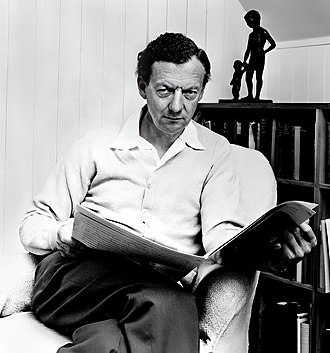
ACHIEVEMENTS: One of the leading twentieth-century English composers, particularly noted for reviving English opera.
NICKNAME/ALIAS: None.
DATE AND PLACE OF BIRTH: 22nd November 1913, in Lowestoft, England.
DATE/PLACE OF DEATH/AGE AT DEATH: 4th December 1976, in Aldeburgh, England. Aged 63.
DISCIPLINE: Musician.
FIELD: Composer, conductor, and pianist.
LANGUAGE: English.
PARENTS: Father, Robert Britten, mother, Edith Hockey Britten.
SIBLINGS: 1 brother, Robert, 2 sisters, Barbara and Beth.
SPOUSE: Never married. (Forty-year relationship with Peter Pears)
CHILDREN: No children.
EDUCATION: Studied composition with Frank Bridge; attended Royal College of Music.
MAJOR WORKS: Peter Grimes, Billy Budd, War Requiem, Death in Venice.
LIFE AND TIMES:
Benjamin Britten was born in 1913, the youngest of four children in a middle-class Suffolk family. His mother was determined that he should become a great composer—the fourth "B," after Bach, Beethoven, and Brahms—and she encouraged his music studies from a young age. By age 14, Britten had more than 100 compositions to his credit. His mother introduced him to the composer Bridge*, who was impressed by the boy's talent and agreed to give him lessons.
Britten entered the Royal College of Music at age 16, with Bridge's encouragement. During his college years, he had his first introduction to the music of Stravinsky* and Gustav Mahler*, whose work would have a tremendous influence on Britten's own.
After his graduation in 1932, Britten hoped to study composition with Alban Berg, another of his idols, but his parents forbade it. Instead, he returned to his hometown of Lowestoft and continued to write music. By his 21st birthday, Britten had enjoyed some significant successes; the BBC had performed his Sinfonietta and several of his works were published. He found work in 1935 writing music for documentary films, and produced sixteen film scores in the next four years.
Through his film connections, Britten found himself admitted to a liberating artistic circle which revolved around the poet W. H. Auden*, who would become one of his closest and most influential friends. Thanks to Auden, Britten had the opportunity to write experimental theater music and meet the writer Montagu Slater, who would eventually write the libretto for his most famous opera, Peter Grimes. Britten signed a publishing contract with Boosey & Hawkes in 1936. His travels to Spain that same year, on the eve of the Spanish Civil War, affirmed in Britten a lifelong pacifism which would manifest itself in his music and in his choice of musical texts.
In 1937, Britten met the tenor Peter Pears, the man who would become his companion and life partner for nearly forty years. Pears' voice would have a lasting effect on the kind of music Britten chose to write; it became the hallmark of many of his compositions, and steered his interests firmly in the direction of opera. In 1937, Britten also honored his old teacher with one of his earliest masterpieces, Variations on a Theme of Frank Bridge.
He wrote 28 commissions for the BBC during the late 1930s, in addition to numerous other works. Britten was an extraordinarily prolific composer who could write up to 30 pages of full score in only one day, possibly thanks to his early experiences writing film music on short deadlines.
Britten and Pears left England for America in 1939, following Auden's example. They were hoping to escape the war, but they also were reacting to negative criticism from the British music press. For a short time, Britten seriously considered applying for U.S. citizenship.
He lived in Amityville, New York for three years and enjoyed participating in local chamber music concerts (one of which was attended by Einstein*). He also continued composing. Britten's Sinfonia da Requiem premiered in Carnegie Hall in 1940. The following year, he and Pears moved into the Auden commune in New York, where he wrote the opera-musical, Paul Bunyan.
Britten decided to return to England in 1942, where he faced a conscientious objectors tribunal and was exempted from military service. During the war, he and Pears gave a number of morale-boosting recital tours throughout Britain. He completed his first great opera, Peter Grimes, in 1945. It was an outstanding success, and is often considered the start of a new era in English art music.
Britten continued to compose operas throughout the 1940s. He also wrote music for children, including The Young Person's Guide to the Orchestra, and helped organize the Aldeburgh Festival, an event centered on his music.
In 1951, Britten conducted the premiere of his second important opera, Billy Budd, with a libretto by E. M. Forster* and Eric Crozier, based on a story by Melville*.
He devoted much of the 1950s to international travel and the Aldeburgh Festival events, but still continued to produce new music, including the opera The Turn of the Screw. Britten's travels to Bali introduced him to gamelan music, which would have a strong influence on his ballet The Prince of the Pagodas and his later opera Death in Venice.
During the early 1960s, Britten met and developed friendships with Russian musicians whose work he had long admired, including the composer Shostakovich* and the cellist Rostropovich, for whom his Cello Sonata and Cello Symphony were written. Rostropovich's wife also sang in the premiere of Britten's War Requiem, a great success for him in 1961.
He used his celebrity status in the late 1960s to raise money for the Aldeburgh Festival, scheduling a series of ambitious international tours. He also conducted the first televised performances of several of his operas, including Peter Grimes. In 1971 he began work on his final opera, the dark and moody Death in Venice.
Despite a major heart surgery, he was able to attend its premiere at Covent Garden in October 1973. In 1976 he became the first composer ever to be created a Baron, but he never took his seat in the House of Lords, due to his fragile health. He died in Peter Pears' arms at their home in Aldeburgh on December 4, 1976, shortly after his 63rd birthday.
ASSESSMENT: Britten is remembered as the most important English opera composer of the twentieth century and a distinctive voice in post-war music.
EXTRA CONNECTIONS: He revived the works of Holst*
Stanford Sir C*? Shostakovich*?
He knew surrealist painter Salvador Dali*
ONELINER: Benjamin Britten, major 20th century British composer
BIBLIOGRAPHY:
Barnett, Rob, 'Benjamin Britten: Biography,' Music on the Web,
http://www.musicweb.uk.net/britten/#intro (Accessed15 May 2002).
Brett, Philip, 'Britten, (Edward) Benjamin,' grovemusic.com, ed. L. Macy (2001),
http://www.grovemusic.com (Accessed 12 May 2002).
Carpenter, Humphrey, Benjamin Britten: A Biography, Scribner, New York, 1992.