Morris, William
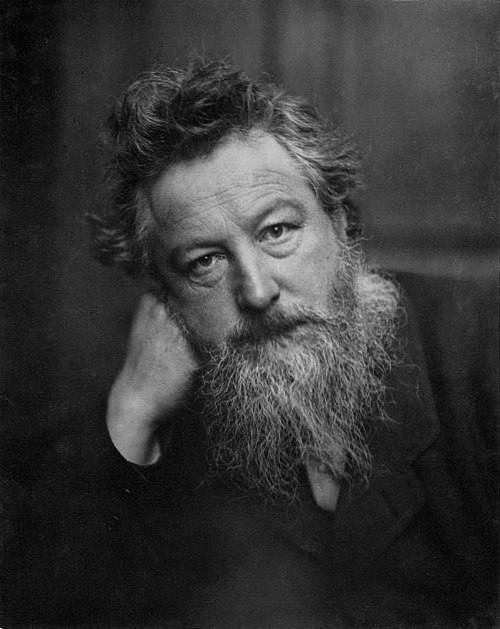
Achievements: Designer and pioneer of Socialism
Born: March 24, 1834; Walthamstow, London, England
Died: October 3, 1896; London, England (Aged 62)
Field & Discipline: Decorative Art; Designer
Education: Marlborough College; Exeter College, Oxford
Major Work:
"The Earthly Paradise" (1868-70)
Life & Times:
At university Morris met the future artist [a pal of] Burne-Jones* who became a lifelong friend. As a boy, the novelist [met] Rudyard Kipling* remembered meeting Morris at the Burne-Jones family home. Morris was part of a group of religious young Oxford Anglo-Catholic aesthetes. He considered taking holy orders and using the wealth he had inherited from his father to found a religious community to produce sacred art, but reading the works of [influenced by] Carlyle* and [influenced by] Ruskin*, and their criticism of contemporary life, turned him to more secular interests.
In 1856 he joined a firm of architects in Oxford who specialised in Gothic revivalist architecture. In the same year he founded "The Oxford and Cambridge Magazine" in which he published some of his own poems. His love of the Middle Ages was confirmed on a series of walking tours to Belgium and northern France when he saw the cathedrals of Chartres, Amiens and Rouen, and the paintings of medieval artists.
Burne-Jones introduced him to the pre-Raphaelite artist and poet [a pal of] Dante Gabriel Rossetti* who persuaded Morris that he should be a painter. He left the architect's office and took a studio in London with Burne-Jones. When they could not find furniture they liked Morris designed some and helped Burne-Jones and Rossetti to decorate it with medieval motifs. Morris then spent the summer with a group of artists who decorated the Oxford Union with illustrations of the legend of King Arthur and his knights. During this period he met the poet [a pal of] Swinburne* (with whom he became friends) and his wife, the beautiful Jane Burden. In 1858 he published a volume of poems under the title "The Defence of Guenevere and Other Poems."
After marrying, Morris commissioned an architect friend to build him a home at Bexleyheath in Kent which became known as the Red House because it was built of red bricks with no stucco finish. The Red House was the first of this type of domestic architecture in nineteenth century England. Morris was determined that the inside of the house should be similarly dedicated to beauty and utility.
In 1861, together with like-minded friends he founded Morris, Marshall, Faulkner and Company, who designated themselves "Fine Art Workmen in Painting, Carving, Furniture, and the Metals".
Burne-Jones was a member of the company, as was Rossetti and the writer [a pal of] Ford Madox Ford*. Their first commissions were for stained glass for the many new churches then being built in England and their most important work was for the chapel at Jesus College, Cambridge. They exhibited furniture and embroidery at the International Exhibition of 1862 and gradually became known for their domestic designs.
The first of Morris's well-known wallpaper designs emerged at this time. He also designed chintzes, tapestries and furniture. In 1865 his health broke down through overwork and he sold the Red House. He settled with his family in London where the firm's workshops formed part of his house.
In 1867 he published his romantic narrative poem "The Life and Death of Jason", followed by "The Earthly Paradise" (1868-70), which dealt with classical and mediaeval themes. These works were extremely successful and made Morris's literary reputation. He followed this with his "Book of Verse" (1870) which contains some of his best illustrations.
In 1871 he and Rossetti, who was desperately in love with Morris's wife, rented Kelmscott manor (in Oxfordshire), a seventeenth century house which provided an idyllic setting for portraits of Jane. Morris made two visits to Iceland to research for an epic poem. In 1875 Morris brought out his partners and renamed the firm Morris & Company. His Icelandic epic "Story of Sigurd the Volsung and the Fall of the Niblungs" came out in 1876.
He began to take part in politics in 1876, in the Eastern Question Association, a group formed to protest against the treatment of Christian minorities by the Turks. In 1877 he was a co-founder of the Society for the Protection of Ancient Buildings. Morris's moral feelings about art and design and his love of medieval art led him to the belief that the contemporary industrial society needed a new idealism. This, in turn, led him from liberalism to socialism. He read "Das Kapital" by [influenced by] Karl Marx* and in 1883 joined the Socialist Democratic Federation and began to tour the industrial areas of Britain, giving lectures on socialism.
Among others, he was heard by the future novelist, [lectured to] HG Wells* and Marx's daughter, [co-socialist with]Eleanor Marx*. She recorded that when Morris addressed middle class socialists he often antagonized them with his forthright admiration of working men and women. His circle included Fabian-Society reformers like [co-socialist with] Shaw*, [co-socialist with] Beatrice and Sidney Webb* and [co-socialist with] Annie Besant*.
Morris then founded the Socialist League, with its own publication "The Commonweal" in which he published his romantic prose expressions of socialist rural utopias "A Dream of John Ball" (1886-87) and "News from Nowhere" (1890). Quarrels between between radicals and socialists wearied Morris and although he remained a socialist all his life, he withdrew from active political participation in the last years of his life.
In a cottage near to Kelmscott House, his large London home at Hammersmith on the banks of the River Thames, he set up the Kelmscott printing press. He was interested in producing modern books whose typography would be the equal of the best fifteenth century books which he greatly admired. Morris designed his own type face and between 1891-98 more than fifty titles were produced by the Press.
Extra Connections:
Met the poet [met] Lazarus* and painter [met] Sickert*
Was a friend of [a pal of] Mucha* and [a pal of] Yeats*
Published [published] Clements Markham*
His work related to chemist [work related to] Tennant*
He was influenced by [influenced by] Hunt*
He owned work by [owned work by] Whistler*
Assessment: Morris was famous as a poet and a decorative designer in his lifetime and is remembered today as one of the early socialists in England and for his influence on the arts and crafts movement which revolutionized Victorian domestic taste.
Oneliner: William Morris, socialist and arts-and-crafts leader
Bibliography:
- Henderson, Philip,William Morris, His Life, Work and Friends, Thames and Hudson, London, 1967.
Language: English
Father: William Morris
Mother: Emma Shelton
Siblings: 1 brother: Edgar; 1 sister: Emma
Spouse: Jane Burden
Children: 2 daughters: Jenny, May
Sandbox (arsenic): TheBrain