Gounod
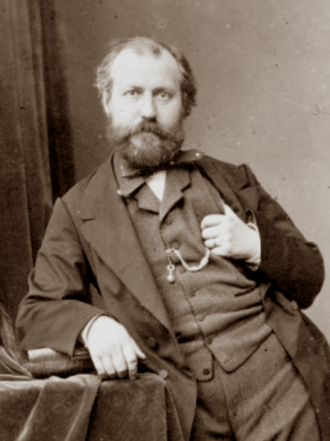
Name: Charles Gounod
Achievements: Major Romantic composer
Born: June 17, 1818; Paris, France
Died: October 18, 1893; Saint-Cloud, France (Aged 75)
Field & Discipline: Music; Opera; Composer
Language: French
Father: Francois Gounod
Mother: Victoire Lemachois
Siblings: Louis Urbain
Spouse: Ann Zimmermann
Children: Jean; Jeanne
Education: Primary schools; Paris and Lycee Saint-Louis, Paris
Major Work: "Faust"
Life & Times:
Gounod entered the Paris Conservatoire in 1836. The director was the composer [studied under] Cherubini*, who assigned him to Halevy to learn counterpoint and fugue. Halevy was a successful opera composer related to Ludovic Halevy, who wrote the libretto for [assistant was] Bizet's* "Carmen".
Gounod’s entry for the 1837 Prix de Rome, the Cantata "Mary Stuart and Rizzio" won only second prize. In 1839, he met [met] Berlioz* during the Conservatoire rehearsals for Berlioz’ "Romeo and Juliet." In the same year, his Cantata "Fernand" won him the Prix de Rome and two years at the Villa Medici, at the same time as the painter [in Rome with] Ingres*.
In June 1842 he left Rome for Vienna, where he met the President of the Vienna Philharmonic, who arranged for the performance of a Mass Gounod had composed in Rome. It was well received and the President commissioned a requiem, played in November 1842, and conducted by Gounod.
In 1843, his Choral Mass was performed in the Carlskirche in Vienna, and he travelled to Leipzig where he met [encouraged by] Felix Mendelssohn*, who gave him encouragement.
Back in Paris, he accepted the post of organist and choirmaster at the Church of the Missions Etrangeres, with the right to be in sole charge of the music performed. He played Palestrina and Bach, but the congregation, including Berlioz, did not appreciate this, and when the church authorities suggested that Gounod revise his programmes, he resigned. Then re-instated, over the next five years he converted his listeners to his own taste. In 1846 he published his “Holy Week Offices”
He now had to convince opera managers that a church musician could write opera. He was introduced to Pauline Viardot, the opera singer, with whom he struck up a rapport and Viardot, who had just had a triumphant success on stage, persuaded Nestor Roqueplan to commission an opera.
Roqueplan was director of the Theatres des Varieties and of the Opera. A childhood friend of Gounod, Emile Augier, then a well-known and successful dramatist, agreed to write the libretto when he heard that Viardot would sing in the work. Viardot invited Gounod to her country house to compose the music and there he met the Russian novelist, [knew] Turgenev*, who was her current admirer. In 1851 "Sappho" was performed in 1851 to mixed reviews and only lasted for thirteen performances. A performance in London the same year was equally unsuccessful.
In April 1852 Gounod married Anna Zimmermann, the daughter of Pierre Zimmermann, an influential teacher at the Conservatoire. That same year Gounod was appointed conductor of the Orpheon Choral Society, a post he held for the next eight years. He wrote the incidental music for a verse play "Ulysses" by Francois Ponsard and was assisted by [assisted by] Saint-Saens*, who was then only seventeen. "Ulysses" was not well received, though music critics including Berlioz thought the music promising.
His "Ave Maria" found great popularity with the public when it was played at a concert in April 1853.
Bizet, a young and gifted musician, played the organ in early performances of the "Ave Maria" and, together with Saint-Saens, became Gounod’s assistant. At this time, Gounod was making a name for himself with songs, while conducting and administrating at the Orpheon, and continuing work on "Faust". His first major religious work was the "Saint Cecilia Mass" which blended secular music with sacred.
In 1856 he was awarded the Legion of Honor. He then suffered a minor breakdown, but recovered quickly and, in 1858, produced his very successful comic opera "The Mock Doctor", based on a play by Moliere.
On 19th March 1859, "Faust" was performed for the first time. The critics were undecided, Berlioz being the most enthusiastic. When [a fan of] Wagner* arrived in Paris at the end of the year, Gounod, having met him through Berlioz, was one of the few who appreciated the German’s work.
Gounod resigned from Orpheon to write grand operas and "Philomen and Baucis" was written 1860, followed by "The Dove" in 1860 and "Mireille" in 1864. Elected to the French Academy in 1866, a year later he wrote "Romeo and Juliet," his last major work. The rest of his musical life was spent writing songs, and works for choral societies. In 1868 he visited Rome and spent an afternoon with [met] Liszt*.
During the Franco-Prussian War, Gounod went to London, where he already had a reputation thanks to "Faust" and "Romeo and Juliet". On 1st May 1871, he conducted a performance of his Oratorio "Gallia" at the Albert Hall. He became a part of London society and was much in demand. In 1872 he conducted a concert at the Albert Hall sponsored by the Royal Choral Society, using a group of singers who became known as Gounod's choir.
In 1874, he returned to Paris and in 1878 his opera "Polyeucte" premiered but was not a success. His Oratorio’s "The Redemption" and "Life and Death", written in 1882 and 1885, fared better.
In 1882, invited to Birmingham, England to conduct "The Redemption", he used 400 singers and an orchestra of 140. [knew] Newman* attended the rehearsal and the concert was extremely successful. "Life and Death" was also warmly received when it was performed in England. In 1885, Gounod wrote his "Little Symphony", a work for small wind orchestra, which is still played and recorded today. By now, Gounod was an international celebrity.
In 1888 he was made a Grand Officer of the Legion of Honour, and he died in 1893.
Extra Connections: [rescored by] Delibes* re-scored “Faust”.
He met [met] Diaghilev*
He was a friend of [a pal of] Delacroix*, and [a pal of] AM Ampere*
He wrote a musical drama about [wrote piece on] Joan of Arc*
He knew pianist [knew] Boulanger*
Scribe*?
Protested about [protested tower of] Eiffel*’s tower.
[a pupil was] Renoir* studied at his choir school
Assessment: Gounod's most famous work, "Faust", is the least characteristic of his work which, at its best, was subtle, melodic and refined.
Oneliner: Charles Gounod, major Romantic composer
Bibliography:
- Harding, James, Gounod, George Allen & Unwin Ltd., London, 1973.