Ingres
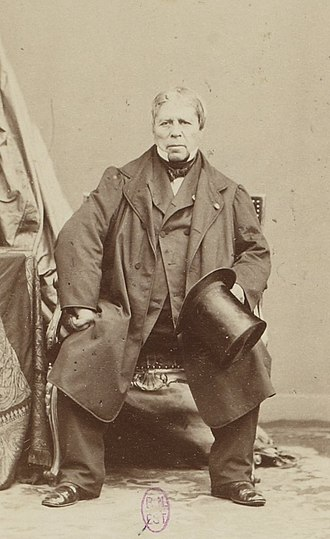
Name: Jean-Auguste-Dominique Ingres
Achievements: Last great French neoclassic painter
Born:August 29, 1780; Montauban, France
Died: January 14, 1867; Paris, France (Aged 87)
Field & Discipline: Art; Painter
Language: French.
Father: Jean-Marie-Joseph Ingres
Mother: Anne Moulet
Siblings: Jacques; Pierre-Victor; Thomas-Alexis; Jeanne-Augustine; Jeanne-Anne-Marie
Spouse: 1) Madeleine Chapelle; 2) Delphine Ramel
Children: None
Education: Brothers of Christian Doctrine, Montauban; Academy of Fine Arts, Toulouse
Major Work:
"Bonaparte as First Consul" (1804)
"Grande Odalisque" (1814)
"Portrait of Monsieur Bertin" (1832)
"The Comtesse d'Haussonville" (1845)
Life & Times:
His father was anxious to develop Ingres' talent so they went to live in Toulouse, where Ingres attended the academy of fine arts. There, Ingres studied under the painter Joseph Roques, best known for his "Death of Marat,” who introduced Ingres to the works of Raphael.
In 1797, probably through a connection between Roques and artist [studied under] David*, Ingres entered David's studio in Paris. David was a celebrated neo-classicist painter, the most famous French artist of his time.
In 1799, Ingres entered the Ecole des Beaux-Arts but continued working in David's studio, where he assisted with David's portrait of "Madame Recamier,” in 1800. The following year, he won the Prix de Rome with his historical painting "The Envoys of Agamemnon.”
Ingres found that he could make a living from portraits and painted his fellow artists and childhood friends who came to visit him in Paris. For most of these he used a restricted palette of brown tones. Ingres’ portraits were remarkable for the clear, steady gaze of their subjects which Ingres achieved by omitting the eyelashes and reducing the upper eyelid to a thin line.
In 1804 he painted "Bonaparte as First Consul,” his first commission from the state. For this famous portrait, [painted] Napoleon* only allowed Ingres one sitting at his Chateau in St Cloud.
In 1806, his second painting of Napoleon had a hostile reception at the Paris salon, France's official exhibition gallery, at its annual show of contemporary painters. "Napoleon on his Imperial Throne" was painted in an almost primitive style, to produce a portrait in which the face of the emperor was virtually lost in his coronation regalia and giving the impression of implacable, archaic power.
In the same year Ingres went to Italy, finally taking up his scholarship in Rome. In 1808, his end-of-year submissions were "Valpincon Bather" and "Oedipus and the Sphinx.” For his final presentation he showed "Jupiter and Thetis" in 1811.
When his scholarship finished, Ingres decided to stay in Italy. He was already gaining commissions to paint portraits of French administrators in French-occupied Italy, and it is likely that he did not relish the thought of competing with David in Paris. Works from this period include "Charles-Joseph-Cordier,” 1811, "Madame de Tournon,” 1812 and "Jacques Marquet, Baron de Montbreton,” 1813.
Ingres’ ambition, however, was to work on historical paintings, which for him were the highest form of art. For the re-decoration of the Quirinal Palace in Rome, he painted two huge paintings "Romulus, Conqueror of Acron" in 1812 and in 1813 "The Dream of Ossian," intended for the ceiling of the Emperor's bedroom.
The "Grande Odalisque" of 1814, today one of Ingres' most admired works, featured a female nude. Its anatomical distortions, and the fluidity which came from its lack of modelling, outraged the critics.
In 1814 Ingres married Madeleine Chapelle. After Napoleon’s defeat the following year, the French administrators left Rome and Ingres lost his source of patronage. He continued to paint historical pictures, scaling them down in size and often painting a series of small pictures on one theme, such as episodes from the life of Henri IV. These paintings sold well, but his reputation in France remained that of an outsider who painted in a ‘Gothic' manner.
In 1820, Ingres moved to Florence and began to work on a large religious picture commissioned for the French cathedral of Montauban. "The Vow of Louis XIII" was done in classical style, influenced by Raphael. When hung at the 1824 Paris salon it was a huge success.
On the basis of this, Ingres moved back to Paris and established his own studio, which soon became highly successful. In 1826, he returned to Montauban for the installation of his picture in the cathedral and was feted as a great artist. The following year, "The Apotheosis of Homer" was again in the neo-classical style, with which Ingres was to be associated for the rest of his life.
In 1829, he was appointed professor at the Paris Ecole des Beaux-Arts. During the revolution of 1830 Ingres enlisted in the military and was tasked with defending the Louvre’s Italian paintings.
In 1832 he painted "Portrait of M. Bertin," shown at the Salon the following year to great acclaim. However, a year later, when his vast religious painting, "Martyrdom of Saint Symphorian" was shown at the Salon ir was received badly. Although Ingres was President of the Ecole des Beaux-Arts in 1834, he declared that he would never exhibit at the Salon again, applied for and got the job of director of the French Academy in Rome, and left France that year.
For six years in Rome he held regular musical soirees, taking [mentor of] Gounod* one of the students under his wing. In 1841, Ingres drew Gounod at the piano. He also used Gounod's hands to substitute for those of the composer Cherubini, whose portrait he painted in 1842.
The duties involved in his position at the Academy left Ingres little time, and during his tenure he only painted three major works. In 1840 he sent "Antiochus and Stratonice" to Paris, where its success encouraged Ingres to return to France.
On his arrival in 1841, he was given a public banquet at which [entertained by] Berlioz* was responsible for the music. He was also invited to dinner with the king.
In 1845, Ingres painted the beautiful portrait of "The Comtesse d'Haussonville,” the wife of a friend who was curator of drawings at the Louvre. In 1848, he painted "Baronne Betty de Rothschild.” In both of these paintings, and in his famous portraits of the renowned beauty "Madame Moitessier" (1844-56 and 1851), the sumptuous treatment of his sitters’ clothes and jewellery caused as much comment as did his graceful compositions and skill in portraiture.
In 1855 he exhibited once more, showing sixty-nine paintings at the Universal Exhibition. He received the title of Grand Officer of the Legion of Honour, the first to be awarded to the arts.
The significant works of his last years were female nudes, including "The Source" in 1856 and the "Turkish Bath" in 1862. In that same year, Ingres was appointed to the Senate.
He died in 1867, and his funeral at Pere Lachaise cemetery was attended by thousands.
Extra Connections: Knew [knew] De Musset*.
Painted by [painted by] Cormon*.
[father’s friend was] Degas* was a friend of his father.
He was inspired by [inspired by] Macpherson’s* ‘Ossian’
His work influenced [influenced] Seurat*
He was a friend of Countess Marie d’ [a pal of] Agoult*
Assessment: Ingres was one of the greatest French painters of the 19th century and
represents the end of the neo-classical movement in France.
Oneliner: J-A-D Ingres, last great French neo-classical painter
Bibliography:
Vigne, Georges, trans. John Goodman, Ingres, Abbeville Press, London, 1995.
Jean-Auguste-Dominique Ingres - Wikipedia