Eiffel Tower
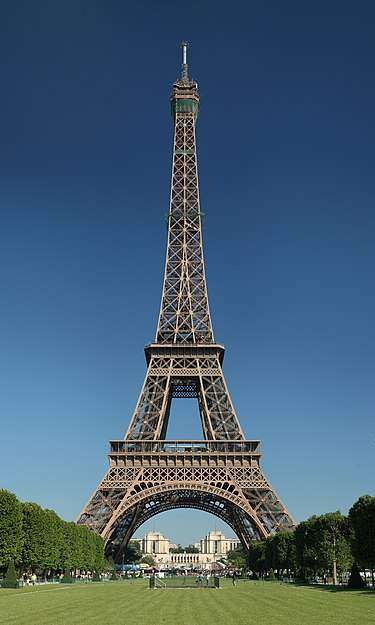
A competition was held in 1884 for a design to be built for the World’s Fair in 1889 to mark the 100thanniversary of the French Revolution. The design competition had approximately 700 design entries. The unanimous winner was Eiffel* with a design for a 300-meter (984 feet) wrought-iron tower which included three observation platforms.
The structural technique involved the use of cross-braced and lattice girders for support construction. The tower is composed of two sections. First, the base is made of four main pillars placed at a slant, close to 80 meters apart and securely attached below ground. The lighter upper section is attached to the base component.
The tower was finished on time and without any loss of life on March 31, 1888. The tower was supposed to stand only twenty years, but Eiffel set out to find other uses for it. It has functioned for radio transmission, astronomical studies, wind study, lightning conductors, barometers, and meteorological study. Elevators were added later to bring visitors to the three levels. The flagpole, in addition to the many antennae, was added later, to make its overall height 324 meters.
The tower is made of 18,038 pieces, 2.5 million rivets, and the metal structure weighs 7,300 tons. The entire structure, including other materials weighs 10,100 tons. Even in severe wind conditions the tower moves only 20 centimeters. The first television trial on the tower began in 1921.
The tower set the style for many later open-work structures designed to withstand strong wind effect.
ONELINER: The Eiffel Tower
OTHER CONNECTIONS:
Maupassant was one of a fair number of 19th-century Parisians (including Charles Gounod, Alexandre Dumas, *fils*, and Charles Garnier) who did not care for the Eiffel Tower[15] (erected in 1887-1889). He often ate lunch in the restaurant at its base, not out of preference for the food but because only there could he avoid seeing its otherwise unavoidable profile.[16] He and forty-six other Parisian literary and artistic notables attached their names to an elaborately irate letter of protest against the tower's construction, written to the Minister of Public Works, and published on 14 February 1887.
Famous visitors to the tower included the Prince of Wales, Sarah Bernhardt, "Buffalo Bill" Cody (his Wild West show was an attraction at the exposition) and Thomas Edison.[27] Eiffel invited Edison to his private apartment at the top of the tower, where Edison presented him with one of his phonographs, a new invention and one of the many highlights of the exposition.[30] Edison signed the guestbook with this message:
To M Eiffel the Engineer the brave builder of so gigantic and original specimen of modern Engineering from one who has the greatest respect and admiration for all Engineers including the Great Engineer the Bon Dieu, Thomas Edison.
On 19 October 1901, Alberto Santos-Dumont, flying his No.6 airship, won a 100,000-franc prize offered by Henri Deutsch de la Meurthe for the first person to make a flight from St. Cloud to the Eiffel Tower and back in less than half an hour.
Installing lifts to the second level was more of a challenge because a straight track was impossible. No French company wanted to undertake the work. The European branch of Otis Brothers & Company submitted a proposal but this was rejected: the fair's charter ruled out the use of any foreign material in the construction of the tower. The deadline for bids was extended but still no French companies put themselves forward, and eventually the contract was given to Otis in July 1887.[33] Otis were confident they would eventually be given the contract and had already started creating designs
Eiffel made use of his apartment at the top of the tower to carry out meteorological observations, and also used the tower to perform experiments on the action of air resistance on falling bodies.
In 1910 Theodor Wulf had conducted experiments on the Eiffel Tower that led to Hess’s discovery of cosmic radiation.
BIBLIOGRAPHY:
EB
“Eiffel Tower” World Book Encyclopedia 2000 ed.
Richardson, C., Alexandre Gustave Eiffel - Man of Architecture and Perfection, 2003.