Franklin, Ben 2
(See Ben 2)
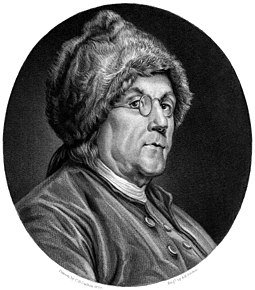
Achievements: The first American to win an international reputation in pure science and the first scientist to become famous for work done wholly in electricity; represented American interests in Europe during the period of the Revolutionary War and helped frame the Declaration of Independence and signed it.
Born: January 17, 1706; Boston, Massachusetts
Died: April 17, 1790; Philadelphia, Pennsylvania (Aged 84)
Field & Discipline: Science; Government & Politics; Journalism; Invention; Scientist; Inventor; Statesman; Journalist
Language: English
Father: Josiah Franklin
Mother: Abiah Folger
Siblings: Eight siblings survived infancy; five half-siblings survived infancy;
Spouse: Deborah Read (common-law wife)
Children: Francis Folger; Sarah; William (illegitimate)
Education: South Grammar School, Boston; George Brownell's English School, Boston
Major Work:
"Experiments and Observations on Electricity"
Life & Times:
At 16, Franklin wrote a series of satirical articles for his father's weekly newspaper, the New England Courant.
In 1723, he moved to Philadelphia, where the governor of Pennsylvania, Sir William Keith, lent him money to set up his own print shop. He also arranged for Franklin to go to England to contact London paper-sellers, but when Franklin arrived, he found his letters of credit and introduction had not arrived. He took a job in a printing shop and over two years became a skilled printer.
In 1726, Franklin returned to the printing business in Philadelphia. His pamphlet "A Modest Enquiry into the Nature and Necessity of a Paper Currency" helped him get the job of printing Pennsylvania's first paper currency.
In 1730, he bought the weekly newspaper "The Pennsylvania Gazette" which became acknowledged as one of the best colonial newspapers. In 1732, he first published "Poor Richard's Almanac," a collection of articles and advice on a vast range of topics, that became immensely popular.
In 1742, Franklin designed the Pennsylvania stove (with under-floor draught), which sold fantastically well.
In 1745, Peter Collinson in London sent a pamphlet describing new German investigations into electricity. Franklin repeated the experiments in the pamphlet, most of them having to do with the Leyden jar (an early capacitor invented in Leyden, Holland, in the mid-1740s).
His research brought him to the view that what was believed to be two kinds of electricity were in fact a single fluid flowing into or out of objects, producing a positive charge (an excess of electricity) or a negative charge (a deficiency of electricity). He concluded that when objects were electrified, nothing new was created or lost, but that the electricity was rearranged (conservation of charge). This view replaced the earlier one of the French experimenter [replaced theory of] Nollet*
In 1750, Franklin proposed the idea of a lightning conductor. He theorized that thunderclouds were like charged bodies, and that pointed conductors could dissipate the charge or carry it safely to earth. In 1751 his letters on electricity were published in London as "Experiments and Observations on Electricity" and translated into French. In 1752, Franklin flew a kite in a thunderstorm and was able to charge up a Leyden jar from sparks produced from the end of the wet hemp string, which he held with a piece of insulating silk.
Franklin abandoned his electrical experiments in late 1747, when French and Spanish privateers attacked ships and settlements on the Delaware River, and the French and the Native Americans attacked Pennsylvania's frontiers.
The Pennsylvania assembly was controlled by Quakers, most of them pacifists, and no one could raise a militia. To rally a retaliatory force, Franklin wrote the pamphlet “Plain Truth; or, Serious Considerations on the Present State of the City of Philadelphia and Province of Pennsylvania,” in which he proposed (and then organized) a militia association. He became a popular local hero, provoking the jealousy of [made an enemy of] Thomas Penn*, Pennsylvania's main property owner.
In 1751, Franklin was elected to the Pennsylvania Assembly, where he remained until 1764. In 1749, he wrote "Proposals Relating to the Education of Youth in Pennsylvania", in which he proposed the founding of an Academy of Philadelphia, which opened in 1751 and from which grew the University of Pennsylvania. In 1756, he was elected to the [member of] Royal Society*, where he met [met] Sir William Jones*.
As Pennsylvania's delegate, Franklin attended the Albany Congress called for the union of the Colonies against the French and Native Americans. In 1757, he was sent to England to present the Philadelphia side in the controversy with the "Pennsylvania Proprietors" (the Penn family). The need for funds to defend the frontier had led the legislature to try to tax the lands of the Penn family, who were the proprietors under the colony's charter. Franklin negotiated a compromise whereby the Penns agreed to pay taxes on improved lands.
In London, Franklin and his son William lodged for 15 years with Margaret Stevenson, whose daughter Mary married the anatomist and physiologist [knew] Hewson*. Franklin made friends with [a pal of] Joseph Priestley*, [a pal of] Price *and [a pal of] Boswell*. In northern England and Scotland, he met [met] Hume* and [met] Adam Smith.
He was elected chairman (1761-62) of the Committee of Colonies and Trade and of the Royal Society for the Encouragement of the Arts, Manufactures and Commerce, which had been founded by [member of Society founded by] Shipley* in 1754, with the aid of [knew] Sir Joshua Reynolds* and [knew] Dr. Johnson*, and which was the predecessor of the Royal Academy of Arts, founded in 1768.
When the Stamp Act was introduced in the late 1760s, Franklin stayed in London to plead the case for Pennsylvania, Georgia, New Jersey, and Massachusetts. He began to realize that there could be no reconciliation, and that his dream of a British empire of self-governing nations would not come true.
Between 1765 and 1775, he published 126 newspaper articles on current controversies, which towards the end became more and more bitter. In May, 1775, realizing war was imminent, he returned to Philadelphia.
The day after his arrival, Franklin was chosen delegate to the Second Continental Congress, and became deeply involved in the colonial struggle for independence. He advised [advised] Washington*, helped draft the Declaration of Independence, and served on a commission that failed to get Canada as an ally.
In September, 1776, Congress appointed Franklin, [worked with] Deane* and [worked with] Jefferson* to go to Paris to negotiate a military and economic aid treaty with France (Arthur Lee took Jefferson's place). Franklin stayed in Paris for most of the next nine years and enjoyed a hero's status. He became a close friend of [a pal of] Voltaire*. In June, 1781, he joined was a [Declaration of Independence co-signer with] John Adams* and John [worked with] Jay* in negotiating a peace treaty with Great Britain. In November, 1781, he asked Congress to recall him, but he was kept in Paris to work on trade treaties.
Franklin observed the first balloon ascension made by the [observed flight of] Montgolfier* brothers, invented bifocal glasses and served on a committee appointed by [nominated by] [Louis XVI](https://app.thebrain.com/brain/f3e16344-7cd9-4fa3-ae1d-59876e128474/679e6cf3-ccd4-5f1f-8d22-c6164aacaac1)* to report on "animal magnetism," or hypnotism, thought by German physician [critiqued] Mesmer* to cure many, if not all, diseases.
He also identified and mapped the North American sector of the Gulf Stream using a new [used thermometer by] Fahrenheit* thermometer.
Franklin finally returned to Philadelphia in September, 1785. His last public act was to sign a memorial to Congress in 1790, calling for the abolition of slavery, as part of a campaign begun in Britain two years earlier by [shared views of] William Wilberforce* and [shared views of] Granville Sharp*.
Extra Connections:
Was friends with [a pal of] Lafayette*
Corresponded with [corresponded with] Pinel*; [corresponded with] Boscovich*; [corresponded with] Hogarth*.
In 1774 he was implicated along with [was a Declaration of Independence co-signer with] Samuel Adams* in the affair over the publication of letters by Massachusetts Governor Thomas Hutchinson to his British superiors.
German philosopher [admired by] Kant* called him the "Prometheus of modern time"
Influenced electrical experimenters [influenced] Sturgeon*, [influenced] Galvani* and lexicographer [influenced] Noah Webster*
Met [met] Jedidiah Morse*, philosopher [met] D’Holbach*, naturalist [met] Johann Forster*, geologist [met] Brongniart*, quack [met] James Graham* and liberal Lord [met] Shelburne*.
[met] Gouverneur Morris* nearly became his secretary in Paris.
Was a critic of US Superintendent of Finance [was a Declaration of Independence co-signer with ] Robert Morris*.
Was influenced by [influenced by] Descartes*, [influenced by] Volta*, and [influenced by] Petrus van Musschenbroek*
Author [biography editor was] Bigelow* edited his autobiography.
[was prefigured by] Kleist* laid the ground for his electrical work.
He was a pal of [ was a Declaration of Independence co-signer with] Rush*
He collaborated with William [collaborated with] Heberden*
He knew [knew] John Paul Jones*
He was a colleague of [a colleague of] Alexander Hamilton*
Was said to have proposed to Mde Helvetius, famous Enlightenment salon
He signed the Declaration of Independence with [was a Declaration of Independence co-signer with]John Hancock*,
[was a Declaration of Independence co-signer with]Josiah Bartlett*, [was a Declaration of Independence co-signer with]William Whipple*, [was a Declaration of Independence co-signer with]Sam Adams*[was a Declaration of Independence co-signer with]Robert Treat Paine*, [was a Declaration of Independence co-signer with]Stephen Hopkins*, [was a Declaration of Independence co-signer with]William Ellery*, [was a Declaration of Independence co-signer with]Roger Sherman*, [was a Declaration of Independence co-signer with]Samuel Huntington*, [was a Declaration of Independence co-signer with]William Williams*, [was a Declaration of Independence co-signer with]William Floyd*, [was a Declaration of Independence co-signer with]Philip Livingston*, [was a Declaration of Independence co-signer with]Francis Lewis*, [was a Declaration of Independence co-signer with]Lewis Morris*, [was a Declaration of Independence co-signer with]Richard Stockton*, [was a Declaration of Independence co-signer with]John Witherspoon*, [was a Declaration of Independence co-signer with]Francis Hopkinson*, [was a Declaration of Independence co-signer with]John Hart*, [was a Declaration of Independence co-signer with]Abraham Clark*, [was a Declaration of Independence co-signer with]Benjamin Franklin*, [was a Declaration of Independence co-signer with]John Morton*, [was a Declaration of Independence co-signer with]George Clymer*, [was a Declaration of Independence co-signer with]James Smith*, [was a Declaration of Independence co-signer with]George Taylor*, [was a Declaration of Independence co-signer with]James Wilson*, [was a Declaration of Independence co-signer with]George Ross*, [was a Declaration of Independence co-signer with]Caesar Rodney*, [was a Declaration of Independence co-signer with]George Read*, [was a Declaration of Independence co-signer with]Samuel Chase*, [was a Declaration of Independence co-signer with]William Paca*, [was a Declaration of Independence co-signer with]Thomas Stone*, [was a Declaration of Independence co-signer with]Charles Carroll*, [was a Declaration of Independence co-signer with]Benjamin Harrison*, [was a Declaration of Independence co-signer with]Thomas Nelson*, [was a Declaration of Independence co-signer with]Francis Lightfoot Lee*, [was a Declaration of Independence co-signer with]Carter Braxton*, [was a Declaration of Independence co-signer with]William Hooper*, [was a Declaration of Independence co-signer with]Joseph Hewes*, [was a Declaration of Independence co-signer with]John Penn*, [was a Declaration of Independence co-signer with]Edward Rutledge*, [was a Declaration of Independence co-signer with]Thomas Heyward*, [was a Declaration of Independence co-signer with]Thomas Lynch Jr.*, [was a Declaration of Independence co-signer with]Arthur Middleton*, [was a Declaration of Independence co-signer with]Button Gwinett*, [was a Declaration of Independence co-signer with]Lyman Hall*, [was a Declaration of Independence co-signer with]George Walton*, [was a Declaration of Independence co-signer with]George Wythe*, [was a Declaration of Independence co-signer with]Elbridge Gerry*, [was a Declaration of Independence co-signer with]Richard Henry Lee*, [was a Declaration of Independence co-signer with]Oliver Wolcott*, [was a Declaration of Independence co-signer with]Matthew Thornton*, [was a Declaration of Independence co-signer with]Thomas McKean*
Franklin invented [invented] bifocals*
[?]Bute*
Assessment: A man of great ability, he was the most famous 18th century American after George Washington
Oneliner: Benjamin Franklin
Bibliography:
- American National Biography.
- Collier's Encyclopedia.
- Dictionary of Scientific Biography.
- Dictionary of Physicists.
- Encyclopedia Britannica.
Wikipedia (see node 2)
Timeline: Franklin in London – Benjamin Franklin House
timeline http://www.benfranklin300.org/timeline/index.html