Aldus Manutius
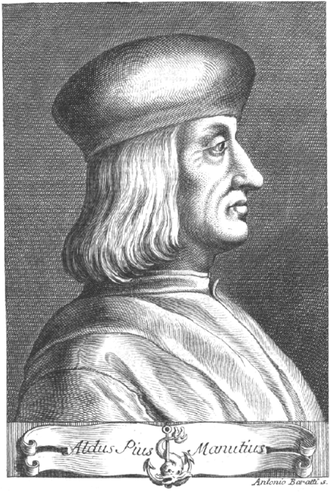
Achievements: The Aldine Press, the first great printing house.
Born: 1449; Bassiano, Italy
Died: February 6, 1515; Venice, Italy (Aged 66)
Field & Discipline: Publishing; Printer; Scholar
Language: Italian; Latin
Father: Unknown
Mother: Unknown
Siblings: Unknown
Spouse: Name Unknown (daughter of Andrea Torresani di Asola, m. 1505)
Children: Paulus Manutius (Paolo Manuzio, 1512-74); two older sons
Education: Rome and Ferrara
Major Work:
Publication of “Virgil” (1501)
Life & Times:
Aldus Manutius studied Latin at Rome and Greek at Ferrara, and in 1482, at the age of 33, he went to stay with Giovanni Francesco Pico, prince of the small territory of Mirandola (and father of [taught family of] della Mirandola*), where he studied Greek for the next two years.
In 1484, Pico appointed him tutor to his nephews at Carpi, where during the late 1480s, Manutius conceived the brilliant and original project of establishing a press at Venice ( a centre for Greek refugees), where he could publish Greek texts on a large scale for European scholars using [used press of] Gutenberg’s* new printing technology.
In 1490 Manutius moved to Venice, where he brought together a group of Greek scholars and copyists, and established the Aldine Press. In 1493, he published his first work, the “Hero and Leander” of Museus, followed in March 1495 by the “Erotemata of Constantine Lascaris” - the first Greek works to be printed.
Over the next three years (1495-98) he produced five volumes of Aristotle, Pietro Bembo's “Idylls of Theocritus” and “De Aetna,” and works by Aristophanes and Politian. His most famous and successful book followed in 1499, the “Hypnerotomachia Poliphili” by Francesco Colonna, which contained outstanding woodcuts by an unknown artist.
During this early period, Manutius experimented with different fonts, commissioning his type-cutter [employed] Griffo* of Bologna to produce at least twelve fonts in three different languages - six rounded or “Roman” Latin types, four Greek cursives, one Hebrew and one italic - from which he chose the most effective.
After 1502, when Griffo left Venice, these individual fonts were replaced by castings from the same matrices, with Manutius settling on one particularly clear Roman type, and a sloping “antiqua” cursive, or italic typeface, developed by Griffo in 1501. This italic type, which became known also as the Aldine, and is believed to have been adapted from the handwriting of Petrarch, was being simultaneously developed in Vicenza as the “cancellaresca corsiva” by the calligrapher and printer [work related to] Arrighi* (priority disputes would later arise).
Both Manutius' Roman and Italic fonts were exceptionally clear and visually pleasing, but the “cancellaresca italica” was particularly suited to his purposes, as it was narrower than the Roman type and therefore could be used to reproduce more text per page. This greatly reduced the cost of the paper, which was generally the most expensive part of the book, and Manutius (whose aim was to publish the best possible books at the lowest possible price) was able to lower the price of his books (which he frequently produced in editions of a thousand), aimed at poor scholars across Europe who could not afford the magnificent editions usually produced.
Griffo's italic type was first used in the Aldine edition of Virgil (published 1501), followed by editions of Juvenal, Martial and Petrarch's “Cose volgari” in the same year, and works by Catullus, Lucan, Thucydides, Sophocles, and Herodotus in 1502. In August of 1502, Manutius then produced his edition of Dante's “La divina commedia,” which first showed the famous colophon of the Aldine anchor and dolphin, with the motto "festina lente" (“hurry slowly”).
In the 1502 edition of Sophocles appeared the first mention of the Aldine Academy of Hellenists (or the New Academy), an organization of scholars founded by Manutius to edit classical texts. This organization was formed in order to promote the study of Greek literature and the publication of Greek authors, and its members were required to speak Greek, with all rules and regulations written in Greek. The organization comprised the most distinguished Greek scholars in Italy, who assisted Manutius in publishing the works of Greek and Latin authors, and under whose direction the first Latin and Greek lexicon was published by the Aldine Press.
In 1505 Manutius married the daughter of Andrea Torresani di Asola, a Venetian printer. The two printing establishments were then combined and from that date the names of Manutius and Asolani appeared on the title-pages of all works from the Aldine Press. In 1507 the great Dutch humanist and scholar [collaborated with ] Erasmus* travelled to Venice to help with the publication of his “Proverbs” (1508) by the Aldine Press.
Within the next few years (to 1514) first editions of Aristophanes Thucydides, Sophocles, Herodotus, Xenophon, Euripides, Aesop, Homer, Virgil, Horace, Demosthenes, Plato, Pindar, and others were produced at Venice. Besides these Greek authors, many Latin and Italian publications were also published.
Extra Connections: [collaborated with] Agricola* worked at the Aldine Press.
Assessment: The first great printer in Europe.
Oneliner: Aldus Manutius, great Renaissance printer
Bibliography:
- Encyclopedia Britannica.
- New Catholic Encyclopedia.