Rockefeller, John D sr
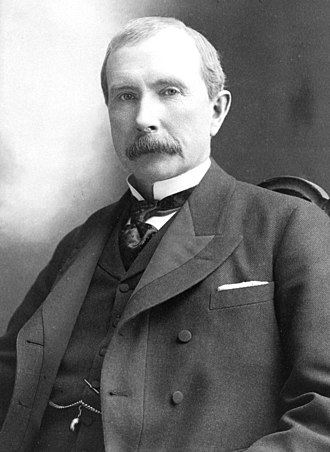
ACHIEVEMENTS: Oil magnate and philanthropist
NICKNAME/ALIAS: None
DATE AND PLACE OF BIRTH: July 8, 1839, Richford, NY
DATE/PLACE OF DEATH/AGE AT DEATH: May 23, 1937, Ormond Beach, FL. Aged 97
DISCIPLINE: Industrialist/Philanthropist
FIELD: Business
LANGUAGE: English
PARENTS: William Avery Rockefeller; Eliza Davison
SIBLINGS: William; Franklin; Lucy; Mary Ann; Frances
SPOUSE: Laura Celestia Spelman
CHILDREN: John; Elizabeth; Edith; Alta
EDUCATION: Owego Academy, Owego, OH; Central High School, Cleveland, OH; Folsom's Commercial College, Cleveland, OH
MAJOR WORK: None
LIFE AND TIMES:
After completing a business course in Cleveland, Rockefeller took a job as a clerk and bookkeeper. In 1859, with a loan from his father, he and a friend, Maurice B. Clark, set up their own successful commission house.
But Rockefeller had his eye on oil, joining the ever-increasing numbers of speculators who had been trying to exploit the new resource since Edwin Drake* had drilled the first oil well in 1859. In 1863, Rockefeller and Clark made an oil-refining deal with Samuel Andrews, an expert in refining crude oil into lamp oil, and two years later, they had the biggest oil refinery in Cleveland.
By 1865, Rockefeller decided it was time to expand and came to Clark with a plan that involved borrowing large sums of money. Clark balked at the idea of being hugely in debt, so Rockefeller bought him out. By 1867, Rockefeller had found a major backer, Henry M. Flagler, who became a close friend and active business partner. In 1870, Rockefeller's company was re-organized as the Standard Oil Company, a joint stock corporation. Rockefeller was company President.
In the early 1870s, the oil industry in the U.S. became chaotic. There was too much production, too many refiners, and prices were falling. As a counter-measure, Rockefeller and Flagler started buying up rival oil companies in Cleveland, and eventually doubled their capital assets.
By 1873, Standard Oil controlled refining in Cleveland and was challenging the New York refiners. Flagler got lower railroad rates for Standard's oil because he could guarantee a consistent volume, considering the greater capacity of Standard Oil refineries.
In 1874, Rockefeller and Flagler went into the pipeline business and three years later consolidated their holdings into United Pipe Lines, one of the three biggest systems in the U.S. At the same time, they were secretly acquiring major refineries in Philadelphia, Pittsburgh, New York, and Parkersburg, WV.
The refineries operated under their old names and were run by their old owners, now Standard Oil stockholders.
By 1879, Standard Oil controlled 90% of U.S. oil-refining capacity. It also controlled the transportation of refined oil, and the piping and storage of crude oil in all Pennsylvania oil regions.
In 1879, an investigation into railroad practices revealed the preferential rates given to Standard Oil. Two years later, after the publication of Henry Demarest Lloyd's article, "The Story of a Great Monopoly", in the "Atlantic Monthly," Rockefeller's business ethics were called into question.
In 1882, the Standard Oil Trust agreement was established, the first modern trust in American business history. According to the arrangement, a board of trustees held the stock of the Ohio company and also of subsidiaries in other states. The trustees issued former stockholders with certificates which entitled them to a proportionate share of the stock dividends.
Inevitably, the Trust agreement was challenged in the court, but Rockefeller, though he answered allegations in court, never defended himself publicly.
Rockefeller's philanthropy, though little was known of it at the time, was prolific. From the beginning of his business career in 1855, he gave to churches, temperance projects, schools, hospitals, old age homes and other causes. Through the Baptist church, he made large donations to provide higher education for African-Americans, and in 1891, endowed the University of Chicago.
Retiring from the daily management of Standard Oil in 1897, he became interested in improving U.S. medicine after reading William Osler's "Principles and Practice of Medicine".
In 1901, he endowed the Rockefeller Institute for Medical Research, and followed that with three major grant-distributing charities, one of which promoted education throughout the U.S. "without distinction of race, sex, or creed".
The Rockefeller Institute was the first in the United States for biomedical research, and by 1906 had built its own New York laboratory.
In 1909, Rockefeller established the Rockefeller Sanitary Commission for the Eradication of Hookworm Disease and funded a five-year public health campaign in the South. In 1913 the Commission was given a mandate to work worldwide, leading to the establishment of the Peking Union Medical College, which developed western medicine in China.
Rockefeller's wife supported him in all his philanthropic work, and when she died in 1915, he created a grant-making body, the Laura Spelman Rockefeller Memorial, in her memory.
Rockefeller remained president of Standard Oil until 1911 when the Standard Oil Trust was dissolved in accordance with new anti-trust legislation.
Rockefeller's daughter (Edith McCormick), the most artistic of his children, provided a grant to the Irish author, Joyce*, to aid him in writing his novel, "Ulysses".
ASSESSMENT: A controversial figure throughout his life and accused of questionable business practices, but his philanthropic generosity resulted, among other things, in an important medical research center and a major charitable foundation, still actively supported by the Rockefeller family.
EXTRA CONNECTIONS: Sinclair* picketed his offices
He was influenced by the Social Darwinism of Herbert Spencer*
ONELINER: JD Rockefeller, oil baron
BIBLIOGRAPHY:
ANB
Nevins, Allan, Study in Power, John D. Rockefeller, Industrialist and Philanthropist, Charles Scribner's Sons, New York, 1953
Nevins, Allan, John D. Rockefeller, The Heroic Age of American Enterprise, Charles Scribner's Sons, New York, 1940.