Sinclair, Upton
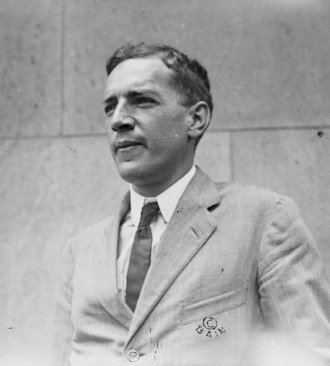
Sinclair, Upton(Beall)
ACHIEVEMENT(S): Successful novelist and Socialist.
DATE/PLACE OF BIRTH: 20th September 1878, in Baltimore, MD.
DATE/PLACE/AGE AT DEATH: 25th November 1968, in Bound Brook, NJ. Aged 90.
DISCIPLINE: Novelist.FIELD: Literature
LANGUAGE: English.
PARENTS: Upton Beall Sinclair, Sr. and Priscilla Harden.
SIBLINGS: None.
SPOUSE: Meta H. Fuller, married 1900-12; Mary Craig Kimbrough, married 1913, died 1961; Mary 'May' Elizabeth Willis, married 1962, died 1965.
CHILDREN: One child by Meta H. Fuller, born 1901.
EDUCATION: New York public school, 1889-92; City College of New York, 1892-97; Columbia University, 1897-1900.
MAJOR WORK: 'The Jungle', 1906.
LIFE AND TIMES:
At Columbia, Sinclair supported himself by writing nearly a hundred "half-dime" novels for Street and Smith, America's leading publisher of pulp-fiction.In May 1900, he left Columbia without a degree, rented a cabin for three months in southern Quebec and wrote his first serious novel, 'Springtime and Harvest'. In October of that year, he married Meta H. Fuller in New York, who bore him his only child, a son, in 1901.Sinclair was unable to find a publisher for 'Springtime and Harvest', so he borrowed money from an uncle and published it himself in 1901. The novel was a financial failure, even when republished commercially as 'King Midas' later the same year.
In 1902, he joined the Socialist party and in 1903, moved to the countryside near Princeton, New Jersey. His second novel, 'The Journal of Arthur Stirling' published in 1903, claimed to be the diary of a real-life poet who committed suicide in New York, but very soon, it was exposed as a work of fiction.
He published his third novel, 'Prince Hagen', in 1903, which was followed by 'Manassas: A Novel of the War', in 1904. Set during the Civil War, the latter's hero meets many important American political figures from the period and becomes convinced of the justice of the abolition of slavery and of socialism. Like his first two novels, ‘Manassas’ sold poorly.
In 1904, he published several articles in the socialist weekly newspaper 'Appeal to Reason.’ The editor suggested he might follow his account of 19th-century slaves in 'Manassas' with a novel about 20th-century "wage slaves".
In order to research the subject, he went to Chicago to observe the organisation of the beef trade. Appalled by what he saw, he returned to New Jersey and began a novel, based on his time in Chicago, entitled 'The Jungle', which the 'Appeal' serialised from February 1905.
That summer, Sinclair, his friend and novelist, Jack London and several other Socialists in New York City founded the Intercollegiate Socialist Society, later called the League for Industrial Democracy.
He completed 'The Jungle' and Doubleday published it the following year. The book was internationally influential and made Sinclair famous.
President Theodore Roosevelt* invited Sinclair to lunch in the White House and, in June, signed the Pure Food and Drug Act and the Meat Inspection Act, for which Sinclair's book was primarily responsible.
A long series of novels followed, although none as popular as 'The Jungle'. Among them were 'A Captain of Industry', finished in 1903 but published in 1906, 'The Industrialist Republic' of 1907, which predicted that America would turn to Socialism in 1913 and 'The Overman', 1907, inspired by Nietzsche*'s 'Thus Spake Zarathustra'.
Two more novels were published in 1908, 'Metropolis', a satire on New York's high society, and 'The Moneychangers', portraying financial double-dealing, based on the American financier and art collector J P Morgan*.
From 1908 to 1914, Sinclair travelled around America, visited Europe and met fellow Socialists, including Shaw*. In 1910, he published 'Samuel the Seeker', ridiculing capitalism and the church and praising Socialism and in 1911, 'Love's Pilgrimage', in which he fictionalised his childhood and marriage.
The following year, Sinclair divorced his wife for infidelity and, in 1913, he married Mary Craig Kimbrough. Soon after this he published the novel 'Damaged Goods', in 1913, on the dangers of sexually-transmitted diseases and two other novels, 'Sylvia' (1913) and 'Sylvia's Marriage' (1914), based on his new wife's earlier life.
During the years of World War I, he supported various Socialist causes and, in 1914, he was arrested for picketing the New York offices of John D. Rockefeller, Jr.*, in support of the coal miners' strike in Ludlow, Colorado (see Ludlow Massacre and JD Rockefeller). Three years later he published 'King Coal', a pro-union novel based on the coal war, but, like some previous novels, it didn’t sell well.
Between 1918 and 1928 he published a further seventeen books. Six were anti-capitalist, non-fiction works in what he called his "Dead Hand" series. Of these, only 'The Brass Check' (1919), exposing pro-capitalist editorial censorship in the press,was a best-seller.
Five of these works were novels, the most successful being 'Oil!', in 1927. The book sold better after it was banned for mentioning birth control. Another of these novels was 'Boston', a 2-volume work published in 1928, based on the executions, the previous year, of Nicola Sacco and Bartolomeo Vanzetti, Italian immigrant anarchists convicted of a 1920 payroll robbery and murder.
During the 1930s Sinclair turned to politics and, during the economic crisis of the period, he organised the EPIC (End Poverty in California) Socialist reform movement. Despite winning 44% of the vote, he was defeated as Democratic candidate for governor in 1934.
In late 1930, while living in California, he raised money to fund a film on Mexico by the great Soviet film director, Eisenstein*, then visiting America. The result of this project was Eisenstein's 'Que Viva Mexico'.
At the end of the 1930s, he began producing his 'Lanny Budd' series. This series of contemporary historical novels began with 'World's End' (1940) and ended, eleven novels and a decade later, with 'The Return of Lanny Budd' (1953). The third novel in the series, 'Dragon's Teeth' (1942) was winner of the 1943 Pulitzer Prize.
The books cover the period from 1913, to the beginning of the Cold War in 1949 and beyond, through the eyes and experiences of Lanny Budd, the illegitimate son of a rich American munitions manufacturer and an internationally famous beauty.
In the last fifteen years of Sinclair's life, his writing gradually diminished and he died in a nursing home near Bound Brook, New Jersey, on 25th November 1968, at the age of 90.
ASSESSMENT: A radical Socialist and prolific writer.
EXTRA CONNECTIONS: Helped Gillette* write his “People’s Corporation.”
The Flivver King describes the rise of Henry Ford, his "wage reform" and his company's Sociological Department, to his decline into antisemitism as publisher of The Dearborn Independent. King Coal confronts John D. Rockefeller Jr., and his role in the 1914 Ludlow Massacre in the coal fields of Colorado.
Sinclair was an outspoken socialist and ran unsuccessfully for Congress as a nominee from the Socialist Party. He was also the Democratic Party candidate for governor of California during the Great Depression, running under the banner of the End Poverty in California campaign, but was defeated in the 1934 election. FDR ditanced himself, Louis B Mayer at MGM made some of the original fake news by making newsreels with hoboes with bad Russian accents.
ONELINER: Upton Sinclair, major American novelist
BIBLIOGRAPHY:
ANB
Yoder, Jon A., Upton Sinclair, New York: 1972.
Multimedia:
Upton Sinclair [https://webbrain.com/brainpage/brain/E212D5AA-EEF5-535C-9D0D-27920B094E45#-22 Socialist governor of California] during the Great Depression? [http://www.booktv.org/Program/15635/Upton+Sinclair+California+Socialist+Celebrity+Intellectual.aspx "Upton Sinclair: California Socialist, Celebrity Intellectual"] audio interview with author Lauren Coodley (see also "Land of Orange Groves and Jails: Upton Sinclair's California").
''Radical Innocent: Upton Sinclair'' by Anthony Arthur. Anthony Arthur discusses his new biography of Upton Sinclair, titled "Radical Innocent." Mr. Arthur suggests that Sinclair was a writer whose work blurred the line of politics and art. Mr. Arthur examines Sinclair's "The Jungle," a novel which was published 100 years ago about the bad conditions at meat-packing plants. Arthur discusses Sinclair's campaign for the California governorship in the early 1930s and his late career start as a historical novelist. Mr. Arthur describes how Upton's historical fictional hero Lanny Budd was admired by Hitler, Goering, F. D. R. and Truman. This event was hosted by the Chautauqua Institution in New York.