NAACP
The National Association for the Advancement of Colored People (NAACP)[a] is a civil rights organization in the United States, formed in 1909 as an interracial endeavor to advance justice for African Americans by a group including W. E. B. Du Bois, Mary White Ovington, Moorfield Storey and Ida B. Wells.[3][4] Over the years, leaders of the organization have included Thurgood Marshall and Roy Wilkins.
Its mission in the 21st century is "to ensure the political, educational, social, and economic equality of rights of all persons and to eliminate race-based discrimination". National NAACP initiatives include political lobbying, publicity efforts and litigation strategies developed by its legal team.[5] The group enlarged its mission in the late 20th century by considering issues such as police misconduct, the status of black foreign refugees and questions of economic development.[6] Its name, retained in accordance with tradition, uses the once common term colored people, referring to those with some African ancestry.[7]
The NAACP bestows annual awards on African Americans in three categories: Image Awards are for achievement in the arts and media, Theatre Awards are for achievements in theatre and stage, and Spingarn Medals are for outstanding achievement of any kind. Its headquarters is in Baltimore, Maryland.[8] On June 29, 2020 Washington, D.C., radio station WTOP reported that the NAACP intends to relocate its national headquarters [to DC]...
Predecessor: The Niagara Movement
Main article: Niagara Movement
The Pan-American Exposition of 1901 in Buffalo, New York, featured many American innovations and achievements, but also included a disparaging caricature of slave life in the South as well as a depiction of life in Africa, called "Old Plantation" and "Darkest Africa", respectively.[22] A local African-American woman, Mary Talbert of Ohio, was appalled by the exhibit, as a similar one in Paris highlighted black achievements. She informed W. E. B. Du Bois of the situation, and a coalition began to form.[22]
In 1905, a group of thirty-two prominent African-American leaders met to discuss the challenges facing African Americans and possible strategies and solutions. They were particularly concerned by the Southern states' disenfranchisement of blacks starting with Mississippi's passage of a new constitution in 1890. Through 1908, Southern legislatures, dominated by white Southern Democrats, ratified new constitutions and laws creating barriers to voter registration and more complex election rules.
In practice, this and the Lily-white movement caused the exclusion of most blacks and many poor whites from the political system in southern states. Black voter registration and turnout dropped markedly in the South as a result of such legislation. Men who had been voting for thirty years in the South were told they did not "qualify" to register.[citation needed] White-dominated legislatures also passed segregation and Jim Crow laws.[23]
Because hotels in the US were segregated, the men convened in Canada at the Erie Beach Hotel[24] on the Canadian side of the Niagara River in Fort Erie, Ontario. As a result, the group came to be known as the Niagara Movement. A year later, three non-African-Americans joined the group: journalist William English Walling, a wealthy socialist; and social workers Mary White Ovington and Henry Moskowitz. Moskowitz, who was Jewish, was then also Associate Leader of the New York Society for Ethical Culture. They met in 1906 at Storer College, Harpers Ferry, West Virginia, and in 1907 in Boston, Massachusetts.[25]
The fledgling group struggled for a time with limited resources and internal conflict and disbanded in 1910.[26] Seven of the members of the Niagara Movement joined the Board of Directors of the NAACP, founded in 1909.[25] Although both organizations shared membership and overlapped for a time, the Niagara Movement was a separate organization. Historically, it is considered to have had a more radical platform than the NAACP. The Niagara Movement was formed exclusively by African Americans. Four European Americans were among the founders of the NAACP, they included Mary White Ovington, Henry Moskowitz, William English Walling and Oswald Garrison Villard.[7]
History
Formation

Founders of the NAACP: Moorfield Storey, Mary White Ovington and W. E. B. Du Bois
The Race Riot of 1908 in Springfield, Illinois, the state capital and Abraham Lincoln's hometown, was a catalyst showing the urgent need for an effective civil rights organization in the U.S. In the decades around the turn of the century, the rate of lynchings of blacks, particularly men, was at an all-time high. Mary White Ovington, journalist William English Walling and Henry Moskowitz met in New York City in January 1909 to work on organizing for black civil rights.[27] They sent out solicitations for support to more than 60 prominent Americans, and set a meeting date for February 12, 1909. This was intended to coincide with the 100th anniversary of the birth of President Abraham Lincoln, who emancipated enslaved African Americans. While the first large meeting did not occur until three months later, the February date is often cited as the organization's founding date.
The NAACP was founded on February 12, 1909, by a larger group including African Americans W. E. B. Du Bois, Ida B. Wells, Archibald Grimké, Mary Church Terrell, and the previously named whites Henry Moskowitz, Mary White Ovington, William English Walling (the wealthy Socialist son of a former slave-holding family),[27][28] Florence Kelley, a social reformer and friend of Du Bois;[29] Oswald Garrison Villard, and Charles Edward Russell, a renowned muckraker and close friend of Walling. Russell helped plan the NAACP and had served as acting chairman of the National Negro Committee (1909), a forerunner to the NAACP.[30]
On May 30, 1909, the Niagara Movement conference took place at New York City's Henry Street Settlement House; they created an organization of more than 40, identifying as the National Negro Committee.[31] Among other founding members were Lillian Wald, a nurse who had founded the Henry Street Settlement where the conference took place.
Du Bois played a key role in organizing the event and presided over the proceedings. Also in attendance was Ida B. Wells-Barnett, an African-American journalist and anti-lynching crusader. Wells-Barnett addressed the conference on the history of lynching in the United States and called for action to publicize and prosecute such crimes.[32] The members chose the new organization's name to be the National Association for the Advancement of Colored People and elected its first officers:[33]
- National President, Moorfield Storey, Boston
- Chairman of the Executive Committee, William English Walling
- Treasurer, John E. Milholland a prominent New York Republican
- Disbursing Treasurer, Oswald Garrison Villard
- Executive Secretary, Frances Blascoer
- Director of Publicity and Research, W. E. B. Du Bois.
The NAACP was incorporated a year later in 1911. The association's charter expressed its mission:
To promote equality of rights and eradicate caste or race prejudice among citizens of the United States; to advance the interest of colored citizens; to secure for them impartial suffrage; and to increase their opportunities for securing justice in the courts, education for their children, employment according to their ability, and complete equality before the law.[34]
The larger conference resulted in a more diverse organization, where the leadership was predominantly white. Moorfield Storey, a white attorney from a Boston abolitionist family, served as the president of the NAACP from its founding to 1915. At its founding, the NAACP had one African American on its executive board, Du Bois. Storey was a long-time classical liberal and Grover Cleveland Democrat who advocated laissez-faire free markets, the gold standard, and anti-imperialism. Storey consistently and aggressively championed civil rights, not only for blacks but also for Native Americans and immigrants (he opposed immigration restrictions). Du Bois continued to play a pivotal leadership role in the organization, serving as editor of the association's magazine, The Crisis, which had a circulation of more than 30,000.[35]
The Crisis was used both for news reporting and for publishing African-American poetry and literature. During the organization's campaigns against lynching, Du Bois encouraged the writing and performance of plays and other expressive literature about this issue.[36]
The Jewish community contributed greatly to the NAACP's founding and continued financing.[37] Jewish historian Howard Sachar writes in his book A History of Jews in America that "In 1914, Professor Emeritus Joel Spingarn of Columbia University became chairman of the NAACP and recruited for its board such Jewish leaders as Jacob Schiff, Jacob Billikopf, and Rabbi Stephen Wise."[37]
Jim Crow and disenfranchisement
)An African American drinks out of a segregated water cooler designated for "colored" patrons in 1939 at a streetcar terminal in Oklahoma City
. Sign for the "colored" waiting room at a bus station in Durham, North Carolina, 1940
In its early years, the NAACP was based in New York City. It concentrated on litigation in efforts to overturn disenfranchisement of blacks, which had been established in every southern state by 1908, excluding most from the political system, and the Jim Crow statutes that legalized racial segregation.
In 1913, the NAACP organized opposition to President Woodrow Wilson's introduction of racial segregation into federal government policy, workplaces, and hiring. African-American women's clubs were among the organizations that protested Wilson's changes, but the administration did not alter its assuagement of Southern cabinet members and the Southern bloc in Congress.
By 1914, the group had 6,000 members and 50 branches. It was influential in winning the right of African Americans to serve as military officers in World War I. Six hundred African-American officers were commissioned and 700,000 men registered for the draft. The following year, the NAACP organized a nationwide protest, with marches in numerous cities, against D. W. Griffith's silent movie The Birth of a Nation, a film that glamorized the Ku Klux Klan. As a result, several cities refused to allow the film to open.[38]
The NAACP began to lead lawsuits targeting disfranchisement and racial segregation early in its history. It played a significant part in the challenge of Guinn v. United States (1915) to Oklahoma's discriminatory grandfather clause, which effectively disenfranchised most black citizens while exempting many whites from certain voter registration requirements. It persuaded the Supreme Court of the United States to rule in Buchanan v. Warley in 1917 that state and local governments cannot officially segregate African Americans into separate residential districts. The Court's opinion reflected the jurisprudence of property rights and freedom of contract as embodied in the earlier precedent it established in Lochner v. New York. It also played a role in desegregating recreational activities via the historic Bob-Lo Excursion Co. v. Michigan after plaintiff Sarah Elizabeth Ray was wrongfully discriminated against when attempting to board a ferry.
In 1916, chairman Joel Spingarn invited James Weldon Johnson to serve as field secretary. Johnson was a former U.S. consul to Venezuela and a noted African-American scholar and columnist. Within four years, Johnson was instrumental in increasing the NAACP's membership from 9,000 to almost 90,000. In 1920, Johnson was elected head of the organization. Over the next ten years, the NAACP escalated its lobbying and litigation efforts, becoming internationally known for its advocacy of equal rights and equal protection for the "American Negro".[39]
The NAACP devoted much of its energy during the interwar years to fight the lynching of blacks throughout the United States by working for legislation, lobbying, and educating the public. The organization sent its field secretary Walter F. White to Phillips County, Arkansas, in October 1919, to investigate the Elaine Race Riot. Roving white vigilantes killed more than 200 black tenant farmers and federal troops after a deputy sheriff's attack on a union meeting of sharecroppers left one white man dead. White published his report on the riot in the Chicago Daily News.[40]
The NAACP organized the appeals for twelve black men sentenced to death a month later based on the fact that testimony used in their convictions was obtained by beatings and electric shocks. It gained a groundbreaking Supreme Court decision in Moore v. Dempsey 261 U.S. 86 (1923) that significantly expanded the Federal courts' oversight of the states' criminal justice systems in the years to come. White investigated eight race riots and 41 lynchings for the NAACP and directed its study Thirty Years of Lynching in the United States.[41]
 NAACP leaders Henry L. Moon, Roy Wilkins, Herbert Hill, and Thurgood Marshall in 1956
The NAACP also worked for more than a decade seeking federal anti-lynching legislation, but the Solid South of white Democrats voted as a bloc against it or used the filibuster in the Senate to block passage. Because of disenfranchisement, African Americans in the South were unable to elect representatives of their choice to office. The NAACP regularly displayed a black flag stating "A Man Was Lynched Yesterday" from the window of its offices in New York to mark each lynching.[42]
It organized the first of the two 1935 New York anti-lynching exhibitions in support of the Costigan-Wagner Bill, having previously widely published an account of the Lynching of Henry Lowry, as An American Lynching, in support of the Dyer Anti-Lynching Bill.
In alliance with the American Federation of Labor, the NAACP led the successful fight to prevent the nomination of John Johnston Parker to the Supreme Court, based on his support for denying the vote to blacks and his anti-labor rulings. It organized legal support for the Scottsboro Boys. The NAACP lost most of the internecine battles with the Communist Party and International Labor Defense over the control of those cases and the legal strategy to be pursued in that case.
The organization also brought litigation to challenge the "white primary" system in the South. Southern state Democratic parties had created white-only primaries as another way of barring blacks from the political process. Since the Democrats dominated southern states, the primaries were the only competitive contests. In 1944 in Smith v. Allwright, the Supreme Court ruled against the white primary. Although states had to retract legislation related to the white primaries, the legislatures soon came up with new methods to severely limit the franchise for blacks.
During the Second Red Scare the NAACP was often linked to Communism by right-wing politicians. The House Un-American Activities Committee, the United States Senate Subcommittee on Internal Security, and security agencies sought to prove to the NAACP had been infiltrated by Communists. To distance themselves from these accusations, the NAACP purged suspected Communists from its membership, according to the Student Nonviolent Coordinating Committee's website.[43][44]
Legal Defense Fund
The board of directors of the NAACP created the Legal Defense Fund in 1939 specifically for tax purposes. It functioned as the NAACP legal department. Intimidated by the Department of the Treasury and the Internal Revenue Service, the Legal and Educational Defense Fund, Inc., became a separate legal entity in 1957, although it was clear that it was to operate in accordance with NAACP policy. After 1961 serious disputes emerged between the two organizations, creating considerable confusion in the eyes and minds of the public.[45]
Desegregation
NAACP representatives E. Franklin Jackson and Stephen Gill Spottswood meeting with President Kennedy at the White House in 1961
By the 1940s, the federal courts were amenable to lawsuits regarding constitutional rights, against which Congressional action was virtually impossible. With the rise of private corporate litigators such as the NAACP to bear the expense, civil suits became the pattern in modern civil rights litigation,[46] and the public face of the Civil Rights Movement. The NAACP's Legal department, headed by Charles Hamilton Houston and Thurgood Marshall, undertook a campaign spanning several decades to bring about the reversal of the "separate but equal" doctrine announced by the Supreme Court's decision in Plessy v. Ferguson.
The NAACP's Baltimore chapter, under president Lillie Mae Carroll Jackson, challenged segregation in Maryland state professional schools by supporting the 1935 Murray v. Pearson case argued by Marshall. Houston's victory in Missouri ex rel. Gaines v. Canada (1938) led to the formation of the Legal Defense Fund in 1939.
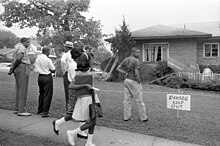 Locals viewing the bomb-damaged home of Arthur Shores, NAACP attorney, Birmingham, Alabama, on September 5, 1963. The bomb exploded on September 4, the previous day, injuring Shores' wife.
The campaign for desegregation culminated in a unanimous 1954 Supreme Court decision in Brown v. Board of Education that held state-sponsored segregation of public elementary schools was unconstitutional. Bolstered by that victory, the NAACP pushed for full desegregation throughout the South.[47]
NAACP activists were excited about the judicial strategy. Starting on December 5, 1955, NAACP activists, including Edgar Nixon, its local president, and Rosa Parks, who had served as the chapter's Secretary, helped organize a bus boycott in Montgomery, Alabama. This was designed to protest segregation on the city's buses, two-thirds of whose riders were black. The boycott lasted 381 days.[48] In 1956 the South Carolina legislature created an anti-NAACP oath, and teachers who refused to take the oath lost their positions.
After twenty-one Black teachers at the Elloree Training School refused to comply, White school officials dismissed them. Their dismissal led to Bryan v. Austin in 1957, which became an important civil rights case.[49] In Alabama, the state responded by effectively barring the NAACP from operating within its borders because of its refusal to divulge a list of its members. The NAACP feared members could be fired or face violent retaliation for their activities. Although the Supreme Court eventually overturned the state's action in NAACP v. Alabama, 357 U.S. 449 (1958), the NAACP lost its leadership role in the Civil Rights Movement while it was barred from Alabama.
New organizations such as the Southern Christian Leadership Conference (SCLC, in 1957) and the Student Nonviolent Coordinating Committee (SNCC, in 1960) rose up with different approaches to activism. Rather than relying on litigation and legislation, these newer groups employed direct action and mass mobilization to advance the rights of African Americans. Roy Wilkins, NAACP's executive director, clashed repeatedly with Martin Luther King Jr. and other civil rights leaders over questions of strategy and leadership within the movement.
The NAACP continued to use the Supreme Court's decision in Brown to press for desegregation of schools and public facilities throughout the country. Daisy Bates, president of its Arkansas state chapter, spearheaded the campaign by the Little Rock Nine to integrate the public schools in Little Rock, Arkansas.[50]
By the mid-1960s, the NAACP had regained some of its prominence in the Civil Rights Movement by pressing for civil rights legislation. The March on Washington for Jobs and Freedom took place on August 28, 1963. That fall, President John F. Kennedy sent a civil rights bill to Congress before he was assassinated.
President Lyndon B. Johnson worked hard to persuade Congress to pass a civil rights bill aimed at ending racial discrimination in employment, education and public accommodations, and succeeded in gaining passage in July 1964. He followed that with passage of the Voting Rights Act of 1965, which provided for protection of the franchise, with a role for federal oversight and administrators in places where voter turnout was historically low.
Under its anti-desegregation director J. Edgar Hoover, the FBI's COINTELPRO program targeted civil rights groups, including the NAACP, for infiltration, disruption and discreditation.[51]
Kivie Kaplan became NAACP President in 1966. After his death in 1975, scientist W. Montague Cobb took over until 1982. Roy Wilkins retired as executive director in 1977, and Benjamin Hooks, a lawyer and clergyman, was elected his successor.
The 1990s
...