Wernher von Braun
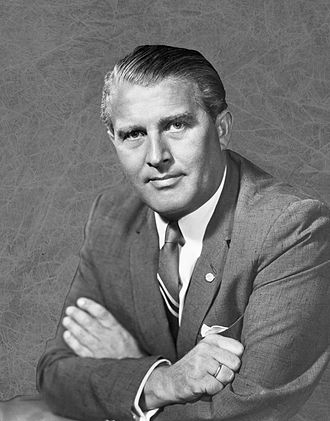
NAME: von Braun, Wernher Magnus Maximilian
ACHIEVEMENT(S): WW II German rocket expert and then leader of NASA Apollo Missions
NICKNAME/ALIAS: None
DATE AND PLACE OF BIRTH: March 23, 1912, Wirsitz, East Prussia [now
Wyrzysk, Poland]
DATE/PLACE/AGE AT DEATH: June 16, 1977, at Alexandria, VA. Aged 65
DISCIPLINE: Rocket engineer
FIELD: Astronautics
EDUCATION: Ettersburg School, near Weimar, Germany; Hermann Lietz School,
Spiekeroog Island, North Sea; Berlin-Charlottenburg Institute of
Technology; Berlin University
MAJOR WORK: Saturn family of rockets, which launched the astronauts on their voyage to the moon in the U.S. Apollo program
LIFE AND TIMES:
As a boy Von Braun was so accomplished at the piano, he was accepted as a pupil by composer <taught by> Hindemith*.
At age 15, he read "Die Rakete zu den Planetenraumen (The Rocket into Interplanetary Space)" by German space pioneer <a pal of> Oberth*, and wrote Oberth, declaring his dedication to the future of rocketry. The two became friends.
After graduation from university Braun caught the attention of the German military. At the time, Captain Walter R. Dornberger (later Major General) was in charge of solid-fuel rocket research in the Ordnance Department and recognized the military potential of liquid-fueled rockets. Dornberger arranged a grant for von Braun, who did research at a small development station adjacent to Dornberger's solid-fuel rocket test facility at Kummersdorf, near Berlin.
Two years later, Braun received a Ph.D. in physics from the University of Berlin. His thesis, for reasons of security, was given the name, "About Combustion Tests", but outlined von Braun's experiments on 300- and 660-pound-thrust rocket engines. By the end of 1934, von Braun and his colleagues had successfully launched two rockets that rose vertically to more than 1.5 miles.
By 1936, engineers at Kummersdorf had completed designs for the V-1 (a flying bomb powered by a pulse-jet engine) and the preliminary design for the V-2. The <developed> V-2 missile* was an exceptionally ambitious undertaking; the long-range ballistic missile was to deliver a one-ton warhead some 160 miles distant, and employ a rocket motor that could deliver a 25-ton thrust for 60 seconds. Von Braun's staff eventually grew to some 80 people, and in early 1937, the group moved to Peenemunde, a large military development on the Baltic coast.
By now, von Braun had joined the Nazi Party. He joined the SS in 1940. Work on the V-2 was fraught with difficulties. Von Braun's team had particular trouble developing a guidance and control system. The first successful launch of the V-2 did not occur until October 3,1942, but it was just one success among many failures. Then in August, 1943, an Allied attack caused huge damage to the facility. As a result, the first fully operational V-2s were not fired until September, 1944. Before the end of the War in May, 1945, several thousand struck London, Antwerp and other allied targets, but the weapon came too late to affect the outcome of the War.
During the last days of the war, von Braun moved hundreds of people from the Baltic facility to the Bavarian Alps, so that he, his younger brother Magnus, Dornberger, and the entire German rocket team could surrender to the United States rather than to the Soviet Union. Von Braun had long recognized the value of the work of U.S. rocket pioneer <influenced by> Goddard*, and considered that the best future for his rocket team lay with the Americans, who had little experience with rocketry.
In September, 1945, von Braun and about 120 of his staff were sent to Fort Bliss near El Paso, Texas, as part of a military operation called Project Paperclip. They worked at the nearby U.S. Army Ordnance Corps White Sands Proving Ground in New Mexico, where they supervised the launching of captured V-2s, with a view to investigating the behavior of rockets at high-altitudes.
In 1950, the team transferred to Redstone Arsenal near Huntsville, Alabama, where, for the next six years, it developed the Redstone medium-range ballistic missile, basically an offshoot of the V-2. In 1955, von Braun became a U.S. citizen. In 1956, he was named director of the development operations division of the newly-established Army Ballistic Missile Agency (ABMA) in Huntsville.
The launching of Sputnik 1 by the Soviet Union on October 4, 1957, and, then, Sputnik 2 on November 3, embarrassed the U.S. government. Three years earlier, an American attempt to put a satellite in space (Project Orbiter) failed. After experimenting with a number of types of rockets and missiles, von Braun's team came up with the three-stage Jupiter C, and then a four-stage version, Juno 1, which launched America's first satellite,
Explorer I, on January 31, 1958. Juno II launched a number of satellites in the Pioneer and Explorer series, including Pioneer IV that went past the moon and entered the solar system after its launch on March 3, 1959.
The Redstone ballistic missile served as the launch vehicle that placed Alan B. Shephard and Virgil I. "Gus" Grissom in suborbital flight in May and July 1961, respectively. In response to the two Sputniks, President Dwight D. Eisenhower formed the National Aeronautics and Space Administration (NASA) in 1958.
In July, 1960, von Braun and over 4,000 ABMA personnel transferred to the <engineer for> NASA* Apollo Missions, forming the George C. Marshall Space Flight Center, which von Braun directed until February, 1970.
It was at the Flight Center that von Braun and his team made their most famous rockets: the powerful Saturns which propelled Americans into lunar orbit for the lunar missions between July,1969, and January, 1971. The operational success of each of the Saturn class of space boosters remains unparalleled in rocket history.
Beyond his role as an engineer, scientist, and project manager, von Braun was also an important advocate for spaceflight, publishing numerous books, including "Das Marsprojekt (The Mars Project"), (1952,) a technical treatise on a hypothetical expedition of 10 spacecraft with 70 men to Mars; "Across the Space Frontier "(1952); "Conquest of the Moon" (1953), and "Exploration of Mars" (1956) -- three popular books describing concepts for the exploration of space.
Towards the end of his time at the Space Flight Center, von Braun wrote another three books popularizing the exploration of space: "A History of Rocketry and Space Travel", (1969), "Moon "(1970), a tribute to the Apollo 11 lunar landing, including a history of man's study of the Moon; and "Space Frontier" (1971), a discussion of the principles of rocketry and space flight in layman's language.
In March, 1970, NASA transfered von Braun to its headquarters in Washington, D.C., as Deputy Associate Administrator. He hoped to drum up renewed interest in the space program. But NASA's budget had been considerably cut and von Braun was reduced to talking about programs he knew could not be funded.
He resigned in 1972, to become vice president for engineering and development at Fairchild Industries Inc., an aerospace company at Germantown, Maryland. In 1975, he founded the National Space Institute, a private organization whose objective was to gain public support for and understanding of space activities. He died of cancer.
ASSESSMENT: Made the Apollo Missions possible
EXTRA CONNECTIONS: His work related to that of Russian rocket expert <work related to that of> Tsiolkovsky*
ONELINER: Wernher von Braun, Apollo rocket engineer
BIBLIOGRAPHY:
EB
Hunley, J.D. "Wernher von Braun", in Notable Twentieth-Century Scientists, vol. 3, New York: Gale Research Inc., 1995
Spangenburg, Roy and Moser, Diane K., Wernher von Braun: Space Visionary and Rocket Engineer, New York: Facts on File, 1995.
Extra Connections:
"Wernher von Braun" (1965):[179] A song written and performed by Tom Lehrer for an episode of NBC's American version of the BBC TV show That Was The Week That Was; the song was later included in Lehrer's albums That Was The Year That Was and The Remains of Tom Lehrer. It was a satire on what some saw as von Braun's cavalier attitude toward the consequences of his work in Nazi Germany.[180] For example, one line in the song states: "A man whose allegiance/ Is ruled by expedience/ Call him a Nazi, he won't even frown/ 'Nazi, Schmazi!' says Wernher von Braun."[181] There was a widespread rumour that von Braun had sued Lehrer for the song, but this is untrue.[180][182]
Several fictional characters have been modeled on von Braun:
- Dr. Strangelove or: How I Learned to Stop Worrying and Love the Bomb (1964 Stanley Kubrick): Dr Strangelove is usually held to be based at least partly on von Braun.[173]
Several fictional characters have been modeled on von Braun:
- Dr. Strangelove or: How I Learned to Stop Worrying and Love the Bomb (1964): Dr Strangelove is usually held to be based at least partly on von Braun.[173]
- Indiana Jones and the Dial of Destiny (2023): Dr. Jürgen Voller, the film's main antagonist, is inspired partly on von Braun according to his performer Mads Mikkelsen.[174]
LANGUAGE: German, English (“and I’m learning Chinese,” according to Tom Lehrer)
PARENTS: Baron Magnus Alexander Maximilian von Braun; Emmy von Quistorp
SIBLINGS: Two brothers: Sigismund, Magnus
SPOUSE: Maria Louise von Quistorp (his cousin)
CHILDREN: Iris Careen; Margrit Cecil; Peter Constantine