Longfellow
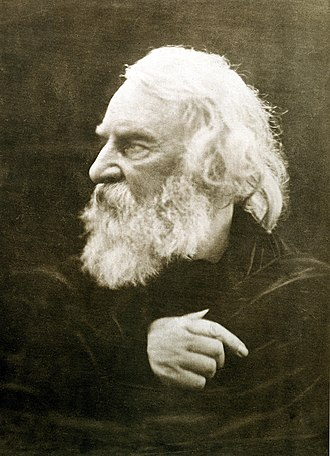
NAME: Longfellow, Henry Wadsworth
ACHIEVEMENT(S): One of the most popular American poets
NICKNAME/ALIAS: None
DATE AND PLACE OF BIRTH: February 27, 1807, Portland, ME
DATE/PLACE OF DEATH/AGE AT DEATH: March 24, 1882, Cambridge,
MA. Aged 75
DISCIPLINE: Poet
FIELD: Literature
EDUCATION: Portland Academy, Maine; Bowdoin College, Brunswick, Maine
MAJOR WORK: “Song of Hiawatha”, “Evangeline”, “The Wreck of the
Hesperus”
LIFE AND TIMES:
Longfellow’s father was a public-spirited lawyer, a trustee of Bowdoin College, and, briefly, a congressman for Maine. His mother, was the inspiration for her son’s religious idealism, and lifelong hatred of violence and war. At Portland Academy, he was a studious pupil, interested in literature, and at 13 published his first poem ,“The Battle at Lovell’s Pond”.
At 15, he began to attend Bowdoin College, where his contemporaries included <a pal of> Nathaniel Hawthorne*, with whom he formed a friendship that lasted through his life. Longfellow’ s studies were taken up mainly by the classics, with a smattering of mathematics, philosophy, and some natural sciences. He also studied French, a subject that was rarely taught at the time.
While in Bowdoin, Longfellow contributed 20 poems to “The American Monthly Magazine” and “The United States Literary Gazette.”
On the strength of a translation of Horace, Longfellow was recommended for a new chair of Modern Languages at Bowdoin. To win the position, however, he was required to travel to Europe at his own expense to gain the proper background and experience.
His father came up with the money, and, Longfellow toured Europe for three years, visiting France, Spain, Italy and Germany. He immersed himself in the romance languages and European literature. In September, 1829, he returned to take up his post as Professor of Modern Languages at Bowdoin.
In 1833, Longfellow published scholarly essays on southern European languages and literature. He wrote little poetry, but concentrated on prose accounts of his travels, which were published as a book, “Outre Mer: a Pilgrimage beyond the Sea” in 1833-34.
At the end of 1834, he was offered the position of Smith Professor of Modern Languages at Harvard. With the position came a year in Europe during which he studied Dutch, Danish, Icelandic, Swedish and some Finnish, and gained a thorough knowledge of German Romantic literature.
Back at Harvard, Longfellow wrote “Hyperion”, a piece of clearly autobiographical prose fiction, in which a widower meets a young woman with whom he falls in love. His poem “The Psalm of Life” appeared in the “Knickerbocker Magazine” in 1838, and was published, along with nine other poems in a book called “Voices of the Night”, in
1839. “The Wreck of the Hesperus” appeared in “The New World” a year later. It appeared again in “Ballads and Other Poems” in 1841.
Longfellow’s third trip to Europe was to undergo a cure for nervous exhaustion. He began work on a poetic play, “The Spanish Student”, taken from “La Gitanella” of Spanish writer Cervantes. He also stayed for a time with English author <stayed with> Dickens*. During this period, he was pressed by friends to put his literary talent to use in the cause of the abolition of slavery. The result was his “Poems on Slavery” in 1843, composed on the voyage home.
He next edited two translations of poems by European writers,“The Poets and Poetry of Europe” and “A Waif: A Collection of Poems.” As for his own poetry, he wrote “The Clock on the Stairs”, which appeared in the collection “The Belfry of Bruges and Other Poems” in 1846. His immensely popular “Evangeline: a Tale of Arcadie” appeared in 1847 and sold more than 37,000 copies over 10 years.
Longfellow’s story of everyday rural life, “Kavanagh”, was published in 1849. A selection of poems appeared the following year. In 1855 Longfellow published his most famous work: "The Song of Hiawatha.” The rhythm he developed, derived from a Finnish ballad, added to the legendary atmosphere of the work. Hiawatha was immediately popular, selling 100,000 copies in two years.
In 1858, “The Courtship of Miles Standish”, his second poem in hexameter appeared. There followed “Seaweed” and “The Bells of Lynn”. Three narrative poems, which appeared in “Tales of a Wayside Inn”, were published in 1863, 1872 and 1874. Over the course of 1865-67, he translated Dante’s “The Divine Comedy”. “The New England Tragedies”, a metric treatment of two grim stories from old colonial chronicles, appeared in 1868.
“The Divine Tragedy” was published first in 1871, then again in 1872, as part of a trilogy called “Christus”. The other two parts were “The New England Tragedies” and “The Golden Legend”.
The poet’ s last trip to Europe lasted 18 months, between 1868-69. British statesman <honoured by> Gladstone* proposed a toast to his health at a banquet, and <met> Queen Victoria* asked to meet him.
A further six volumes of short poems were published during his lifetime: “Flower-de-Luce”, (1867), “Three Books of Song”, (1872), “Aftermath”, (1873), “The Masque of Pandora and Other Poems”, (1875), “Kéramos and Other Poems”, (1878), and” Ultima Thule”, (1880). From 1876-79, Longfellow was editor-in-chief of the 31 volumes of “Poems of Places”, which also contained some of his own works.
His health began to fail in 1881, but he completed “The Bells of San Blas” before he died of peritonitis at age 75 in 1882. A collection of poems called “In The Harbor” was published posthumously in 1882. A fragment of his intended poetic drama “Michelangelo” was published in 1883.
ASSESSMENT: A founder of American poetic literature.
EXTRA CONNECTIONS: Saturday Club member with <club-member with> Holmes* and <club-member with> Harte*.
Contributed to the <supported> Alcott* fund.
Met <met> Wilkie Collins*, <met> Washington Irving,* <met> Monckton Milnes*, <met> Wilde* and <met> Tennyson*
Friend of <a pal of> WD Howells*.
Went for nature walks with <did nature walks with> Bryant*
<a fan was> Poe* was a fan
Taught <taught> Thoreau*
He wrote an inaccurate account of the ride of Paul <wrote poem about>Revere*
For ‘Hiawatha,’ he may have copied the work of Finnish writer <may have copied>Lonnrot*
ONELINER: HW Longfellow, major 19th century American poet
BIBLIOGRAPHY:
Eric S. Robertson. Henry Wadsworth Longfellow. Kennikat Press, Port Washington, N.Y./London. 1972 (first published 1888).
Edward L. Hirsh. Henry Wadsworth Longfellow. University of Minnesota Press. Minneapolis. 1964.
Henry Wadsworth Longfellow - Wikipedia
LANGUAGE: English
PARENTS: Stephen Longfellow, Zilpah Wadsworth
SIBLINGS: 7 siblings
SPOUSE: 1) Mary Potter; 2) Frances Appleton
CHILDREN: Charles; Ernest; Fanny; Alice; Edith; Annie