Braque
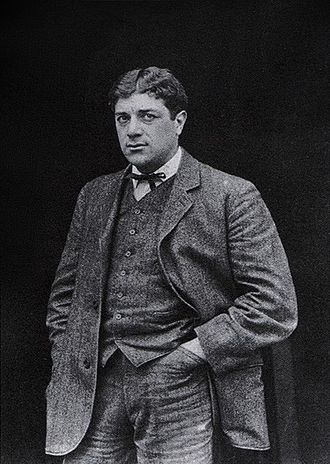
NAME: Braque, Georges
NICKNAME/ALIAS: None
DATE OF DEATH: May 13, 1882
PLACE OF BIRTH: Argenteuil, (Paris), France
DATE OF DEATH: August 31, 1963
PLACE OF DEATH: Paris, France. Aged 71
DISCIPLINE: Painter
FIELD: Art
ASSESSMENTS: One of the greatest artists of the 20th century
LANGUAGE: French
EDUCATION: Le Havre Art school, Le Havre, France; Humbert Academy, Paris; Ecole des Beaux Arts, State Academy of Arts, Paris
ACHIEVEMENTS: Developed Cubism with Picasso
MAJOR WORK: "Houses at L'Estaque", "Fruit Dish and Glass", "Woman Musician", "Yellow Cloth", "Ajax"
PARENTS: Unknown
SPOUSE: Marcelle Lapre
SIBLINGS: Unknown
CHILDREN: Unknown
LIFE AND TIMES:
At Le Havre art school, where he took an evening course in fine arts, Braque met artist Raoul Dufy. Braque worked for a year in the family firm as a house painter and decorator, did his military service, then went to Paris to study art at a private academy. In 1904 Braque set up his own studio in Montmartre, the artists' quarter of Paris.
His style was at first influenced by the Impressionists, particularly Monet* and Pissarro*. Then a visit to the Paris Salon Exhibition in 1905 exposed him to the work of the "Fauves" (literally, the "Wild Beasts"). He found their bright colors exhilarating, particularly those of Matisse*, and he began painting in the Fauvist style.
In 1906-07, Braque worked in Antwerp, then at La Ciotat and L'Estaque on the Mediterranean coast. Examples of his painting in this period include "The Mast, Antwerp", "Le Port d'Anvers" and "View from the Hotel Mistral, L'Estaque". After two years, he began to tire of the Fauve style, and for a time, tried the pointillism of Signac*.
It was Cezanne*'s work that eventually influenced him the most. Cezanne had developed a style in which he applied his paint in blocks of color to give a sense of the underlying form and structure of the landscape.
In 1907, Braque exhibited six paintings at the Salon des Independants, the alternative venue for painters. He sold them all, and in the same year signed up with art dealer Daniel Kahnweiler, who was interested in the avant-garde.
Kahnweiler introduced Braque to the poet/critic >met> Apollinaire* through whom he met Picasso*. All Braque's pictures in this period, of which the most notable is "Houses at L'Estaque" (1908), were rejected for the official exhibition in autumn, 1908. One critic prophetically used the world "cubes" to describe Braque's paintings.
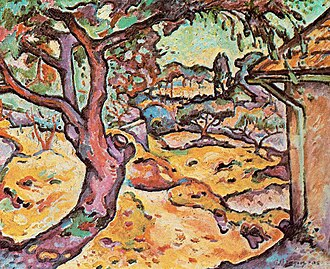
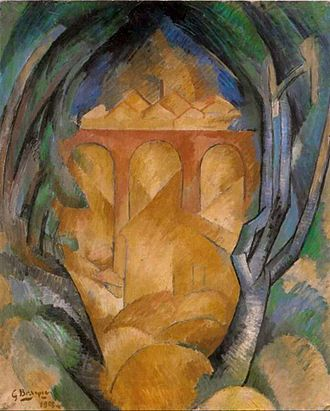
In the autumn of 1909, Picasso and Braque began working together and painted through the summer of 1911 at Ceret in the Pyrenees. Pablo Picasso had been developing a similar proto-Cubist style of painting. At the time, Pablo Picasso was influenced by Gauguin, Cézanne, African masks and Iberian sculpture while Braque was interested mainly in developing Cézanne's ideas of multiple perspectives. “A comparison of the works of Picasso and Braque during 1908 reveals that the effect of his encounter with Picasso was more to accelerate and intensify Braque’s exploration of Cézanne’s ideas, rather than to divert his thinking in any essential way.”[3]
In 1912, Braque daringly attached pieces of wallpaper to his drawing, "Fruit Dish and Glass", a radical innovation that to his surprise started a trend. By 1914, Braque and Picasso had created the "Cubism" movement. American expatriate writer Gertrude Stein* incorporated Cubist ideas into her writing.
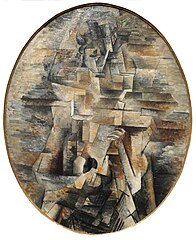
In 1917-18, Braque painted "Woman Musician", a strongly-colored painting, almost abstract. He also painted still-lifes in the same style. Within a year, he had discarded severe geometrical shapes and was drawing more fluidly as in "Still Life with Playing Cards" (1919) and "Still Life with Sonata" (1920).
By the early 1920s, Braque had established his reputation as a serious artist, and was commissioned by Diaghilev* to design stage sets in 1923 and 1925. He was making good money and in 1925, moved to a new house on the Left Bank. At the beginning of the 1930s, he experimented with a new medium: creating white drawings on black plaster plaques, similar to Greek pottery. In a more elaborate style, he painted "Pink Cloth" in 1933, and "Yellow Cloth" in 1937, which won first prize at the Carnegie Exhibition in Pittsburgh.
In the last 20 years of his life, Braque produced paintings in series on the same subject. His first series was of billiard tables, then he did a series of studio interiors, then birds. Among the large paintings of his last years, "Ajax" (1949-54) became famous. In 1961, he became the first living artist to have his works hung in the Louvre.
EXTRA CONNECTIONS: His work related to that of Klee* and Leger* .
Ford Madox Ford* published his reviews.
Le Corbusier*?
On 20 May 2010, the Musée d'Art Moderne de la Ville de Paris reported the overnight theft of five paintings from its collection. The paintings taken were Le pigeon aux petits pois (The Pigeon with the Peas) by Pablo Picasso, La Pastorale by Henri Matisse, L'Olivier Près de l'Estaque (Olive Tree near Estaque) by Georges Braque, La Femme à l'Éventail [fr] (Woman with a Fan) by Amedeo Modigliani and Nature Morte aux Chandeliers (Still Life with Chandeliers) by Fernand Léger and were valued at €100 million ( $123 million USD).[20][21] A window had been smashed and CCTV footage showed a masked man taking the paintings.[20] Authorities believe the thief acted alone.[22] The man carefully removed the paintings from their frames, which he left behind.[23]
ONELINER: Georges Braque, co-founder (with Picasso) of Cubism
BIBLIOGRAPHY:
Russell, John, G. Braque, Phaidon Press, London, 1959.