Frost R
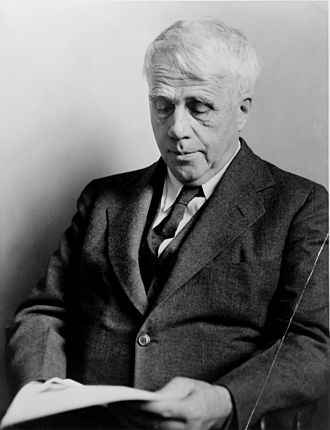
NAME: Frost, Robert Lee.
ACHIEVEMENTS: Major modern American poet
NICKNAME/ALIAS: None.
DATE/PLACE OF BIRTH: 26th March 1874, in San Francisco, CA.
DATE/PLACE/AGE AT DEATH: 29th January 1963, in Boston, MA. Aged 86.
DISCIPLINE: Poet.
FIELD: Poetry.
LANGUAGE: English.
PARENTS: William Prescott Frost and Isabelle Moodie.
SIBLINGS: 1 sister, Jeanie.
SPOUSE: Elinor White.
CHILDREN: One son, Carol and three daughters, Lesley, Irma and Marjorie.
EDUCATION: Primary School, Salem, New Hampshire; High School, Lawrence, MA; Dartmouth College, Hanover, New Hampshire.
MAJOR WORK: ‘North Boston’ (1914), ‘New Hampshire’ (1923), ‘A Further Range’ (1937) and ‘A Witness Tree’ (1942).
LIFE AND TIMES:
After one semester at Dartmouth, Frost went to work in a woollen mill in Lawrence, trimming lamps, before becoming a schoolteacher. In his spare time, he wrote poetry and, in 1894, the ‘Independent’, a weekly literary magazine in New York, published his poem ‘My Butterfly: an Elegy’.
For a while he worked as a reporter, then went back to teaching and, at the end of 1895, married his childhood sweetheart Elinor White, after she had finished college. Both of them worked as teachers, while Frost continued to write.
In 1897, he went to Harvard to train as a high school teacher of Latin and Greek but when his health broke down in spring 1899 he left. The Frost’s rented a poultry farm in Methuen in April 1900, but tragedy struck when their three-year old son died of cholera two months later. Frost collapsed under the strain and, when their landlord evicted them in the fall, Elinor took charge.
Her mother found them a farm in Derry, New Hampshire and Elinor persuaded Frost's grandfather to pay for it. For the next few years, Frost worked on the farm and wrote at night, contributing poetry and articles to poultry journals. It was a hard life and, by 1906, there were four children in the family. To supplement their income, he took a teaching job at the nearby Pinkerton Academy.
Frost was involved in athletics, the re-organization of the English curriculum and helping with student activities, and he became a great success as a teacher. In 1911, he left to take a part time job in Plymouth, New Hampshire, then, in 1912, he and his family went to Britain, arriving in September.
They set up home in a country cottage near Beaconsfield, Buckinghamshire and Frost toured bookshops and publishers in London, in an effort to find a publisher for some of the work he had done in Derry. In October 1912, ‘A Boy's Will’ was accepted for publication and, encouraged, he entered a new period of creativity.
By March 1913, he had started to move in literary circles and the American writer, <encouraged by> Pound*, working as a reviewer, introduced him to the poets <met> Yeats* and <met> Ford Madox Ford*. The family moved further from London to Gloucestershire, where they could live more cheaply.
In May 1914, ‘North of Boston’, a collection of poems in the real speech of ordinary working people in the New England countryside (and mostly written on the farm in Derry) was published to a good reception.
The poems revealed the influence of <influenced by> Wordsworth* and <influenced by> Robert Browning* and the collection included some of Frost’s most enduring work, including ‘Mending Wall’, ‘The Death of the Hired Man’, ‘Home Burial’ and ‘After Apple-Picking’. By now, Frost was considered to be one of the leading poets in England.
In 1915, a New York publisher agreed to publish his books in America, so he went back to the US, to be greeted as one of the leading poets in the new realistic movement that celebrated the American countryside and its people. Frost enjoyed being high in the literary elite, particularly when he was made Phi Beta Kappa poet at Harvard and then was elected to the National Institute of Arts and Letters.
A new collection was published in 1916, as ‘Mountain Interval’, which included ‘Birches’, ‘The Hill Wife’ and ‘An Old Man's Winter Night’. Then, in 1917, Frost moved to Amherst and took a job at the college, with complete freedom over his choice of teaching subjects.
At Amherst, Frost had found a lifestyle that agreed with him and he spent the rest of his life in a cycle of teaching at Amherst, the University of Michigan and Dartmouth, as well as going on poetry recital tours. In his private life, though, he was still a troubled and anxious man.
In 1923, he won a Pulitzer Prize for his collection of short lyric poems in ‘New Hampshire’, then again in 1930, for ‘Collected Poems’ and another in 1937, for ‘A Further Range’.
His career was as successful as anybody could want, but from 1938, his private life began to fall apart. In that year, Elinor died and Frost seemed to be heading for a breakdown, until Kathleen Morrison took him in hand. The two formed a close relationship and she became his secretary and manager.
The 1940s saw more tragedy for Frost. His son committed suicide and his daughter Irma was committed to a psychiatric institute.
Frost never stopped writing and published ‘A Witness Tree’, which won him a fourth Pulitzer Prize in 1942 and contained some of his best poems, like ‘The Most of It’ and ‘The Silken Tent’.
He spent his last years as an honoured citizen and was invited to read a poem at the inauguration of President <read at inauguration of> Kennedy*. As such a respected US citizen, the State Department sent Frost on goodwill missions that took him to Brazil in 1954, Britain in 1957 and Greece in 1961.
The poet <a fan was> T S Eliot*, who in 1922 had shown himself to be one of Frost’s greatest critics, praised him in 1957 as the most distinguished Anglo-American poet. Frost’s last volume of poetry, ‘In the Clearing’, was published in 1962 and a few months later, Kennedy asked Frost to visit the Soviet Union. In the summer of 1962, Frost accompanied Interior Secretary Stewart Udall on a visit to the Soviet Union in hopes of meeting Nikita Khrushchev to lobby for peaceful relations between the two Cold War powers. While he was there, he met Russian writers, as well as the first secretary of the Communist Party and Prime Minister, <met> Krushchev*.
ASSESSMENT: Frost was considered a supreme advocate for the New England countryside and the life and speech of ordinary country people.
EXTRA CONNECTIONS: He was taught by <taught by> Santayana*
He wrote a poem about the mysterious disappearance of the daughter of Arron Burr, Theodosia.
Influenced by
Influenced * Seamus Heaney
His poem "Fire and Ice" influenced the title and other aspects of George R. R. Martin's fantasy series *A Song of Ice and Fire.
Jawaharlal Nehru (1889–1964), the first Prime Minister of India, had kept a book of Robert Frost's close to him towards his later years, even at his bedside table as he lay dying
ONELINER: Robert Frost, American poet
BIBLIOGRAPHY:
Sergeant, Elizabeth Shepley, Robert Frost, The Trial by Existence, Holt, Rheinhart & Winston, New York, 1961.