Pound
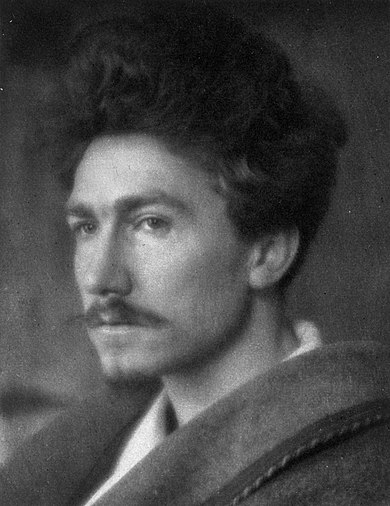
Full Name: Ezra Loomis Pound
Achievements: Poems. Fascist supporter.
Born: October 30, 1885; Hailey, Idaho
Died: November 1, 1972; Venice, Italy (Aged 87)
Field & Discipline: Literature; Poetry; Criticism
Language: English
Father: Homer Loomis Pound
Mother: Isabel Weston
Siblings: None
Spouse: Dorothy Shakespear
Children: by Dorothy Shakespear, 1 son, Omar; by Olga Rudge, 1 daughter, Maria
Education: Cheltenham Military Academy, Philadelphia, PA; Local high school, Wyncote, Philadelphia, PA; University of Pennsylvania; Hamilton College, Clinton, NY.
Major Work:
Poetry:
“Personae: The Collected Poems” (1949)
“The Cantos” (1970)
Criticism:
“Literary Essays” (1954)
Life & Times:
At Pennsylvania University, Pound met the poet [a pal of] William Carlos Williams*, who became a lifelong friend. When he finally graduated in 1907, he had a wide knowledge of modern and ancient languages including Latin, Greek and, unusually, Provencal and Anglo-Saxon.
Pound took a job as professor of Romance languages at Wabash Presbyterian College in Crawfordsville, Indiana, but after a few months was dismissed for “bohemian behaviour” and, in 1908, he left the US for Europe.
He settled in Venice, Italy, where, in that same year, he published his first volume of poems, “A Lume Spento” (“With Tapers Quenched”). At the end of 1908, he moved to London, where he lived for the next twelve years. He became friendly with the American writer [a pal of] Ford Madox Ford* and soon joined London's literary world.
The following year, Pound met [a pal of] Yeats*, who, he thought, was the world’s greatest living poet and the two men became close friends. His work at time in his life was influenced by Yeats, [influenced by] Robert Browning* and the pre-Raphaelites (such as [influenced by] Dante Gabriel Rossetti*) of the late nineteenth century and this is most clearly seen in “Personae,” written in 1909 and “Canzoni,” in 1911.
After “Canzoni,” the experimental work being produced around him influenced his style. His language became more spare, as is seen in “Ripostes,” written in 1912, which had a more personal and modern tone with a harder edge. By this time, Pound was already writing poetry in colloquial speech, but still trying to keep the emotional impact of more traditional forms of verse.
Pound set up the Imagist movement to promote this ideal and from 1913 to 1916, he and Yeats spent the winters together in a cottage in Sussex, trying to develop their use of language under the influence of Chinese poetry and the Japanese Noh drama.
Pound was associated with several literary magazines and from 1914 to 1915, was the editor of “Blast: A Review of the Great English Vortex,” the magazine of the short-lived and little-known Vorticist movement. He published two editions of the magazine denouncing the established authorities who, the Vorticists believed, were saturated with the self-satisfaction of the Edwardian upper classes.
Pound wrote a great deal as a literary critic and helped to promote writers that he thought had broken away from the constrictions of the older generation. These included the Irish novelist [encouraged] Joyce, J* and the American poets [encouraged] Frost* and [encouraged] T S Eliot*. At the same time, he published his poems in the Chinese style in “Cathay,” 1915 and his most significant modern work up until that time, “Lustra,” 1916.
As the casualties mounted during World War I, Pound began to view the war as a symptom of the rule of the old establishment. He began to read the works of the new
economists, hoping to find a historical explanation for the disaster of the war and was impressed by the ideas of [influenced by] C H Douglas*, who founded Social Credit.
In 1917, he analysed the contemporary cultural scene in “Homage to Sextus Propertius” and, when the war was over, he wrote a sequel ,”Hugh Selwyn Mauberley,” a work in which he denounced the literary scene in London.
In 1921, Pound left London and moved to Paris, where he joined the avant-garde circle that hovered around [knew] Stein* and other expatriate writers and artists like [knew] Hemingway* and [knew] Picasso*.
Pound had started to work on “The Cantos” which he had planned a few years before. He originally envisaged a hundred of these, written in homage to Dante's “Divine Comedy,” but the project turned into a record of his own life, his reading and opinions.
He made several trips to Italy and eventually decided that he preferred it to Paris, so in 1924, he set up home in Rapallo. In 1925, Pound published “A Draft of XVI Cantos,” in which he condemned the slaughter of the First World War and praised Sigismondo Malatesta, a Renaissance autocrat who created the Tempio in Rimini.
By now, Pound had developed fascist leanings and an admiration for [admirer of] Mussolini*, the Italian leader. In 1930, he published “A Draft of XXX Cantos” and, around the same time, in Rapallo, arranged concerts which were significant for their rediscovery of the composer [rediscovered] Vivaldi*.
Pound’s work was by now showing the influence of his fascist ideals. The depression in the 1930's drew him to more extreme social and economic views. He wrote a series of prose pieces, in which he denounced President [denounced] Franklin D Roosevelt's* New Deal programme and praised the Fascist rule in Italy.
Pound supported the Italian invasion of Ethiopa and was entirely divorced from liberal opinion in Britain and America. His cantos during the thirties were concerned with what he saw as the evil practice of usury and the iniquities of Jewish financiers.
He contributed to the fascist periodical “Meridiano di Roma” and in 1939, he suggested that it should publish in English, so that American readers would understand and sympathize with the aims of fascism. During the Second World War, Pound made a series of broadcasts from Rome, adding anti-Semitic and anti-American criticism to his literary discussions.
In 1945, when the war ended, Pound was arrested by Italian partisans and locked up near Pisa, in the US Army's Disciplinary Training Center. During his time in prison, he wrote most of “The Pisan Cantos.” After six months, Pound was taken to Washington where he was indicted for treason. He was found unfit for trial and was committed to St Elizabeth's Hospital for the Insane. In 1948 “The Pisan Cantos” were published and a year later Pound was awarded the Bollingen prize.
He was kept in the asylum, where he continued to write poetry, until 1958, when friends managed to arrange his release. He went back to Italy, where, in 1959, he published “Thrones: Cantos 96 to 109.” Together with his wife, Pound spent his last years in Rapallo and Venice and his final publication was in 1969.
Extra Connections: The critic [a fan was] Leavis was an admirer.
He was painted by [painted by] Kokoschka*
Assessment: He played a significant part in the development of twentieth-century literature by promoting new modern writers in England and America.
Oneliner: Ezra Pound, modern American poet
Bibliography:
- Stock, N, The Life of Ezra Pound, 1970, revised 1982.
- Kenner, H, The Pound Era, 1971.
- Carpenter, Humphrey, A Serious Character, The Life of Ezra Pound, Faber and Faber, London, 1988.