Gobineau
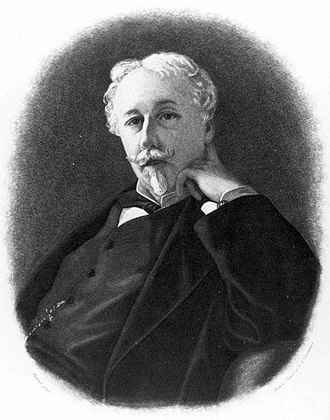
NAME: Gobineau, Joseph-Arthur, comte de
ACHIEVEMENTS: ‘Gobinist’ pseudoscientific theory of racial inequality.
NICKNAME/ALIAS:
DATE AND PLACE OF BIRTH:
July 14, 1816, Ville-d'Avray, France
DATE/PLACE OF DEATH/AGE AT DEATH:
October 13, 1882 , Turin, Italy. Age 66
DISCIPLINE: Diplomat. Writer. Racialist.
FIELD: Diplomacy. Literature. Racialism.
LANGUAGE: French
PARENTS: French royalist reactionaries. His father commanded the Imperial Guard of Louis XVIII.
SIBLINGS:
SPOUSE:
CHILDREN:
EDUCATION: Considerable knowledge of languages. Military school, until the revolution of 1830 ruined his family
MAJOR WORK: He is today remembered solely for his Essai sur l’Inégalité des race humaines, (Essay on the inequality of human races) published in several volumes 1853-55.
LIFE AND TIMES:
Gobineau moved to Paris in 1835, seeking a place in public life. While holding minor clerical posts, he traveled in aristocratic circles and acquired a reputation as a linguist and student of history.
In 1848, Alexis de Tocqueville, the author of Democracy in America, hired Gobineau as his secretary during a brief term as Foreign Secretary.
Gobineau’s personal politics were anti-democratic, Bourbonist, and royalist in the extreme. Still, after Tocqueville’s fall from power, Gobineau remained in the French diplomatic service until his retirement in 1877, serving briefly in Berne and Hanover before taking a long-term post in Frankfurt. In 1854-58, and 1861-64, Gobineau was posted to Tehran (with a term in Newfoundland in between).
Later posts took him to Athens in 1864, Rio de Janeiro in 1868, and back to France in time to witness the Franco-Prussian War of 1870-71. His last posting was to Stockholm in 1872, from which he was forced into retirement under vaguely disreputable circumstances in 1877.
Gobineau retired to Italy (mainly Rome). He wrote and published a great deal during, and especially after, his diplomatic career. The work included volumes on ethnology, cuneiform writing, Persian history and literature, as well as historical, political and philosophical essays, a history of his family, travel books, novels and short stories, a tragedy, a long epic, and lyric poetry.
He also produced The Renaissance (considered his most substantial work): a series of five imaginary conversations (on the topic of the Italian Renaissance) with Savonarola, Cesare Borgia, Popes Julius II and Leo X, and Michelangelo.
However, Gobineau is best-known today for his first major work, the Essay on the Inequality of the Human Races, an inspiration for racists and pseudo-scientists since its initial appearance.
Like all racist theoreticians, Gobineau sought to establish the ultimate superiority of a single human group: his own. Whatever other uses his racial writing has since been put to, Gobineau’s concern was to prove that the fount of all that is best in human culture, art, politics, and science was the rural aristocracy of France.
Gobineau insisted that all human achievement was exclusively based on race. This assumed existence of a racial ‘consciousness’ or ‘spirit.’ This aspect of Gobineau had tremendous appeal to all kinds of mystical enthusiasts, from <influenced> Wagner* to Carl Jung to <influenced> Hitler*.
More insidiously, Gobineau identified the superiority of the French aristocracy with their descent from the Franks, the Germanic peoples who rose to power in France after the Roman Empire collapsed. Gobineau drew upon Persian pre-history and myth in order to support the concept of an “Aryan” race (modern Iran takes its name from the same root-word).
This mythical race was identified with Germans only insofar as the French aristocracy was supposed to be more “Aryan” than the rest of the French population. Gobineau did not consider contemporary Germans to be of the same quality.
Gobineau held that only whites (and of them only Aryans, and of them only French royalist aristocracy) could be the source of any growth or innovation in human culture. He held a pessimistic view that the ‘dilution’ of the aristocratic French ‘race’ spelt the doom of humanity.
Gobineau’s invention of an Aryan race, and its identification with Germans, was immensely appealing to intellectuals on the other side of the Rhine. Gobineau’s focus on the French, and his belief in racial decline, were ignored in endless hymns to the racial glory to which all Germans could lay claim.
Since no such ‘race’ ever really existed, any accomplishment of non-German people could be ascribed to an ‘Aryan’ presence. Some German academics went so far as to claim that Moses, Abraham, and Christ were really Aryans. This claim was popular enough to lead to identifying the Germans as the ‘real’ Chosen People of the Old Testament.
A minor branch of this view survives in the “British Israel” movement, which claims that English Tories are the Lost Tribe of Israel.
Richard Wagner drew upon Gobineau for his mystical racism. Meanwhile <influenced> Haeckel* somehow forged a connection between Gobineau’s writing and <work related to> Darwin*’s Origin of Species (which appeared in print four years after Gobineau’s Essai).
In England, Darwin’s cousin, the statistician <work related to> Galton* proposed a ‘science’ of eugenics, by which the health of the nation was to be improved by increasing the birthrate of ‘superior’ persons while discouraging reproduction of the ‘unfit.’
While at the time, no explanation was possible of the mechanism of evolution (Mendel’s work lay unread until the turn of the 20th century) many extravagant theories of cultural, social, and racial ‘evolution’ were produced.
Social Darwinism, [by which imperialism and “weeding out of inferiors or the diseased” was justified as an evolutionary process (“politics is applied biology,” as Haeckel put it)], and eugenics have been the most persistent of these. Social Darwinism ignores all economics, anthropology, sociology and history in its attempt to create a method of self-justification for conquest. Eugenics is rooted in naïve assumptions about human heredity and evolution, none of which have survived scientific examination.
ASSESSMENT: With 20th century hindsight, it is difficult to believe that the ragbag of anecdotes, circular reasoning, and pomposity that composed Gobineau’s thesis could have been taken as seriously as it was.
EXTRA CONNECTIONS:
Gobineau's writings were quickly praised by white supremacist, pro-slavery Americans like Josiah C. Nott and Henry Hotze, who translated his book into English. They omitted around 1,000 pages of the original book, including those parts that negatively described Americans as a racially mixed population. Inspiring a social movement in Germany named Gobinism,[1] his works were also influential on prominent antisemites like Richard Wagner, Wagner's son-in-law Houston Stewart Chamberlain, the Romanian politician Professor A. C. Cuza, and leaders of the Nazi Party, who later edited and re-published his work....Gobineau's ideas were influential in a number of countries, especially Romania, Ottoman Empire, Germany, and Brazil, both during his lifetime and after his death.
ONELINER: Count de Gobineau, racial ‘theorist’
BIBLIOGRAPHY:
Gobineau. The inequality of human races. (still in print, still popular with far-right nuts)
Gould, Stephen Jay, The Mismeasure of Man, New York: W.W. Norton. 1966. Free full text