Haeckel
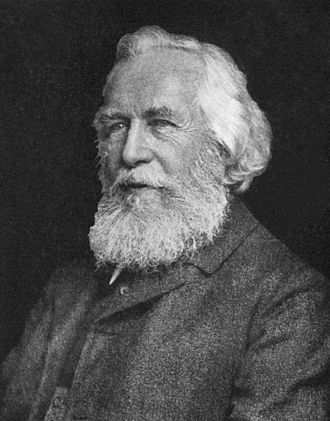
NAME: Haeckel, Ernst
ACHIEVEMENT(S): Coined: “Ecology.” Inspired Nazis.
NICKNAME/ALIAS: in full, Ernst Heinrich Philipp August Haeckel
DATE/PLACE OF BIRTH: 16 February 1834, at Potsdam, Prussia [Germany]
DATE/PLACE/AGE AT DEATH: 9 August 1919, in Jena, Germany. Aged 85
DISCIPLINE: Zoologist
FIELD: Zoology
LANGUAGE: German
PARENTS: Carl Haeckel (1781-1871) and Charlotte Sethe (1799-1889)
SIBLINGS: Karl (1824-97)
SPOUSE: Anna Sethe (1835-64), married 1862; Agnes Huschke (1842-1915),
married 1867
CHILDREN: None
EDUCATION: Domgymnasium, Merseburg, 1846-52; Universities of Wurzburg and
Vienna, 1852-54; University of Berlin, 1854-58
MAJOR WORK: 'Systematic Philogeny' (1894)
LIFE AND TIMES: At Berlin, Haeckel was taught by the great pathologist <taught by> Virchow* and the equally-famous physiologist and anatomist <taught by> Johannes Muller, Johannes P*, who inspired in him a great interest in zoology and comparative anatomy.
After graduation, with Muller's death in 1858, Haeckel returned to Merseburg and set up a medical practice. During a zoological expedition near Messina, Sicily (1859-60), Haeckel continued Muller's investigations of the one-celled protozoan group Radiolaria and discovered 144 new radiolarian species.
On his return, Haeckel read the German translation of <defender of> Charles Darwin's* 'On the Origin of Species, by Means of Natural Selection' (1859), and became an
immediate convert to the theory of evolution.
In 1861, while writing up the results of his Mediterranean expedition, he was appointed Privatdozent (junior unsalaried lecturer) of zoology at the University of Jena, and the following year he became extraordinary (associate) professor of comparative anatomy at the Zoological Institute at Jena.
The same year he published his first monograph, 'Die Radiolarien' (1862), which treated the morphology, systematics and embryology of the radiolarians, and then interpreted his findings in the light of Darwin's theory.
From 1863, when he publicly championed the then highly-controversial theory of organic evolution at a congress of German naturalists at Stettin, Haeckel became the first German scientific proponent of Darwinism, and was soon lecturing to scientific and lay audiences on the descent theory.
In 1865 Haeckel was appointed full professor, and he remained at Jena until his retirement in 1909, becoming a high-profile academic figure, known for his support of <supporter of> Bismarck*’s Prussian expansion.
Between 1859 and 1866, Haeckel worked on many invetebrate groups, including radiolarians, poriferans (sponges), and annelids (segmented worms), and these studies led him to publish in 1866 his first work of importance: 'General Morphology of Organisms', which became a classic in the field of Darwinian biology, which he followed two years later with his 'Natural History of Creation', a more populist outline of his evolutionary theory.
Haeckel developed Darwin's notion of evolution (the natural selection of accumulated favourable variations that in time formed new species) further in order to provide a foundation for a science-based world view.
In these works he also first published his famous genealogical tables or "family trees" of relationships within the animal and vegetable kingdoms – for plants, coelenterates, echinoderms, articulates (infusorians, worms, anthropods), mollusks, vertebrates, and mammals - and reconstructed the human ancestral tree in order to demonstrate man's descent from the lower animals.
During the late 1860s and early 1870s Haeckel continued to try to find out, by studying the development of an individual, what its adult ancestors were like. (This concept, which Haeckel had revived, had already been disproved long before by <theory disproved by> Karl von Baer*, who had shown that embryos resemble the embryos only and not the adults of other species).
Haeckel viewed adult organisms as the embryonic stages of more advanced organisms - i.e. development of advanced species was seen to pass through stages represented by adult organisms of more primitive species, and thus the creation of new phyla mark steps towards the completion of human development. According to such a view, humans evolved when the embryo of the highest ape added on a new stage.
In Haeckel elaborated these ideas on the evolution of man in works widely read in his day, especially in the best-selling: 'Riddle of the Universe' (1899). In these works he tried to apply Darwin's doctrine of evolution to philosophy and religion, believing that just as the higher animals had evolved from the simpler forms of life, so the highest human faculties have evolved from the soul of the animals.
Haeckel produced his great work: 'Systematic Philogeny' in 1894. During the early 20th century, his ideas - particularly his "biogenetic law" - were adapted uncritically by many of the new social sciences.
Early cultural anthropologists adopted his view that other cultures were "primitive" in the embryological sense, in that their development has stopped short of Western culture. Some, building on <work related to> de Gobineau's* 'Essay on the Inequality of the Human Races' (1853-55) and using Haeckel's theories as a basis, ordered the different races in a linear fashion from top to bottom.
Haeckel himself stated (1902) that there was a progression of rationality from the primitive to the greatest thinkers, that the races differed in this ability, and that the difference in rationality between the "savage races" and Europeans was greater than that between the dogs and savages, and that this difference demanded that the savage races be subjugated to the Europeans.
These ideas gave scientific validity to the racial prejudices in Europe which culminated in the genocidal biopolicy of the Third Reich. <influenced> Hitler* paraphrased many of Haeckel's central statements in his: 'Mein Kampf' (1925).
At Jena, Haeckel established the Monist League (1906), dedicated to the dissemination of Haeckel's thought, continued to write and lecture into old age, and established important natural history collections, founding both the Phyletic Museum in Jena and the Ernst Haeckel Haus, which contains his books and archives, and in which many mementos of his life and work are preserved.
ASSESSMENT: Haeckel developed ideas that are still accepted, including his view that the origin of life lies in the chemical and physical factors of the environment, such as sunlight, oxygen, water and methane. His method of representing evolutionary history by means of tree-like diagrams is still used today by animals systematists to show degrees of
relationship.
EXTRA CONNECTIONS: He criticized the work of <criticized work of> Hensen* and <work related to> Ostwald*
He was influenced by the primeval slime theory of <influenced by slime theory of>Oken*
He was influenced by the Social Darwinism theories of Herbert <influenced by ideas of>Spencer*
ONELINER: Ernst Haeckel, German zoologist
BIBLIOGRAPHY: DSB, EB
Gasman, Daniel, The Scientific Origins of National Socialism: Social Darwinism in Ernst Haeckel and the German Monist League, 1976.