Hitler
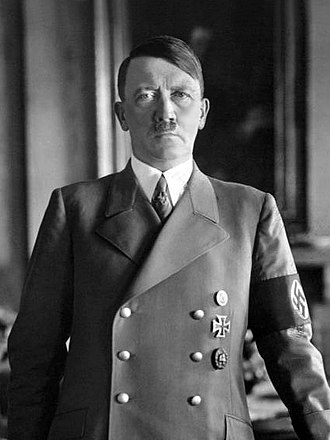
Name: Adolf Hitler
Nickname/Alias: Der Fuhrer
Achievements: Nazism
Born: April 20, 1889; Braunau am Inn, Austro-Hungary
Died: April 30, 1945; Berlin, Germany (Aged 56)
Field & Discipline: Politics; Dictator
Language: German
Father: Alois Schickelgruber Hitler (1837-1903)
Mother: Klara Poelzl (d. 1908)
Siblings: Five siblings, only one, Paula (d. 1960), survived infancy
Spouse: Eva Braun (married 1945; d. 1945)
Children: None
Education: Linz Realschule, 1897-1901; Steyr Boarding School, 1901-05
Major Work:
“Mein Kampf” (“My Struggle,” 1925)
Life & Times:
Adolf Hitler was born in 1889 at Braunau am Inn, Austria, the son of a 52-year-old Habsburg customs official, Alois Schickelgruber Hitler, and his third wife, a young peasant girl named Klara Poelzl. Hitler attended a primary school in Braunau for five years, and then moved with his family to Linz, the capital of Upper Austria, on his father's retirement in 1897.
He then spent four years at the Linz Realschule, followed by a period at a boarding school in Steyr. Hitler failed to succeed in his studies and left school in 1905 to become a painter. After two idle years in Linz, in October 1907 Hitler left his mother (who was incurably ill with cancer) and moved to Vienna, where he remained until 1913 leading a bohemian existence, making a precarious living selling paintings and drawings of Vienna and producing posters and advertisements for small traders.
During this Vienna period (1907-13), Hitler read a great deal and absorbed many of the anti-Semitic, anti-liberal and anti-democratic ideas then common in Austria, spread by, amongst others, the defrocked monk, Lanz von Liebenfels (whose theory of "Theozoology" divided humanity into two groups - Aryan supermen and animal subhumans), and the Austrian Pan-German leader, Georg von Schoenerer.
From these and other sources, the young Hitler began to construct a vision of the world in which Jews (by race, rather than by religion) became the symbol and cause of all chaos, corruption, and destruction in culture, politics and the economy, and that the press, prostitution, syphilis, capitalism, Marxism, democracy and pacificism were all means exploited by 'the Jew' in his conspiracy to undermine the German nation and the purity of the creative Aryan race.
In May 1913, Hitler left Vienna for Munich, Germany in order to avoid military training in Austria. In August 1914 he enlisted in the Sixteenth Bavarian Infantry Regiment, serving as a despatch runner on the Western front.
Although he did not rise above the rank of Lance Corporal, he proved himself an able and courageous soldier, wounded twice and awarded the Iron Cross, both first and second class, for conspicuous bravery. He was badly gassed four weeks before the end of the war and, temporarily blinded, spent three months recuperating in a hospital in Pomerania.
During the war Hitler had found comradeship, discipline, and participation in conflict intensely satisfying, and in November 1918 learned with horror of Germany's defeat, and of the humiliation of the armistice arranged by the 'big three': [influenced by] Lloyd George* (UK) , [influenced by] Clemenceau* (France) and [influenced by] Woodrow Wilson* (US).
On leaving hospital, Hitler returned to Munich, where he worked for the army as a political agent, spying on extremist groups like the nationalist and racist German Workers' Party (DAP), which Hitler joined in September 1919.
He quickly showed a marked talent for inflammatory speaking, political agitation and party organization. Hitler left the army in 1920, and became party propagandist, editing the party newspaper the 'Volkischer Beobachter' ('People’s Observer'), arranging frequent meetings, changing the name of the party to the National-sozialistische Deutsche Arbeiterpartei (the National Socialist German Workers' Party, NSDAP or Nazi Party), imposing himself as its Chairman by July 1921, and giving the new Party its symbol - the swastika - and its greeting, 'Heil!'.
The Nazi Party adopted the ideas Hitler had acquired in Vienna - violent racial nationalism, anti-Semitism and opposition to liberal democracy, combined with perverted versions of the philosophies of such German thinkers as [influenced by] Haeckel* and [influenced by] Nietzsche* - combined with a hatred of the post-war republican German government and 'socialistic' ideas of profit-sharing and nationalization.
By November 1921, mainly through Hitler's aggressive leadership, the party had 3,000 members. From these Hitler organized strong-arm squads to keep order at his meetings and to break up those of his Socialist and Communist opponents. Out of this grew the storm troopers (SA), organized in 1921 by Captain Ernst Rohm, and Hitler's black-shirt personal bodyguard force, the 'Schutzstaffel' (SS).
At the same time, Hitler gathered around him several of Nazi leaders who later became infamous, including [collaborated with] Rudolf Hess* (who introduced him to [influenced by] Haushofer’s* expansionist theory of "Lebensraum").
By November 1923 Hitler was convinced that the Weimar Republic was on the verge of collapse, and together with [attempted coup with] Ludendorff* and local nationalist groups he tried to overthrow the Bavarian government in Munich.
In a Munich beer-hall, on the night of 8 November, he and Ludendorff proclaimed the "National Revolution", and the following day they marched through Munich at the head of 3,000 men, only to be met by police fire which left 16 dead (and [worked with] Goering* severely injured) and brought the attempted 'putsch' to an end.
Hitler was tried on 26 February 1924 and sentenced to five years imprisonment at Landberg fortress. However, he was released after only nine months, during which he dictated to Hess his autobiography and personal testament 'Mein Kampf' ('My Struggle'), published in 1925 and which by 1939 had sold five million copies, making Hitler a wealthy man.
On his release, Hitler began to rebuild the Nazi Party, which had disintegrated in his absence, with the help of Goering, Hess and [worked with] Goebbels*, and in 1926 he grabbed power from a rival Nazi leader, Gregor Strasser.
From his experiences, Hitler had now learned that the road to power lay not through force alone, but through legal subversion of the Weimar Constitution, and he set out to build a mass movement empowered by a combination of parliamentary strength and extra-parliamentary street terror and intimidation.
At first, development was slow. The mid-1920s saw a period of economic stability in Germany, and while in January 1925 the ban on the party was removed in Bavaria, allowing Hitler to speak in public, elsewhere prohibitions remained in force until 1927-28, and the Nazi Party won only 12 seats in the 1928 elections. However, the depression of 1929 enhanced the appeal for the Nazis, and Hitler found support among wealthy industrialists keen to finance a strong right-wing, anti-democratic government, which at last placed the Party on a secure financial footing.
With the backing of the press tycoon, Alfred Hugenberg, in 1929-30 Hitler got nationwide exposure and in the 1930 elections, after an intensive series of rallies, the Nazi vote jumped dramatically from 810,000 to 6,409,000 (18.3 per cent of the total vote), and the Party won 107 seats in the Reichstag, becoming the second largest party in the country.
During the years 1930-33 Hitler's impassioned promises attracted members of all social groups in Germany, including industrial magnates, high-ranking army officials, prominent intellectuals (including the philosopher [influenced] Heidegger* and, until 1934, the cultural historian [influenced] Spengler*) and the wealthy members of the 'Landbund', or League of Land, who opposed the redistribution of land proposed by the Weimar Republic.
In the 1932 elections, just after becoming a German citizen, Hitler opposed the aging [won election over] Hindenburg* in the presidential election, taking 36.8 percent of the vote on the second ballot and depriving von Hindenburg of the necessary absolute majority. Although Hindenburg won the majority in the run-off election held in July 1932, the Nazi Party emerged as the single largest party in Germany, obtaining nearly 14 million votes and 230 seats.
Then, in spite of a decline in the party's votes to 11 million in November 1932, Hitler was helped to power by a deal with former Chancellor [did deal with] Papen*, in which they secretly agreed to work together for a government in which Hitler would be chancellor and Papen's conservative supporters would hold important ministeries. In January 1933 Papen persuaded a reluctant von Hindenburg to nominate Hitler as Reich Chancellor, a position he accepted on 30 January.
Once in power, Hitler moved with great speed to outmaneuvre his rivals and began consolidating the foundations of a totalitarian one-party state; the Reichstag fire in February 1933 (apparently the work of a Dutch Communist, Marinus van der Lubbe) provided the excuse for clamping down on and legalizing the regime's intimidating tactics.
In the last 'democractic' elections held in Germany in March 1933, the Nazi Party gained a majority, and two days later an enabling bill giving full powers to Hitler was passed in the Reichstag by the combined votes of Nazi, Nationalist, and Centre party deputies. By July 1933, Hitler had virtually removed the conservatives from any real participation in government, abolished the free trade unions, eliminated the Communists, Social Democrats and Jews from any role in political life, and had begun putting opponents in concentration camps.
In June 1934, Hitler was confronted by serious opposition from within his own party, dissatisfaction and dissension centering around the SA and its leader, Captain Ernst Rohm, who were demanding more radical social reforms.
Hitler tried first to secure Rohm's support for his policies by persuasion and by giving him government office but failed to persuade him and, with pressure from Goering and [worked with] Himmler*, in June 1934 he approved the so-called Blood Purge, when Rohm and some 150 SA leaders were murdered, leaving Hitler as undisputed dictator of the Third Reich. Both the army and the judiciary passively accepted these murders, and at the beginning of August consented to the merging of the chancellorship and the presidency - with which went the supreme command of the armed forces of the Reich - and all officers and ministers took an oath of allegiance to Hitler personally.
During the next four years (1934-38), helped by economic recovery and a reduction in unemployment, Hitler enjoyed a series of international successes which consolidated his power in Germany, and helped (along with Goebbels' propaganda) Germany to accept the nazification of all aspects of German life, enforced by Himmler's Secret State Police (Gestapo) and the opening of concentration camps for political opponents and Jews, who were systematically persecuted.
He also began preparing for the war of revenge he had promised in 'Mein Kampf.’ In 1935 he abandoned the Versailles Treaty, re-establishing universal military service, building a powerful air force, and persuading the British to sign a naval treaty recognizing Germany's right to rearm. In 1936, he occupied and fortified the Rhineland, with the Italian dictator [collaborated with] Mussolini* began sending military aid to Franco's fascist forces in Spain, and in October 1936 forged the Rome-Berlin Axis. In February 1938, he dismissed 16 senior generals and took personal command of the armed forces. In March 1938, he forced Austria into 'Anschluss' (political union) with Germany, making a triumphantal entry into Vienna.
On 29 September 1938, Hitler and Mussolini met at Munich with the British Prime Minister Neville Chamberlain and French Prime Minister Daladier, who agreed to the bloodless surrender of the Sudetenland by Czechoslovakia, and in March 1939 German troops entered Prague and the absorption of Czechoslovakia was complete.
In August 1939, Hitler and [signed pact with] Stalin* signed a nonaggression pact, freeing Hitler to turn his full attention to Western Europe. Convinced that the natural field of expansion for German Lebensraum lay eastwards, on 1 September 1939 German armies invaded Poland (the independence of which was guaranteed by Britain and France), and two days later Britain and France declared war on Germany.
From the first, Hitler held personal command of the armed forces and pushed his plans for total war against the conviction of army leaders ( particularly General Ludwig Beck, chief of the general staff) that Germany was not strong enough to defeat the Allied powers.
The first phase of World War II was dominated by German 'Blitzkrieg' tactics - sudden shock attacks against airfields, communications, military installations, using fast mobile armour and infantry to follow up the first wave of bomber and fighter aircraft, through which Poland was overrun in 19 days, Denmark and Norway in two months, and Holland, Belgium, Luxembourg, and France in six weeks.
After the fall of France in June 1940, Hitler then turned his attention to the invasion of Great Britain. The Battle of Britain, in which the Royal Air Force denied the Luftwaffe aerial control over the English Channel, was Hitler's first setback, and in October 1940 he cancelled the invasion code-named Operation Sea Lion.
He then turned his attention to the Balkans and North Africa, where his Italian allies had suffered defeats, and the German armies rapidly overran Greece, Yugoslavia, the island of Crete and Cyrenaica.
With the failure of the British campaign, Hitler again looked eastwards, and began the long preparations for the invasion of the Soviet Union, which would prove his most crucial decision of the war. The attack against the U.S.S.R., racially and ideologically justified by Hitler as an anti-Bolshevik anti-Jewish crusade, was finally launched on 22 June 1941, with Hitler so confident of success that he announced it would be over in six weeks, and refused to provide winter clothing and equipment for his troops.
Although the German army advanced fast into the Soviet Union, an unexpected counter attack in December 1941 made it clear that Hitler's plan for of a single campaign were wrong. A day later, the Japanese attacked Pearl Harbor, and Hitler declared war on the United States, although the German pact with Japan was purely defensive and he had not been informed of Japanese intentions.
This widening of the conflict into a world war by the end of 1941 finally drove Hitler to implement the 'Final Solution of the Jewish Question' which had been under consideration since 1939. He directed Himmler to prepare the ground for the "New Order" in Europe, and the concentration camps in Poland were expanded, in preparation for what had now become a policy of the liquidation of all Jews under German rule. Adding more extermination camps at Auschwitz, Belsen, Treblinka and Mauthausen, as well as mobile extermination squads, during the next three years in German-occupied Europe between 5,000,000 and 6,000,000 Jews were killed, along with hundreds of thousands of Slavs, Poles, Russians, gypsies and political dissidents.
At the end of 1942, German defeat at el-Alamein and at Stalingrad brought the turning point in the war, and Hitler's character and way of life began to alter, his personal decline symbolized by his increasingly rare appearances and his self-enforced isolation in the 'Wolf's Lair' in the east Prussian forests.
He refused to read reports of defeats, and those close to him, especially his secretary Martin Bormann, took care that only positive information reached him. In July 1943 the Allies captured Sicily and Mussolini's regime collapsed in Italy. In September 1943, the Allies invaded Italy, and then Normandy, France in June 1944. Soon a million Allied troops were driving the German allies eastwards, while the Soviets came from the opposite direction.
At last Germany had to face the fact that it lacked the resources equal to a struggle against a world alliance which Hitler himself had provoked.
On 29 July 1944 came the last of several attempts to assassinate Hitler when Colonel von Stauffenberg exploded a time bomb at a conference at Hitler's field headquarters. Hitler escaped with only minor injuries, however, and ordered the execution of all those implicated.
His narrow escape convinced him that he had been chosen by God to lead the German people, and he drastically reduced the army's independence, appointing National Socialist political officers to all military positions.
In December 1944 he moved his headquarters to Berlin, where he directed the German offensive in the Ardennes. When it failed, he clutched at fantastic hopes that his 'secret weapons', the V-1 and V-2 rockets, would turn the tide of war.
From January 1945 Hitler never left the chancellery bunker in Berlin. As the Red Army approached Berlin and the Anglo-Americans reached the Elbe, on 19 March Hitler ordered the destruction of what remained of German industry, communications and transport systems, and refused to allow his troops to surrender, effectively sentencing them to death.
On 29 April, having finally accepted the inevitability of defeat, Hitler married his long-term mistress Eva Braun and dictated his final political testament, appointed Admiral Donitz as head of state and Goebbels as chancellor, and concluded, "Above all, I charge the leaders of the nation and those under them to scrupulous observance of the laws of race and to merciless opposition to the universal poisoner of all peoples, international Jewry."
The following day, Hitler committed suicide with his wife and, in accordance with his instructions, their bodies were carried into the garden of the Reich Chancellery by aides, covered with petrol and burned (as documented by, for example, Trevor-Roper's*: 'The Last Days of Hitler', 1947).
Extra Connections: His anti-Jewish laws caused physicist [fired] Born* to be fired.
An early supporter was [supported by] Lenard*
Influenced by theories of [influenced by] Mackinder* and [influenced by] Gobineau*
Had political connection with [political connection with] Benes*
Assessment: His 'Third Reich', which was to have endured forever, ended after twelve years of unparalleled brutality, in which 30 million people lost their lives, twelve million of them far from the battlefields in the Holocaust : by mass shootings, in forced labour camps and in the gas ovens of Belsen, Dachau, Auschwitz, Ravensbruck and other concentration camps in accordance with Nazi racial theories.
Oneliner: Adolf Hitler, World War II German leader and head of Nazi party.
Bibliography:
- Encyclopedia Britannica.
- Collier’s Encyclopedia.
- Geary, Dick, Hitler and Nazism, London: Routledge, 2000.
Wistrich, Robert S., Who's Who in Nazi Germany, London: Routledge, 1995.