Coriolis
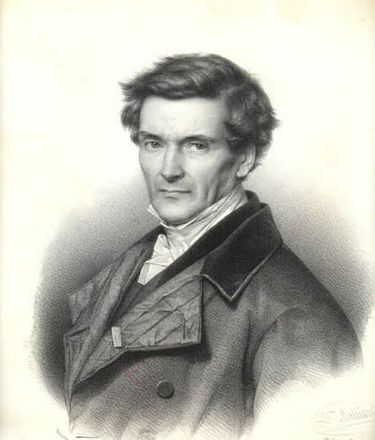
NAME: Coriolis, Gaspard Gustave
ACHIEVEMENT(S): Coriolis effect (Earth spin)
NICKNAME/ALIAS: None
DATE AND PLACE OF BIRTH: May 21, 1792, Paris, France
DATE/PLACE OF DEATH/AGE AT DEATH: September 19, 1843, Paris, France. Aged 51
DISCIPLINE: Theoretical and applied mechanics
FIELD: Physics
LANGUAGE: French
PARENTS: Unknown
SIBLINGS: Unknown
SPOUSE: None
CHILDREN: None
EDUCATION: Ecole Polytechnique, Paris, France
MAJOR WORK: The Coriolis Force
LIFE AND TIMES:
After graduating as a highway engineer, Coriolis served several years in the corps of engineers. In 1816, he became assistant professor of analysis and mechanics at the Paris Ecole Polytechnique, where he worked until 1829, when he was named to the chair of mechanics at the newly-founded Ecole Centrale des Arts et Manufactures (Central School of Arts and Crafts).
In 1829, Coriolis published "Du calcul et de l'effet des machines", the result of 10 years of work that was inspired by his reading of Sadi Carnot*. Heeding Carnot's call for a rational notation of mechanics so that general principles can be stated clearly, Coriolis suggested some new terminology, including "kinetic energy." Coriolis then began to study the moving parts of machinery in relation to its fixed framework. In 1831, he examined how fluids worked in hydraulic machines, and went on to consider relative motion in machines.
In 1835, Coriolis applied his ideas to rotating systems, showing that an inertial force acts on the relative motion of a freely-moving body when it is within a rotating frame of reference.
This inertial force acts on a rotating surface at right angles to its direction of motion, causing the motion of a body to follow a curved path instead of a straight one. Now known as the Coriolis Effect, this principle can be applied to the Earth's rotation and affects wind and sea currents (and missiles) traveling away from the equator, so that they have a greater velocity in an eastward direction than the ground beneath them. Flow caused by the Coriolis Effect follows a clockwise direction in the northern hemisphere, and an anti-clockwise direction in the southern hemisphere.
Work in this area was independently developed by American meteorologist Ferrel*.
ASSESSMENT: Did much to clarify thinking in the fields of mechanics and dynamics. He was the first to apply the term travail (translated as "work") for the transfer of energy by a force acting through a distance.
EXTRA CONNECTIONS: His work related to that of Foucault*, Maury*, Buys Ballot* and Ekman*
His work was influenced by that of Coulomb*
ONELINER: GG Coriolis, of the ‘Coriolis Effect’
BIBLIOGRAPHY:
DSB