Foucault 2
See main node
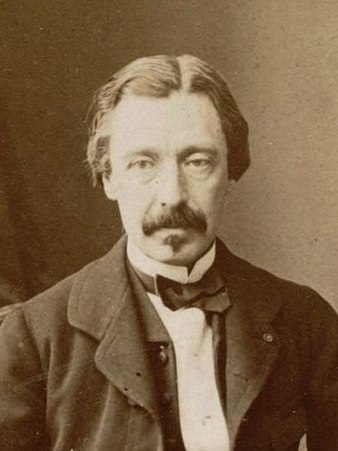
Jean Bernard Léon Foucault (UK: /ʒɒ̃ ˈbɛərnɑːr ˌleɪɒ̃ ˈfuːkoʊ/, US: /ˌʒɒ̃ bɛərˈnɑːr leɪˌɒ̃ fuːˈkoʊ/; French: [ʒɑ̃ bɛʁnaʁ leɔ̃ fuko]; 18 September 1819 – 11 February 1868) was a French physicist best known for his demonstration of the Foucault pendulum, a device demonstrating the effect of Earth's rotation. He also made an early measurement of the speed of light, discovered eddy currents, and is credited with naming the gyroscope.
Early years[]
The son of a publisher, Foucault was born in Paris on 18 September 1819. After an education received chiefly at home, he studied medicine, which he abandoned in favour of physics due to a blood phobia.[1] He first directed his attention to the improvement of Louis Daguerre's photographic processes. For three years he was experimental assistant to Alfred Donné (1801–1878) in his course of lectures on microscopic anatomy.
With Hippolyte Fizeau he carried out a series of investigations on the intensity of the light of the sun, as compared with that of carbon in the arc lamp, and of lime in the flame of the oxyhydrogen blowpipe; on the interference of infrared radiation, and of light rays differing greatly in lengths of path; and on the chromatic polarization of light.
In 1849, Foucault experimentally demonstrated that absorption and emission lines appearing at the same wavelength are both due to the same material, with the difference between the two originating from the temperature of the light source.[2][3]
Middle years[]
Foucault's pendulum in the Panthéon, Paris
In 1850, he did an experiment using a rotating mirror to measure the speed of light; it was viewed as "driving the last nail in the coffin" of Newton's corpuscular theory of light when it showed that light travels more slowly through water than through air.[4] In 1851, he provided an experimental demonstration of the rotation of the Earth on its axis (diurnal motion). This experimental setup had been used by Vincenzo Viviani but became well known to the public by Foucault's work. Foucault achieved the demonstration by showing the rotation of the plane of oscillation of a long and heavy pendulum suspended from the roof of the Panthéon, Paris.
The experiment caused a sensation in both the learned and popular worlds, and "Foucault pendulums" were suspended in major cities across Europe and America and attracted crowds. In the following year he used (and named[5]) the gyroscope as a conceptually simpler experimental proof (see Foucault's gyroscope experiment). In 1855, he received the Copley Medal of the Royal Society for his 'very remarkable experimental researches'. Earlier in the same year he was made physicien (physicist) at the imperial observatory at Paris.
In September 1855 he discovered that the force required for the rotation of a copper disc becomes greater when it is made to rotate with its rim between the poles of a magnet, the disc at the same time becoming heated by the eddy current or "Foucault currents" induced in the metal.
In 1857 Foucault invented the polarizer which bears his name,[6] and in the succeeding year devised a method of testing the mirror of a reflecting telescope to determine its shape.[7][8] The so-called "Foucault knife-edge test" allows the worker to tell if the mirror is perfectly spherical or has non-spherical deviation in its figure. Prior to Foucault's publication of his findings, the testing of reflecting telescope mirrors was a "hit or miss" proposition.
Foucault's knife edge test determines the shape of a mirror by finding the focal lengths of its areas, commonly called zones and measured from the mirror center. In the test, light from a point source is focused onto the center of curvature of the mirror and reflected back to a knife edge. The test enables the tester to quantify the conic section of the mirror, thereby allowing the tester to validate the actual shape of the mirror, which is necessary to obtain optimal performance of the optical system. The Foucault test is in use to this date, most notably by amateur and smaller commercial telescope makers as it is inexpensive and uses simple, easily made equipment.
With Charles Wheatstone’s revolving mirror he, in 1862, determined the speed of light to be 298,000 km/s – 10,000 km/s less than that obtained by previous experimenters and only 0.6% in error of the currently accepted value.
Later years[]
In 1862 Foucault was made a member of the Bureau des Longitudes and an officer of the Legion of Honour. He became a member of the Royal Society of London in 1864, and member of the mechanical section of the Institute a year later. In 1865 he published his papers on a modification of James Watt's centrifugal governor; he had for some time been experimenting with a view to making its period of revolution constant and developing a new apparatus for regulating the electric light. Foucault showed how, by the deposition of a transparently thin film of silver on the outer side of the object glass of a telescope, the sun could be viewed without injuring the eye. His chief scientific papers are to be found in the Comptes Rendus, 1847–1869. Near his death he returned to Roman Catholicism that he previously abandoned.[9]
Death and afterwards[]

Grave of Jean Bernard Léon Foucault in Montmartre Cemetery
Foucault died of what was probably a rapidly developing case of multiple sclerosis[10] on 11 February 1868 in Paris and was buried in the Montmartre Cemetery.
The asteroid 5668 Foucault was named for him.[11] His is one of the 72 names inscribed on the Eiffel Tower.
Bibliography[]
Collected Works:
- Recueil des travaux scientifiques de Léon Foucault Volume One, Volume Two, 1878. (Université de Strasbourg) or Internet Archive (US)
- Donné & Foucault *Atlas* of medical micrographs 1845
See also[]
Knowledge Web Content (see main node)
NAME: Foucault, Jean Bernard Leon
ACHIEVEMENT(S): Gyroscopic principle
NICKNAME/ALIAS: None
DATE AND PLACE OF BIRTH: September 19, 1819, Paris, France
DATE/PLACE OF DEATH/AGE AT DEATH: February 11, 1868, Paris, France.
Aged 48
DISCIPLINE: Experimental Geophysics
FIELD: Physics
LANGUAGE: French
PARENTS: Unknown
SIBLINGS: Unknown
SPOUSE: None
CHILDREN: None
EDUCATION: Ecole de Medicine, Paris
MAJOR WORK: Foucault's Pendulum; Gyroscope
LIFE AND TIMES:
Between 1845 and 1847, Foucault and <collaborated with> Fizeau* made photographic history. Using a new photographic technique developed by <used invention by> Daguerre*, the pair took the first picture of the sun.
The two went on to develop the theory of the wave structure of light, proving that interference occurs between rays of light.. By comparing heat rays of the sun with radiant heat they also discovered that the wavelength of heat was identical to that of light.
When <furthered work by> Arago* failed to determine the speed of light in air, Foucault and Fizeau decided to give it a try. Though each worked on his own, they both used the rotating-mirror method first applied by <used idea of> Wheatstone* in his experiments to determine the speed of electricity. Fizeau was the first to measure the speed of light at the Earth's surface.
Then Foucault became the first to discover that light travels faster in air than in water. Using a variation of the rotating-mirror apparatus, Foucault compared the speed of the reflection of a source of light bouncing off a rotating mirror and passing through air to a stationary mirror with the speed of the same source of light bouncing off the same mirror, but passing through water to be reflected in another stationary mirror.
The fact that the reflection traveling through water was more often deflected by the spinning mirror than the reflection passing through air, proved that light traveled faster in air than in water.
In his work in astronomical photography, Foucault found that pictures of celestial objects required especially-long exposures and, therefore, special telescopes were needed that could follow the photographic subject. Foucault used a clock whose pendulum had an iron rod, and he noticed that if the rod were set vibrating while fixed in lathe, it maintained its plane of vibration even when the lathe was rotated.
This gave him the idea for an experiment, which he carried out in the cellar of his house. Using steel thread two meters long, he suspended a free-swinging pendulum with a 5-kilogram bob. On Jan. 8, 1851, he recorded that the pendulum gradually turned "in the direction of the diurnal movement of the celestial sphere", meaning in the direction of the sun.
He did the same experiment on a larger scale in the Pantheon in Paris, and over the next two years, the experiment was repeated at different locations around the world. For this work, Foucault was awarded the French Cross of the Legion of Honor.
Later in 1851, Foucault discovered the principle of the gyroscope, (aka the <discovered principle of> gyro* : a heavy, spinning disk, mounted to move freely in any direction) that showed the rotation of the earth more visibly than the pendulum.
The principle of the gyroscope helped meteorologists like <work helped> Buys Ballot* and <work helped> Ferrel* study the behavior of wind and ocean currents moving on a turning Earth. The American <work helped> Sperry* would later use the gyroscope to stabilize ships and guns.
Not entirely satisfied with his pendulum device, Foucault continued to research better ways to make mechanical movement uniform. He came up with a "heliostat", which could be used to keep a telescope continuously directed at the sun, and a "siderostat" (perfected after his death), which kept a telescope continuously trained on a star.
Among many other innovations produced by Foucault was a regulator for the electric arc lamp.
With a special talent for explaining science in accurate and understandable terms, between 1844 and 1846 Foucault wrote texts on geometry, arithmetic and chemistry for secondary schools.
ASSESSMENT: His discoveries led to the founding of geophysics and contributed to the developing fields of meteorology and oceanography
EXTRA CONNECTIONS: His work related to that of <work helped> Maury*, <work helped> Coriolis*.
He knew <knew> Kelvin*
He anticipated then spectroscopic work of <anticipated work of> Kirchhoff*
He may have anticipated the schlieren work of <possibly anticipated> Toepler*
ONELINER: JBL Foucault, discoverer of the gyroscope
BIBLIOGRAPHY:
Dictionary of Scientific Biography