Cassini
Name: Cassini family
Achievements: Advances in astronomy
Born: Gian Domenico Cassini: June 8, 1625. Perinaldo, Genoa, Italy.
Jacques Cassini: February 8, 1677; Paris, France.
Cesar-Francois Cassini de Thury, aka Cassini III: June 17, 1714; Thury, France.
Dominique, comte de Cassini, aka Cassini IV: June 30, 1748; Paris, France.
Died: Gian Domenico Cassini: September 14, 1712; Paris, France (Aged 87).
Jacques Cassini II: April 18, 1756; Thury, France (Aged 79).
Cesar-Francois Cassini de Thury: September 4, 1784; Paris, France (Aged 70).
Dominique, comte de Cassini: October 18, 1845; Thury, France (Aged 97).
Field & Discipline: Science; Astronomy; Geodesy; Astronomers; Geodesists
Language: French
Father: Unknown
Mother: Unknown
Siblings: Unknown
Spouse: Unknown
Children: Unknown
Education: Unknown
Major Work:
Cassini I: “Ephemerides Bononienses mediceorem siderum” (1668)
Cassini II: “Tables astronomiques du soleil, de la lune, des planetes, des etoiles fixes et des satellites de Jupiter et de Saturne” (1740, “Astronomical Tables of the Sun, Moon, Planets, Fixed Stars, and Satellites of Jupiter and Saturn”)
Cassini III: “Carte geometrique de la Francen” (1789 “Geometric Map of France”)
Life & Times:
The Cassini family were at the forefront of astronomy and geodesy in France from the second half of the seventeenth century through to the nineteenth century. They originated in Italy where Gian Domenico Cassini, the first astronomer in the family, worked in the observatory of an Italian nobleman at Panzano, near Bologna. Cassini had first been interested in astrology but was put off by reading [influenced by] della Mirandola’s* treatise against the subject.
In 1650, Cassini was appointed professor of anatomy at Bologna university. He corresponded with [corresponded with] Gassendi* about planetary observations in 1653 and in the same year made his reputation by designing a new meridian at San Petronio church in Bologna. Using the San Petronio meridian, Cassini provided new and precise measurements on the activity of the sun and the planets, and in 1656 published “Specimen observationum Bononiensium” which he dedicated to [dedicated work to] Queen Christina* of Sweden. Cassini continued his astronomical researches, principally on phenomena relating to the sun, but also had to undertake official state duties involving defences against flooding, experiments in applied hydraulics and other practical matters.
In 1663 he was appointed superintendent of fortifications. Around 1666 he obtained much more powerful telescopes through his friendship with two Roman lens-makers and over the next three years he made several important discoveries about the planets. These included remarkably accurate measurements of the rotation of Jupiter and Mars and of the movements of Jupiter’s satellites, a task with had been unsuccessfully attempted by Galileo*, and published tables entitled “Ephemerides Bononienses mediceorem siderum” (1668) which were used by astronomers and navigators for several decades, and also, in 1675, by the Danish astronomer [work related to] Romer* to demonstrate that light has a finite speed.
Cassini was now famous and [hired by] Colbert*, Louis XIV’s first minister, induced him to go and work in Paris at the recently founded Royal Academy of Sciences. Cassini arrived in Paris in 1669 and immediately became involved in controversy when he tried, unsuccessfully, to modify plans for the Observatory which had been designed by Claude Perrault. Two years later, Cassini was appointed director of the Observatory and in 1673 he became a French citizen. Through his marriage to a Frenchwoman, he acquired the estate at Thury on the river Oise which became the Cassini summer residence.
The king favoured Cassini, which meant generous funding for the Observatory. Cassini bought all the latest equipment (quadrants, octants, azimuth compasses) and made use of new developments such as the attachment of eyepieces to measuring instruments.
He discovered four of Saturn’s moons (Iapetus, Rhea, Tethys and Dione), and in 1675 discovered that the band he had earlier found on the surface of Saturn was divided into two with a dark ring between the two bands – a phenomenon now known as Cassini’s division. Between 1671-79 he made observations of the lunar surface from which he made a map of the moon.
The spectacular comet of 1680 strengthened his rejection of [rejected theory of] Newton’s* gravitational theory. However, in 1683 he declared, in agreement with [agreed with] Kepler*, that zodiacal light was cosmic in origin and not a meteorological phenomenon. Cassini began to work on a project to extend the Paris meridian in 1683 but Colbert died the following year and the project lapsed.
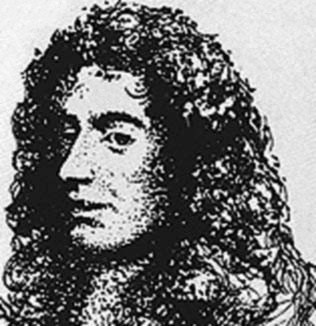
Cassini’s younger son, Jacques (Cassini II), showed an early interest in astronomy. On travels in the low countries and England, Cassini II made further astronomical and geodesic measurements and met Newton, and the astronomers [met] Halley* and [met] Flamsteed*. He joined his father when the extension of the Paris meridian was resumed in 1700 and when Cassini died in 1712 he succeeded him as director of the Paris Observatory.
Cassini II came up with a new method for determining longitude by means of the eclipses of the stars and the planets by the moon and in 1718 he completed the measurement of the arc of the meridian between Dunkirk and Perpignan. In the controversy between those whose theories were based on [supported theory of] Descartes* and those who followed Newton, Cassini supported the idea that the Earth is an elongated sphere, rather than flattened at the poles, as Newton said. For this he was criticized by Newtonians such as [criticized by] Maupertuis*, Anders Celsius and Desaguliers. Like his father, Cassini II was a skilled observer and in 1738 he made a valuable contribution to knowledge of the proper motions of the stars.
In 1740 he published “Elements d’astronomie” (“Elements of Astronomy”) and “Tables astronomiques du soleil, de la lune, des planetes, des etoiles fixes et des satellites de Jupiter et de Saturne” (“Astronomical Tables of the Sun, Moon, Planets, Fixed Stars, and Satellites of Jupiter and Saturn”) which included the first tables of the orbital motions of Saturn’s satellites. From around 1740, Cassini II increasingly left the scientific arguments about the form of the terrestial spheroid to his son, Cesar-Francois (Cassini III).
Cesar-Francois had worked with his father on his geodesic operations and after being converted to the Newtonian approach about the Earth’s shape, and in 1744 he moved on to astronomical observations and, more significantly, to the production of a new map of France. On the basis of work done by his father and himself, and other triangulation projects on the coasts and land borders of France, Cassini III brought out a preliminary map which was presented to the Academy in 1745.
After executing cartographical work in Flanders and the Netherlands, he was commissioned by the king to direct the production of new map of France on the same model. The surveying for a map on the scale of l:86,4000 began in 1750 and continued until 1756 when state funding was discontinued. Cassini III organized private finance and at his death in 1784 the map was complete with the exception of Brittany. It was completed by Cassini III’s son, Dominique (Cassini IV).
Together with his collaborators Cassini IV co-operated on a joint survey to join the Paris and Greenwich meridians for which the English effort was directed by [collaborated with] Roy*. The completed map of France, the first to be produced on modern principles of wide-ranging triangulation and topographical survey, was published in 1789. Cassini IV, who took over as director of the Observatory from his father, was also occupied with the re-organization and restoration of the Observatory. Cassini IV was arrested and imprisoned briefly in 1794 after which he retired to the family estate at Thury. He was decorated by Napoleon and Louis XVIII and became a prominent local politician.
Extra Connections: Cassini had a row with [a row with] Celsius*
Cassini work related to that of [work related to] George Graham.*
Cassini appointment to Paris was supported by [supported by] Picard*
One of their colleagues was Italian astronomer [colleague was] Viviani*
Assessment: Cassini I made valuable new astronomical observations and improved observational methods. Cassini II compiled the first tables of the orbital motions of Saturn’s satellites and his descendants are remembered mainly for their involvement in the map of France associated mainly with the name of Cassini III.
Oneliner: The Cassini family of astronomers
Bibliography:
- Dictionary of Scientific Biography.
- Encyclopedia Britannica.