Beecham Sir T
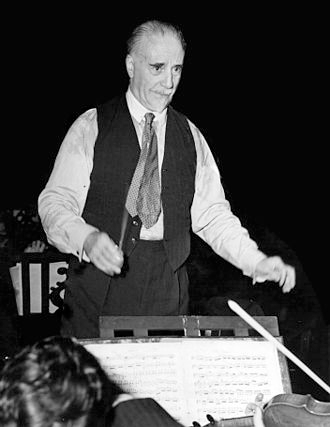
ACHIEVEMENTS: Self-made conductor, impresario. Beecham founded 6 major orchestras including the London Philharmonic and Royal Philharmonic.
NICKNAME/ALIAS: “Tommy.”
DATE AND PLACE OF BIRTH: St Helens, Lancashire, 29 April 1879.
DATE/PLACE OF DEATH/AGE AT DEATH: London, 8 March 1961. Aged 81.
DISCIPLINE: Conductor
FIELD: Music.
LANGUAGE: English
PARENTS: Father: Sir Joseph Beecham, an immensely wealthy patent medicine manufacturer. Mother: Josephine Burnett.
SIBLINGS: Emily, Henry, Josephine, Christine, three others.
SPOUSE: Three marriages:
- to Utica Welles, an American heiress, divorced in the 1940s after 30 years of separation.
- to British pianist Betty Humby who died in the 50s.
- at age 80, to orchestra administrator/secretary Shirley Hudson.
CHILDREN:
Sir Adrian Welles Beecham
Thomas Beecham III
EDUCATION: Rossall School, and a short stint at Wadham College, Oxford. Private study of composition with Charles Wood and, in Paris, with Moskosvsky.
MAJOR WORK:
LIFE AND TIMES:
Beecham’s life and work demonstrate that wealth and privilege may be tolerable when put to good use. After private study of composition, and a period accompanying voice lessons given by the great baritone Maurel, Beecham accepted his first professional conducting engagement in 1902 when the manager of the “Imperial Grand Opera Company” realized that Beecham knew the company’s entire repertoire by heart. An inheritance from a grandparent permitted Beecham to study composition for two more years.
On returning to London, he began to consider that he could be better involved in music as a conductor than as a composer. Accordingly, he hired his own orchestra and gave two series of concerts in 1905, the results were impressive enough for him to be asked to participate in the founding of the “New Symphony Orchestra.”
By 1910, Beecham had begun his long association with the music of Delius*, founded another orchestra, the modestly named “Beecham Symphony” and recruited his father as financial backer for a decade of the most ambitious musical activity imaginable.
Between 1910 and 1920, Beecham conducted 120 different operas, 60 of which were new, or at least new to England; brought Richard Strauss* and Bruno Walter to London as guest conductors; introduced Chaliapin*, Nijinsky*, Stravinsky* and the Ballets Russes to England; took the “Beecham Symphony” to Liverpool, Manchester, Birmingham, and Berlin; formed his own opera company, volunteered for a diplomatic mission to Rome; was knighted for his services to British music, inherited his father’s baronetcy; and conducted and managed Covent Garden for three seasons.
The death of his father, in the midst of a vast scheme of organizing a chain of opera theatres, and of his manager left Beecham with his finances in such a state that in 1920 he was forced to withdraw from performing for three years. Had he done nothing else in his life, Beecham would be a legend on the basis of his achievements in these early years.
Although he lacked “official” credentials as a conductor, Beecham’s musicality and knowledge put him in the first rank from the very beginning. While he was often chided for erratic use of the baton (he occasionally dropped it, or got it tangled in his coat-tails) he earned enormous respect and affection from his players and singers.
Although he could give routine, perfunctory performances of works which did not interest him, his knowledge of his chosen repertoire was encyclopedic. Beecham brought Haydn and Mozart back to public attention, both in the opera house and the concert hall, he revived neglected works of Handel and forgotten French operas, he championed Delius, organizing two major festivals of his work and publishing an exhaustive biographical study.
Still, Beecham’s taste had its odd quirks, he found Brahms boring, loathed jazz, and dismissed J.S. Bach as: "Too much counterpoint, and, what is worse, Protestant counterpoint." Conversely, he took great pleasure in encore pieces and salon music trifles that he called “lollipops,” and had no qualms about “improving” the writing of Handel and Mozart.
On returning to public activity in 1923, Beecham guaranteed a lifetime of financial trouble by attempting to launch a national opera society. The 20s also saw the beginning of an extensive recording career. Beecham guest conducted in New York, Philadelphia, Boston, Paris, Berlin and Vienna, and founded the London Philharmonic Orchestra before taking control of the Royal Opera House at Covent Garden in 1933. Beecham’s term at Covent Garden is still considered a sort of golden age.
During World War II Beecham toured the U.S., Mexico and Australia before settling into two residencies: with the Seattle Symphony and the Metropolitan Opera in New York. While in America, Beecham divorced his estranged wife and married the English pianist Betty Humby.
Beecham returned to England in 1944. A troubled relationship with the London Philharmonic led Beecham to found the Royal Philharmonic. The post-war years saw several extensive tours encompassing Italy, Spain, Portugal, Switzerland, Vienna, Paris, Canada, the U.S. and Latin America.
Through his seventies Beecham continued to work at a prodigious rate, though much reduced by his standards. He spent much of the 1950’s recording, and many of these performances are not only still on sale, but considered a standard by which others may be judged. His conducted his last opera season in Buenos Aires in 1958, and his last performance was with the Royal Philharmonic in May of 1960.
He said, famously: "There are two golden rules for an orchestra:- start together and finish together. The public doesn't give a damn what goes on in between.”
ASSESSMENT: Beecham is simultaneously a quaint relic of Victorian musicianship (re-orchestrating and ‘correcting’ scores) and the wellspring of the modern orchestra and opera company.
EXTRA CONNECTIONS: He brought Diaghilev*'s opera and ballet companies to England.
ONELINER; Sir Thomas Beecham, great 20th-century conductor
BIBLIOGRAPHY:
Atkins, Harold, & Archie Newman (eds.) Beecham Stories: Anecdotes, sayings and impresions of Sir Thomas Beecham. St. Martin’s Press : New York, 1979.
Beecham, Thomas. A Mingled Chime: Leaves from an Autobiography. Putnam : New York, 1943.
Beecham, Thomas. Frederick Delius. Hutchinson : London, 1959.
Procter-Gregg, Humphrey. Sir Thomas Beecham: conductor and impresario. As remembered by his friends and colleagues. Privately published, 1959.
Reid, Charles. Thomas Beecham: An independent biography. E.P. Dutton : New York, 1962.
Blackwood, A. Sir Thomas Beecham: the Man and the Music. (London, 1994)
Lucas J. Sir Thomas Beecham: a Biography.