Stravinsky
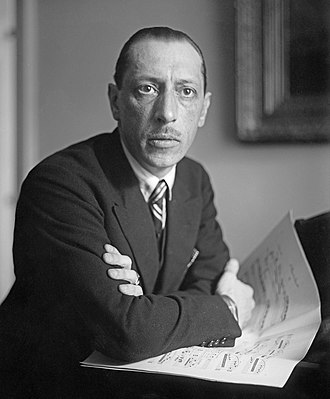
NAME: Stravinsky, Igor (Fyodorovich)
ACHIEVEMENT(S): His work had a revolutionary impact on music before and after the First World War
NICKNAME/ALIAS: None
DATE AND PLACE OF BIRTH: June 17, 1882, Oranienbaum [now Lomonosov], near St. Petersburg, Russia
DATE/PLACE OF DEATH/AGE AT DEATH: April 6, 1971, New York, N.Y. Aged 88
DISCIPLINE: Composer
FIELD: Music
LANGUAGE: Russian
EDUCATION: St. Petersburg School; St. Petersburg
University
MAJOR WORK: "The Rite of Spring"; "Firebird" ; "The Rake's Progress"
LIFE AND TIMES:
One of Stravinsky’s student friends was Vladimir, the youngest son of Russian composer <knew family of> Rimsky-Korsakov*, to whom, in 1902, Stravinsky showed some piano pieces. Stravinsky spent much time at the Rimsky-Korsakov home and attended weekly musical gatherings there.
In 1905, several of his works were performed at the weekly gatherings, including his early "Piano Sonata in F-sharp Minor". In 1908, the year Rimsky-Korsakov died, the Court Orchestra in St. Petersburg played Stravinsky's "Symphony in E-flat Major" and "The Faun and the Shepherdess", a song cycle with words by Aleksandr Pushkin.
1909 was a turning point in Stravinsky's career. Russian impresario <collaborated with> Diaghilev*, together with his adviser, dancer and choreographer <collaborated with> Fokine*, attended a concert in St. Petersburg in which two short but brilliant Stravinsky orchestral pieces were played: "Scherzo fantastique" and "Fireworks".
After the concert, he asked Stravinsky to orchestrate Grieg's "Kobold" for a ballet, "Le festin", and two Chopin piano pieces for "Les sylphides". For the 1910 season, Diaghilev invited Stravinsky to write the music, in collaboration with Fokine, for a ballet based on the Russian fairy tale, "The Firebird".
It was Stravinsky's first full-scale commission. "The Firebird", danced by the Ballets Russes at the Paris Opera in June, 1910, was an instant, dazzling success, and it made the young Stravinsky famous virtually overnight.
"The Firebird" was the first of a series of spectacular collaborations between Stravinsky and Diaghilev's Ballets Russes. Stravinsky moved to Paris with his family. In 1911, Diaghilev presented Stravinsky's second ballet "Petrushka", with <collaborated with> Nijinsky* dancing the title role. It was as successful as "The Firebird", and showed even more originality.
Stravinsky by now was on friendly terms with French composers <a pal of> Debussy* and <a pal of> Ravel* and many other celebrities in Paris. In late November, 1912, Stravinsky began a four-month tour accompanying the Ballets Russes to Berlin (where he first met composer <met> Schoenberg* ) Vienna, and London. Meanwhile, he conceived the idea of writing a kind of symphonic pagan ritual to be called "Great Sacrifice".
But Diaghilev persuaded him to cast it in the form of a ballet. The result was "The Rite
of Spring", composed over two years, 1911-13. The first performance at the Theatre des Champs Élysées in May, 1913, provoked a riot, one of the most animated first-night riots in the history of music. The spectators were scandalized. They were bewildered by the highly original composition, its shifting and audacious rhythms, and its unresolved dissonances.
Stravinsky became known as a "destructive modernist" par excellence. After the outbreak of the First World War, Diaghilev's activities were curtailed. Stravinsky found he could no longer rely on the Ballets Russes as an outlet for his compositions.
He and his family moved to Switzerland, where he lived partially on an extremely generous allowance from the English conductor and impresario <supported by> Beecham*. In 1914 ,he visited Diaghilev in Florence, and in 1915 he went with him to Rome, where he met the composer <met> Prokofiev*, newly arrived from Russia.
Stravinsky's works from 1914 to 1920 were mainly sets of short instrumental and vocal pieces based variously on Russian folk texts and idioms, or on ragtime and other style models from Western popular or dance music.
"Pulcinella" was choreographed by <work choreographed by> Massine*, with decor and costumes by <collaborated with> Picasso*, and premiered at the Paris Opera in May, 1920.
Also in 1920, the Stravinsky’s moved from Switzerland to Brittany, France, where they stayed until 1939, with Stravinsky spending considerable time in Paris. In 1921, Stravinsky toured with the Ballets Russes to Spain and London.
In 1926 he experienced a religious crisis and returned to the Russian Orthodox Church
of his youth. The conversion had a notable effect on his stage and vocal music: in such major works as the operatic oratorio, "Oedipus Rex" (1927), which uses as text the Latin translation of a libretto by <a librettist was> Cocteau*, and in the cantata "Symphony of Psalms" (1930), an overtly sacred work based on biblical texts.
Religious feeling is also evident in the ballets "Apollo Musagetes" (1928), his last ballet to be mounted by Diaghilev (it premiered only a year before Diaghilev died), "The Fairy's Kiss" (1928), and "Persephone" (1934).
In the autumn of 1939, just after the Second World War broke out in Europe, Stravinsky visited the United States and in 1940, he settled permanently in Hollywood. During the War years, Stravinsky composed two important symphonic works: "Symphony in C" (1938-40), and the "Symphony in Three Movements " (1942-45).
From 1948 to 1951, Stravinsky worked on his only full-length opera, "The Rake's Progress", with libretto by British writer <a librettist was> W.H. Auden* and the American writer Chester Kallman, based on a series of moralistic engravings by the English artist <used work of> Hogarth*.
In 1948, Stravinsky met a young conductor and scholar, Robert Craft, who was to influence the composer's last years and who was a devotee of the serial, or 12-tone, compositional techniques of composer Arnold Schoenberg, (serial music is based on the repetition of a series of tones in an arbitrary but fixed pattern without regard for traditional tonality).
Stravinsky began with a series of cautiously experimental works: "Cantata " (1951-52), "Septet" (1952-53) and "Memoriam Dylan Thomas" (1954). He then wrote a pair of hybrid masterpieces: the ballet "Agon " (1957) and the choral "Canticum Sacrum" (1955), that still retain some kind of tonal framework.
These works led to the choral work "Threni " (1958), a setting of the biblical Lamentations of Jeremiah in which a strict 12-tone method of composition is applied to chant-like material. The piece recalls earlier choral works like: "The Wedding" and: "Symphony of Psalms". In his "Movements for piano and orchestra" (1959) and his orchestral "Variations" (1964), Stravinsky refined his manner still further, pursuing a variety of serial techniques.
In 1962, he attended a dinner party at the White House hosted by President <hosted by> Kennedy* and, later in the year, after an absence of nearly 50 years, returned to Russia, where he was received by Soviet leader <received by> Krushchev*.
Stravinsky's last major work, "Requiem Canticles" (1966), is an adaptation of modern serial techniques to a personal imaginative vision that was deeply rooted in his Russian nature. At his widow's suggestion, his body was buried in Venice, on the island of San Michele, not far from Diaghilev's grave.
ASSESSMENT: A seminal figure in 20th-century music and a great composer.
EXTRA CONNECTIONS: Stravinsky planned an opera with <planned opera with> Dylan Thomas*.
<a pal was> T.S. Eliot* and <a pal of> Isherwood* were friends.
He was anticipated by <anticipated by> Satie*
He worked with <worked with> Chagall*
Balanchine*?
He influenced <influenced> Copeland*, <influenced> Britten*, <influenced> Bartok* and <influenced> Shostakovich*
Player piano*?
His Dumbarton Oaks debut was conducted by <work conducted by> Boulanger*
<his father worked with> Chaliapin* worked with his father
He was supported by <supported by> de Falla*
He met Sir <met> William Walton*
ONELINER: Igor Stravinsky, influential modern composer
BIBLIOGRAPHY:
EB
Oxford Dictionary of Music.
White, Eric Walter & Jeremy Noble, "Igor Stravinsky", in The New Grove Modern Masters: Bartok, Stravinsky, Hindemith, London: Macmillan, 1984.
Multimedia:
Just for fun, Radiolab had a segment that reflects on why stravinsky causes riots in 1913 but shows up in disney kid film 37 yrs later. http://www.radiolab.org/blogs/radiolab-blogland/2013/may/09/musical-illusions/**
PARENTS: Fyodor Ignat'yevich Stravinsky; Anna Kholodovsky
SIBLINGS: 3 brothers: 2 older, younger brother Gury
SPOUSE: 1) Katerina Nossenko; 2) Vera Soudeikine
CHILDREN: Fyodor; Ludmila; Svyatoslav Sulima; Milena