Stravinsky 2
See man node
Igor Fyodorovich Stravinsky[a] (17 June [O.S. 5 June] 1882 – 6 April 1971) was a Russian composer, conductor, and pianist with citizenship in France (from 1934) and the United States (from 1945). He is widely considered one of the most important and influential composers of the 20th century and a pivotal figure in modernist music.
Born to an established bass opera singer, Stravinsky grew up taking piano and music theory lessons. While studying law at the University of Saint Petersburg, Stravinsky met Nikolai Rimsky-Korsakov and studied under him until Rimsky-Korsakov's death in 1908.
Stravinsky met the impresario Sergei Diaghilev soon after, who commissioned Stravinsky to write three ballets: The Firebird (1910), Petrushka (1911), and The Rite of Spring (1913), the last of which brought him international fame after the near-riot at the premiere and changed the way composers understood rhythmic structure.
Stravinsky's compositional career is divided into three periods: his Russian period (1913–1920), his neoclassical period (1920–1951), and his serial period (1954–1968). Stravinsky's Russian period was characterised by influence from other Russian composers like Rimsky-Korsakov, Lyadov, and Tcherepnin, and use of Russian folk songs and themes in works like The Nightingale (1914) and Les noces (1917).
His neoclassical period exhibited themes and techniques from the classical period, like the use of the sonata form in his Octet (1923) and use of Greek mythological themes in works like Apollon musagète (1927), Oedipus rex (1927), and Persephone (1935). In his serial period, Stravinsky turned towards compositional techniques from the Second Viennese School like Arnold Schoenberg's twelve-tone technique. In Memoriam Dylan Thomas (1954) was the first of his compositions to be fully based on the technique, and Canticum Sacrum (1956) was his first to be based on a tone row. Stravinsky's last major work was the Requiem Canticles (1966), which was performed at his funeral.
Stravinsky married his first wife, Katherina Nosenko, in 1906, and they had four children. After Nosenko's death in 1939, he married Vera de Bosset, with whom Stravinsky had an affair in 1921. In the later parts of his life, Stravinsky conducted around the world, and was known for his polite, courteous, and helpful manner.
Stravinsky's reception was mixed; composers and academics of the time disliked the avant-garde nature of his music, while later writers recognized the importance of his works to the development of modernist music. Stravinsky was one of the most important composers of the 20th century, influencing composers and conductors like Aaron Copland, Philip Glass, and Robert Craft. In 1998, *Time* magazine named Stravinsky one of the 100 most influential people of the century. Stravinsky died of pulmonary edema on 6 April 1971 in New York City.
Biography
Early life, 1882–1901
Stravinsky was born on 17 June 1882 in the town of Oranienbaum on the southern coast of the Gulf of Finland, 25 mi (40 km) west of Saint Petersburg.[2][3] His father, Fyodor Ignatievich Stravinsky, was an established bass opera singer in the Kiev Opera and the Mariinsky Theatre in Saint Petersburg and his mother, Anna Kirillovna Stravinskaya (née Kholodovskaya; 1854–1939), a native of Kiev, was one of four daughters of a high-ranking official in the Kiev Ministry of Estates. Igor was the third of their four sons; his brothers were Roman, Yury, and Gury.[4] The Stravinsky family was of Polish and Russian heritage,[5] descended "from a long line of Polish grandees, senators and landowners".[6] It is traceable to the 17th and 18th centuries to the bearers of the Sulima and Strawiński coat of arms. The original family surname was Sulima-Strawiński; the name "Stravinsky" originated from the word "Strava", one of the variants of the Streva river in Lithuania.[7][8]

Stravinsky's house in Ustilug, now a museum
On 10 August 1882, Stravinsky was baptised at Nikolsky Cathedral in Saint Petersburg.[4] Until 1914, he spent most of his summers in the town of Ustilug, now in Ukraine, where his father-in-law owned an estate. Stravinsky would later compose many of his early works here, including The Rite of Spring.[9][10] Stravinsky's first school was the Second Saint Petersburg Gymnasium, where he stayed until his mid-teens. Then, he moved to Gourevitch Gymnasium, a private school, where he studied history, mathematics, and languages (Latin, Greek, and Slavonic; and French, German, and his native Russian).[11] Stravinsky expressed his general distaste for schooling and recalled being a lonely pupil: "I never came across anyone who had any real attraction for me."[12]
At around eight years old, he attended a performance of Tchaikovsky's ballet The Sleeping Beauty at the Mariinsky Theatre, which began a lifelong interest in ballets and Tchaikovsky.[13] Stravinsky took to music at an early age and began regular piano lessons at age nine, followed by tuition in music theory and composition.[14] By age fourteen, Stravinsky mastered Mendelssohn's Piano Concerto No. 1, and at age fifteen finished a piano reduction of a string quartet by Alexander Glazunov, who reportedly considered Stravinsky unmusical and thought little of his skills.[13]
Education and first compositions, 1901–1909
Despite Stravinsky's enthusiasm and ability in music, his parents expected him to study law. In 1901, he enrolled at the University of Saint Petersburg, studying criminal law and legal philosophy, but attendance at lectures was optional and he estimated that he turned up to fewer than fifty classes in his four years of study.[15]
In 1902, Stravinsky met Vladimir, a fellow student at the University of Saint Petersburg and the youngest son of Nikolai Rimsky-Korsakov. Rimsky-Korsakov at that time was arguably the leading Russian composer, and he was a professor at Saint Petersburg Conservatory. Stravinsky wished to meet him to discuss his musical aspirations. He spent the summer of 1902 with Rimsky-Korsakov and his family in Heidelberg, Germany. Rimsky-Korsakov suggested to Stravinsky that he should not enter the Saint Petersburg Conservatory but continue private lessons in theory.[16]
By the time of his father's death in 1902, Stravinsky was spending more time studying music than law.[15] His decision to pursue music full time was helped when the university was closed for two months in 1905 in the aftermath of Bloody Sunday, which prevented him from taking his final law exams.[17] In April 1906, Stravinsky received a half-course diploma and concentrated on music thereafter.[18]
In 1905, he had begun studying with Rimsky-Korsakov twice a week and came to regard him as a second father.[15] These lessons continued until Rimsky-Korsakov's death in 1908.[19] Stravinsky completed his first composition during this time, the Symphony in E-flat, catalogued as Opus 1. In the wake of Rimsky-Korsakov's death, Stravinsky composed Funeral Song, Op. 5, which was performed once and then considered lost until its re-discovery in 2015.[20]
In August 1905, Stravinsky became engaged to his first cousin, Katherina Gavrylovna Nosenko.[10] In spite of the Orthodox Church's opposition to marriage between first cousins, the couple married on 23 January 1906. They lived in the family's residence at 6 Kryukov Canal in Saint Petersburg before they moved into a new home in Ustilug, which Stravinsky designed and built, and which he later called his "heavenly place". He wrote many of his first compositions there.[21][22] It is now a museum with documents, letters, and photographs on display, and an annual Stravinsky Festival takes place in the nearby town of Lutsk.[23][24] The couple had two children, Fyodor and Ludmila, who were born in 1907 and 1908, respectively.[25]
Ballets for Diaghilev and international fame, 1909–1920

Sergei Diaghilev in a 1906 painting by Léon Bakst
By 1909, Stravinsky had composed two more pieces, Scherzo fantastique, Op. 3, and Feu d'artifice (Fireworks), Op. 4. In February of that year, both were performed in Saint Petersburg at a concert that marked a turning point in Stravinsky's career. In the audience was Sergei Diaghilev, a Russian impresario and owner of the Ballets Russes who was struck with Stravinsky's compositions. He commissioned Stravinsky to write some orchestrations for the 1909 ballet season, which were finished by April of that year. While planning for the 1910 ballet season, Diaghilev wished to stage a new ballet from fresh talent that was based on the Russian fairytale of the Firebird.[26]
After Anatoly Lyadov was given the task of composing the score, he informed Diaghilev that he needed about one year to complete it.[27] Diaghilev then asked the 28-year-old Stravinsky, who had provided satisfactory orchestrations for him for the previous season at short notice and agreed to compose a full score.[28] At about 50 minutes in length, The Firebird was revised by Stravinsky into concert suites in 1919 and 1945.[29]
The Firebird premiered at the Opera de Paris on 25 June 1910 to widespread critical acclaim and Stravinsky became an overnight sensation.[30][31] As his wife was pregnant, the Stravinskys spent the summer in La Baule in western France. In September, they moved to Clarens, Switzerland, where their second son, Soulima, was born.[32] The family would spend their summers in Russia and winters in Switzerland until 1914.[33] Diaghilev commissioned Stravinsky to score a second ballet for the 1911 Paris season. The result was Petrushka, based on the Russian folk tale featuring the titular character, a puppet, who falls in love with another, a ballerina.[34] Though it failed to capture the immediate reception that The Firebird had following its premiere at Théâtre du Châtelet in June 1911, the production continued Stravinsky's success.[35]

2008 production of The Rite of Spring by Pina Bausch

Opening measures of the "Sacrificial Dance", showing the odd metres and chords[b]
It was Stravinsky's third ballet for Diaghilev, The Rite of Spring, that caused a sensation among critics, fellow composers, and concertgoers. Based on an idea thought up by Stravinsky while composing Firebird, the production features a series of primitive pagan rituals celebrating the advent of spring.[36] Stravinsky's score contained many novel features for its time, including experiments in tonality, metre, rhythm, stress and dissonance. The radical nature of the music and choreography caused a near-riot at its premiere at the Théâtre des Champs-Élysées on 29 May 1913.[37][38]
Shortly after the premiere, Stravinsky contracted typhoid from eating bad oysters and he was confined to a Paris nursing home. He left in July 1913 and returned to Ustilug.[39] For the rest of the summer he focused on his first opera, The Nightingale, based on a story by Hans Christian Andersen, which Stravinsky had started in 1908.[40] On 15 January 1914, Stravinsky and Nosenko had their fourth child, Marie Milène (or Maria Milena). After her delivery, Nosenko was discovered to have tuberculosis and was confined to a sanatorium in Leysin in the Alps.
Stravinsky took up residence nearby, where he completed The Nightingale.[41][42] The work premiered in Paris in May 1914, after the Moscow Free Theatre had commissioned the piece for 10,000 roubles but soon became bankrupt. Diaghilev agreed that the Ballets Russes to stage it.[43][44] The opera had only lukewarm success with the public and the critics, apparently because its delicacy did not meet their expectations following the tumultuous Rite of Spring.[42] However, composers including Ravel, Bartók, and Reynaldo Hahn found much to admire in the score's craftsmanship, even claiming to detect the influence of Arnold Schoenberg.[45]

Group of supporters and members of the Ballets Russes in April 1911 (left to right: Khokhlova, Koribut-Kubitovich, Karsavina, Nijinsky, Stravinsky, Benois, Diaghilev, Notthaft, sit. Oblakova)
In April 1914, Stravinsky and his family returned to Clarens.[46] Stravinsky was ineligible for military service in the World War due to his history of typhoid.[47][47] Stravinsky managed a short visit to Ustilug to retrieve personal items just before borders were closed.[48] In June 1915, he and his family moved from Clarens to Morges, a town six miles from Lausanne on the shore of Lake Geneva. The family lived there (at three different addresses), until 1920.[49] In December 1915, Stravinsky made his conducting debut at two concerts in aid of the Red Cross with The Firebird.[50] The war and subsequent Russian Revolution in 1917 made it impossible for Stravinsky to return to his homeland.[51]
Stravinsky began to struggle financially in the late 1910s. When Russia (and its successor, the USSR) did not adhere to the Berne Convention and the aftermath of World War I left countries in ruin, royalties for performances of Stravinsky's pieces stopped coming.[52][53] Stravinsky, seeking financial assistance, approached the Swiss philanthropist Werner Reinhart, who agreed to sponsor him and largely underwrite the first performance of L'Histoire du soldat in September 1918.[54]
In gratitude, Stravinsky dedicated the work to Reinhart and gave him the original manuscript.[53] Reinhart supported Stravinsky further when he funded a series of concerts of his chamber music in 1919.[55][56] In gratitude to his benefactor, Stravinsky dedicated his Three Pieces for Solo Clarinet to Reinhart, who was an amateur clarinettist.[57] Stravinsky travelled to Paris to attend the premiere of Pulcinella by the Ballets Russes on 15 May 1920, returning to Switzerland afterwards.[58]
Life in France, 1920–1939
In June 1920, Stravinsky and his family left Switzerland for France, first settling in Carantec for the summer while they sought a permanent home in Paris.[59][60]
[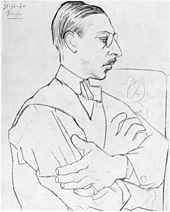
Stravinsky as drawn by Picasso in 1920
They soon heard from the couturière Coco Chanel, who invited the family to live in her Paris mansion until they had found their own residence. The Stravinskys accepted and arrived in September.[61] Chanel helped secure a guarantee for a revival production of The Rite of Spring by the Ballets Russes from December 1920 with an anonymous gift to Diaghilev that was claimed to be worth 300,000 francs.[62]
In 1920, Stravinsky signed a contract with the French piano manufacturing company Pleyel. As part of the deal, Stravinsky transcribed most of his compositions for their player piano, the Pleyela. The company helped collect Stravinsky's mechanical royalties for his works and provided him with a monthly income. In 1921, he was given studio space at their Paris headquarters where he worked and entertained friends and acquaintances.[63][64] The piano rolls were not recorded, but were instead marked up from a combination of manuscript fragments and handwritten notes by Jacques Larmanjat, musical director of Pleyel's roll department. During the 1920s, Stravinsky recorded Duo-Art piano rolls for the Aeolian Company in London and New York City, not all of which have survived.[65]

Stravinsky's second wife, Vera de Bosset, in 1921 by Serge Sudeikin
Stravinsky met Vera de Bosset in Paris in February 1921,[66] while she was married to the painter and stage designer Serge Sudeikin, and they began an affair that led to de Bosset leaving her husband in the Spring of 1922.[67]
In May 1921, Stravinsky and his family moved to Anglet, a town close to the Spanish border.[68] Their stay was short-lived as by autumn, they had settled to nearby Biarritz and Stravinsky completed his Trois mouvements de Petrouchka, a piano transcription of excerpts from Petrushka for Artur Rubinstein. Diaghilev then requested orchestrations for a revival production of Tchaikovsky's The Sleeping Beauty.[69] From then until his wife's death in 1939, Stravinsky led a double life, dividing his time between his family in Anglet, and de Bosset in Paris and on tour.[70] Nosenko reportedly bore her husband's situation "with a mixture of magnanimity, bitterness, and compassion".[71]
In June 1923, Stravinsky's ballet Les noces premiered in Paris and performed by the Ballets Russes.[72] In the following month, he started to receive money from an anonymous patron from the US who insisted on remaining anonymous and only identified themselves as "Madame". They promised to send him $6,000 in the course of three years, and sent Stravinsky an initial cheque for $1,000. Craft believed that the patron was the famed conductor Leopold Stokowski, whom Stravinsky had recently met, and theorised that the conductor wanted to win Stravinsky over to visit the US.[72][73]
Stravinsky in the 1920s
In September 1924, Stravinsky bought a new home in Nice.[74] Here, the composer re-evaluated his religious beliefs and reconnected with his Christian faith with help from a Russian priest, Father Nicholas.[75] He also thought of his future, and used the experience of conducting the premiere of his Octet at one of Serge Koussevitzky's concerts the year before to build on his career as a conductor. Koussevitzky asked Stravinsky to compose a new piece for one of his upcoming concerts; Stravinsky agreed to a piano concerto. The Concerto for Piano and Wind Instruments was first performed in May 1924 with Stravinsky as the soloist.[76]
The piece was a success, and Stravinsky secured himself the exclusive rights to perform the work for the next five years.[77] Stravinsky visited Catalonia six times, and the first time, in 1924, after holding three concerts with the Pau Casals Orchestra at the Gran Teatre del Liceu, he stated: "Barcelona will be unforgettable for me. What I liked most was the cathedral and the sardanas".[78] Following a European tour through the latter half of 1924, Stravinsky completed his first US tour in early 1925, which spanned two months.[77] It opened with Stravinsky conducting an all-Stravinsky programme at Carnegie Hall.[79]
In May 1927, Stravinsky's opera-oratorio Oedipus Rex premiered in Paris. The funding of its production was largely provided by Winnaretta Singer, Princesse Edmond de Polignac, who paid 12,000 francs for a private preview of the piece at her house. Stravinsky gave the money to Diaghilev to help finance the public performances. The premiere at the Théâtre Sarah-Bernhardt received a negative reaction, believed by painter Boris Grigoriev to be due to its tameness compared to The Firebird, which irked Stravinsky, who had started to become annoyed at the public's fixation on his early ballets.[56] In the summer of 1927 Stravinsky received a commission from Elizabeth Sprague Coolidge, his first from the US. A wealthy patron of music, Coolidge requested a thirty-minute ballet score for a festival to be held at the Library of Congress, for a $1,000 fee. Stravinsky accepted and wrote Apollo, which premiered in 1928.[80]
From 1931 to 1933, the Stravinskys lived in Voreppe, a commune near Grenoble in southeastern France.[81] In June 1934, the couple acquired French citizenship. Later in that year, they left Voreppe to live on Rue du Faubourg Saint-Honoré in Paris, where they stayed for five years.[82][83] The composer used his citizenship to publish his memoirs in French, entitled Chroniques de ma Vie in 1935, and undertook a US tour with Samuel Dushkin. His only composition of that year was the Concerto for Two Solo Pianos, which was written for himself and his son Sviatoslav using a special double piano that Pleyel had built.
The pair completed a tour of Europe and South America in 1936.[82] In April 1937 in New York City he directed his three-part ballet Jeu de cartes, a commission for Lincoln Kirstein's ballet company with choreography by George Balanchine.[84] Upon his return to Europe, Stravinsky left Paris for Annemasse near the Swiss border to be near his family, after his wife and daughters Ludmila and Milena had contracted tuberculosis and were in a sanatorium.[85] Ludmila died in late 1938, followed by his wife of 33 years, in March 1939.[86] Stravinsky himself spent five months in hospital at Sancellemoz,[87] during which time his mother also died.[86]
During his later years in Paris, Stravinsky had developed professional relationships with key people in the United States: he was already working on his Symphony in C for the Chicago Symphony Orchestra[88] and he had agreed to accept the Charles Eliot Norton Chair of Poetry of 1939–1940 at Harvard University and while there, deliver six lectures on music as part of the prestigious Charles Eliot Norton Lectures.[89][90]
Life in the United States, 1939–1971
Early US years, 1939–1945

Famous photograph of Stravinsky at a grand piano by Arnold Newman
Stravinsky arrived in New York City on 30 September 1939 and headed for Cambridge, Massachusetts, to fulfil his engagements at Harvard. During his first two months in the US, Stravinsky stayed at Gerry's Landing, the home of art historian Edward W. Forbes.[91] Vera arrived in January 1940 and the couple married on 9 March in Bedford, Massachusetts. After a period of travel, the two moved into a home in Beverly Hills, California, before they settled in Hollywood from 1941. Stravinsky felt the warmer Californian climate would benefit his health.[92] Stravinsky had adapted to life in France, but moving to America at the age of 58 was a very different prospect.
For a while, he maintained a circle of contacts and émigré friends from Russia, but he eventually found that this did not sustain his intellectual and professional life. He was drawn to the growing cultural life of Los Angeles, especially during World War II, when writers, musicians, composers, and conductors settled in the area. The music critic Bernard Holland claimed Stravinsky was especially fond of British writers, who visited him in Beverly Hills, like W. H. Auden, Christopher Isherwood, and later Dylan Thomas: "They shared the composer's taste for hard spirits – especially Aldous Huxley, with whom Stravinsky spoke in French."[93] Stravinsky and Huxley had a tradition of Saturday lunches for west coast avant-garde and luminaries.[94]
In 1940, Stravinsky completed his Symphony in C and conducted the Chicago Symphony Orchestra at its premiere later that year.[95] At this time, Stravinsky began to associate himself with film music; the first major film to use his music was Walt Disney's animated feature Fantasia (1940) which includes parts of The Rite of Spring rearranged by Leopold Stokowski to a segment depicting the history of Earth and the age of dinosaurs.[96] Orson Welles urged Stravinsky to write the score for Jane Eyre (1943), but negotiations broke down; a piece used in one of the film's hunting scenes was used in Stravinsky's orchestral work Ode (1943). An offer to score The Song of Bernadette (1943) also fell through; Stravinsky considered the terms were too much in the producer's favour. Music he had written for the film was later used in his Symphony in Three Movements.[96]
Stravinsky's unconventional dominant seventh chord in his arrangement of the "Star-Spangled Banner" led to an incident with the Boston police on 15 January 1944, and he was warned that the authorities could impose a $100 fine upon any "re-arrangement of the national anthem in whole or in part".[c] The police, as it turned out, were wrong. The law in question forbade using the national anthem "as dance music, as an exit march, or as a part of a medley of any kind",[97] but the incident soon established itself as a myth, in which Stravinsky was supposedly arrested, held in custody for several nights, and photographed for police records.[98]
On 28 December 1945, Stravinsky and his wife de Bosset became naturalised US citizens.[99] Their sponsor and witness was the actor Edward G. Robinson.[100]
Last major works, 1945–1966

Stravinsky on the cover of TIME in 1948
On the same day Stravinsky became an American citizen, he arranged for Boosey & Hawkes to publish rearrangements of several of his compositions and used his newly acquired American citizenship to secure a copyright on the material, thus allowing him to earn money from them.[101] The five-year contract was finalised and signed in January 1947 which included a guarantee of $10,000 per for the first two years, then $12,000 for the remaining three.[102]
In late 1945, Stravinsky received a commission from Europe, his first since Perséphone, in the form of a string piece for the 20th anniversary for Paul Sacher's Basle Chamber Orchestra. The Concerto in D premiered in 1947.[103] In January 1946, Stravinsky conducted the premiere of his Symphony in Three Movements at Carnegie Hall in New York City. It marked his first premiere in the US.[104]
In 1947, Stravinsky was inspired to write his English-language opera The Rake's Progress by a visit to a Chicago exhibition of the same-titled series of paintings by the eighteenth-century British artist William Hogarth, which tells the story of a fashionable wastrel descending into ruin. W. H. Auden and writer Chester Kallman worked on the libretto. The opera premiered in 1951 and marks the final work of Stravinsky's neoclassical period.[105] While composing The Rake's Progress, Stravinsky befriended Robert Craft, who became his personal assistant and close friend and encouraged the composer to write serial music. This began Stravinsky's third and final distinct musical period which lasted until his death.[106]
In 1953, Stravinsky agreed to compose a new opera with a libretto by Dylan Thomas, which detailed the recreation of the world after one man and one woman remained on Earth after a nuclear disaster. Development on the project came to a sudden end following Thomas's death in November of that year. Stravinsky completed In Memoriam Dylan Thomas, a piece for tenor, string quartet, and four trombones, in 1954.[107]
Stravinsky in 1962
In 1961, Stravinsky, de Bosset, and Craft travelled to London, Zürich and Cairo on their way to Australia where Stravinsky and Craft conducted all-Stravinsky concerts in Sydney and Melbourne. They returned to California via New Zealand, Tahiti, and Mexico.[108][109] In January 1962, during his tour's stop in Washington, D.C., Stravinsky attended a dinner at the White House with President John F. Kennedy in honour of his eightieth birthday, where he received a special medal for "the recognition his music has achieved throughout the world".[110][111]
In September 1962, Stravinsky returned to Russia for the first time since 1914, accepting an invitation from the Union of Soviet Composers to conduct six performances in Moscow and Leningrad. During the three-week visit he met with Soviet Premier Nikita Khrushchev and several leading Soviet composers, including Dmitri Shostakovich and Aram Khachaturian.[112][113] Stravinsky did not return to his Hollywood home until December 1962 in what was almost eight months of continual travelling.[114] Following the assassination of Kennedy in 1963, Stravinsky completed his Elegy for J.F.K. in the following year. The two-minute work took the composer two days to write.[115]
By early 1964, the long periods of travel started to affect Stravinsky's health. His case of polycythemia worsened and his friends noticed that his movements and speech had slowed.[115] In 1965, Stravinsky agreed to have David Oppenheim produce a documentary film about himself for the CBS network. It involved a film crew following the composer at home and on tour that year, and he was paid $10,000 for the production.[116] The documentary includes Stravinsky's visit to Les Tilleuls, the house in Clarens where he wrote the majority of The Rite of Spring. The crew asked Soviet authorities for permission to film Stravinsky returning to his hometown of Ustilug, but the request was denied.[117] In 1966, Stravinsky completed his last major work, the Requiem Canticles.[118]
Final years and death, 1967–1971
In February 1967, Stravinsky and Craft directed their own concert in Miami, Florida, the composer's first in that state. By this time, Stravinsky's typical performance fee had grown to $10,000. However subsequently, upon doctor's orders, offers to perform that required him to fly were generally declined.[119] An exception to this was a concert at Massey Hall in Toronto in May 1967, where he conducted the relatively physically undemanding Pulcinella suite with the Toronto Symphony Orchestra. It was his final performance as conductor.[120] While backstage at the venue, Stravinsky informed Craft that he believed he had suffered a stroke.[119] In August 1967, Stravinsky was hospitalised in Hollywood for bleeding stomach ulcers and thrombosis which required a blood transfusion.
By 1968, Stravinsky had recovered enough to resume touring across the US with him in the audience while Craft took to the conductor's post for the majority of the concerts.[121] In May 1968, Stravinsky completed the piano arrangement of two songs by Hugo Wolf for a small orchestra.[121] In October, Stravinsky, de Bosset, and Craft travelled to Zürich to sort out business matters with Stravinsky's family. While there, Stravinsky's son Fyodor held the manuscript of The Rite of Spring while Stravinsky signed it before giving it to de Bosset.[122] The three considered relocating to Switzerland as they had become increasingly less fond of Hollywood, but they decided against it and returned to the US.[123]
In October 1969, after close to three decades in California and Stravinsky being denied to travel overseas by his doctors due to ill health, Stravinsky and de Bosset secured a two-year lease for a luxury three bedroom apartment in Essex House in New York City. Craft moved in with them, effectively putting his career on hold to care for the ailing composer.[124] Among Stravinsky's final projects was orchestrating two preludes from Bach's The Well-Tempered Clavier, but it was never completed.[125] In June 1970, he travelled to Évian-les-Bains by Lake Geneva where he reunited with his eldest son Fyodor and niece Xenia.[126]
On 18 March 1971, Stravinsky was taken to Lenox Hill Hospital with pulmonary edema where he stayed for ten days. On 29 March, he moved into a newly furnished apartment at 920 Fifth Avenue, his first city apartment since living in Paris in 1939. After a period of well-being, the edema returned on 4 April and de Bosset insisted that medical equipment should be installed in the apartment.[127] Stravinsky soon stopped eating and drinking and died at 5:20 a.m. on 6 April at the age of 88. The cause on his death certificate is heart failure. A funeral service was held three days later at Frank E. Campbell Funeral Chapel.[125][128] In accordance with his wishes, he was buried in the Russian corner of the cemetery island of San Michele in Venice, several yards from the tomb of Sergei Diaghilev,[129] having been brought there by gondola after a service at Santi Giovanni e Paolo led by Cherubin Malissianos, Archimandrite of the Greek Orthodox Church.[129][130] During the service, his Requiem Canticles and organ music by Andrea Gabrieli were performed.[131]
Music
Further information: List of compositions by Igor Stravinsky
Wikipedia
Knowledge Web Content (see main node)
NAME: Stravinsky, Igor (Fyodorovich)
ACHIEVEMENT(S): His work had a revolutionary impact on music before and after the First World War
DATE AND PLACE OF BIRTH: June 17, 1882, Oranienbaum [now Lomonosov], near
St. Petersburg, Russia
DATE/PLACE OF DEATH/AGE AT DEATH: April 6, 1971, New York, N.Y. Aged 88
DISCIPLINE: Composer
FIELD: Music
EDUCATION: St. Petersburg School; St. Petersburg University
MAJOR WORK: "The Rite of Spring"; "Firebird" ; "The Rake's Progress"
LIFE AND TIMES:
One of Stravinsky’s student friends was Vladimir, the youngest son of Russian composer Rimsky-Korsakov*, to whom, in 1902, Stravinsky showed some piano pieces. Stravinsky spent much time at the Rimsky-Korsakov home and attended weekly musical gatherings there.
In 1905, several of his works were performed at the weekly gatherings, including his early "Piano Sonata in F-sharp Minor". In 1908, the year Rimsky-Korsakov died, the Court Orchestra in St. Petersburg played Stravinsky's "Symphony in E-flat Major" and "The Faun and the Shepherdess", a song cycle with words by Aleksandr Pushkin.
1909 was a turning point in Stravinsky's career. Russian impresario Diaghilev*, together with his adviser, dancer and choreographer Fokine*, attended a concert in St. Petersburg in which two short but brilliant Stravinsky orchestral pieces were played: "Scherzo fantastique" and "Fireworks".
After the concert, he asked Stravinsky to orchestrate Grieg's "Kobold" for a ballet, "Le festin", and two Chopin piano pieces for "Les sylphides". For the 1910 season, Diaghilev invited Stravinsky to write the music, in collaboration with Fokine, for a ballet based on the Russian fairy tale, "The Firebird".
It was Stravinsky's first full-scale commission. "The Firebird", danced by the Ballets Russes at the Paris Opera in June, 1910, was an instant, dazzling success, and it made the young Stravinsky famous virtually overnight.
"The Firebird" was the first of a series of spectacular collaborations between Stravinsky and Diaghilev's Ballets Russes. Stravinsky moved to Paris with his family. In 1911, Diaghilev presented Stravinsky's second ballet "Petrushka", with Nijinsky* dancing the title role. It was as successful as "The Firebird", and showed even more originality.
Stravinsky by now was on friendly terms with French composers Debussy* and Ravel* and many other celebrities in Paris. In late November, 1912, Stravinsky began a four-month tour accompanying the Ballets Russes to Berlin (where he first met composer Schoenberg* ) Vienna, and London. Meanwhile, he conceived the idea of writing a kind of symphonic pagan ritual to be called "Great Sacrifice".
But Diaghilev persuaded him to cast it in the form of a ballet. The result was "The Rite
of Spring", composed over two years, 1911-13. The first performance at the Theatre des Champs Élysées in May, 1913, provoked a riot, one of the most animated first-night riots in the history of music. The spectators were scandalized. They were bewildered by the highly original composition, its shifting and audacious rhythms, and its unresolved dissonances.
Stravinsky became known as a "destructive modernist" par excellence. After the outbreak of the First World War, Diaghilev's activities were curtailed. Stravinsky found he could no longer rely on the Ballets Russes as an outlet for his compositions.
He and his family moved to Switzerland, where he lived partially on an extremely generous allowance from the English conductor and impresario Beecham*. In 1914 ,he visited Diaghilev in Florence, and in 1915 he went with him to Rome, where he met the composer Prokofiev*, newly arrived from Russia.
Stravinsky's works from 1914 to 1920 were mainly sets of short instrumental and vocal pieces based variously on Russian folk texts and idioms, or on ragtime and other style models from Western popular or dance music.
"Pulcinella" was choreographed by Massine*, with decor and costumes by Picasso*, and premiered at the Paris Opera in May, 1920.
Also in 1920, the Stravinsky’s moved from Switzerland to Brittany, France, where they stayed until 1939, with Stravinsky spending considerable time in Paris. In 1921, Stravinsky toured with the Ballets Russes to Spain and London.
In 1926 he experienced a religious crisis and returned to the Russian Orthodox Church
of his youth. The conversion had a notable effect on his stage and vocal music: in such major works as the operatic oratorio, "Oedipus Rex" (1927), which uses as text the Latin translation of a libretto by Cocteau*, and in the cantata "Symphony of Psalms" (1930), an overtly sacred work based on biblical texts.
Religious feeling is also evident in the ballets "Apollo Musagetes" (1928), his last ballet to be mounted by Diaghilev (it premiered only a year before Diaghilev died), "The Fairy's Kiss" (1928), and "Persephone" (1934).
In the autumn of 1939, just after the Second World War broke out in Europe, Stravinsky visited the United States and in 1940, he settled permanently in Hollywood. During the War years, Stravinsky composed two important symphonic works: "Symphony in C" (1938-40), and the "Symphony in Three Movements " (1942-45).
From 1948 to 1951, Stravinsky worked on his only full-length opera, "The Rake's Progress", with libretto by British writer W.H. Auden* and the American writer Chester Kallman, based on a series of moralistic engravings by the English artist Hogarth*.
In 1948, Stravinsky met a young conductor and scholar, Robert Craft, who was to influence the composer's last years and who was a devotee of the serial, or 12-tone, compositional techniques of composer Arnold Schoenberg, (serial music is based on the repetition of a series of tones in an arbitrary but fixed pattern without regard for traditional tonality).
Stravinsky began with a series of cautiously experimental works: "Cantata " (1951-52), "Septet" (1952-53) and "Memoriam Dylan Thomas" (1954). He then wrote a pair of hybrid masterpieces: the ballet "Agon " (1957) and the choral "Canticum Sacrum" (1955), that still retain some kind of tonal framework.
These works led to the choral work "Threni " (1958), a setting of the biblical Lamentations of Jeremiah in which a strict 12-tone method of composition is applied to chant-like material. The piece recalls earlier choral works like: "The Wedding" and: "Symphony of Psalms". In his "Movements for piano and orchestra" (1959) and his orchestral "Variations" (1964), Stravinsky refined his manner still further, pursuing a variety of serial techniques.
In 1962, he attended a dinner party at the White House hosted by President Kennedy* and, later in the year, after an absence of nearly 50 years, returned to Russia, where he was received by Soviet leader Krushchev*.
Stravinsky's last major work, "Requiem Canticles" (1966), is an adaptation of modern serial techniques to a personal imaginative vision that was deeply rooted in his Russian nature. At his widow's suggestion, his body was buried in Venice, on the island of San Michele, not far from Diaghilev's grave.
ASSESSMENT: A seminal figure in 20th-century music and a great composer.
EXTRA CONNECTIONS: Stravinsky planned an opera with Dylan Thomas*.
T.S. Eliot* andIsherwood* were friends.
He was anticipated by Satie*
He worked with Chagall*
Balanchine*?
He influenced Copeland*, Britten*, Bartok* and Shostakovich*
Player piano*?
His Dumbarton Oaks debut was conducted by Boulanger*
Chaliapin* worked with his father
He was supported by de Falla*
He met Sir William Walton*
ONELINER: Igor Stravinsky, influential modern composer
BIBLIOGRAPHY:
EB
Oxford Dictionary of Music.
White, Eric Walter & Jeremy Noble, "Igor Stravinsky", inThe New Grove Modern Masters: Bartok, Stravinsky, Hindemith,London: Macmillan, 1984.
LANGUAGE: Russian
PARENTS: Fyodor Ignat'yevich Stravinsky; Anna Kholodovsky
SIBLINGS: 3 brothers: 2 older, younger brother Gury
SPOUSE: 1) Katerina Nossenko; 2) Vera Soudeikine
CHILDREN: Fyodor; Ludmila; Svyatoslav Sulima; Milena
just for fun, Radiolab had a segment that reflects on why stravinsky causes riots in 1913 but shows up in disney kid film 37 yrs later. http://www.radiolab.org/blogs/radiolab-blogland/2013/may/09/musical-illusions/**