Proudhon, JP
His best-known assertion is that *****"property is theft!", contained in his first major work, What Is Property? Or, an Inquiry into the Principle of Right and Government (Qu'est-ce que la propriété?
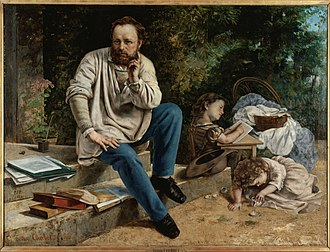
Pierre-Joseph Proudhon 15 January 1809 – 19 January 1865) was a French socialist, politician, philosopher, economist and the founder of mutualistphilosophy. He was the first person to declare himself an anarchist,[9][10]^ using that term and is widely regarded as one of anarchism's most influential theorists. Proudhon is considered by many to be the "father of anarchism".[11]^
Proudhon became a member of the French Parliament after the Revolution of 1848, whereafter he referred to himself as a *federalist*.[12]^(https://en.wikipedia.org/wiki/Pierre-Joseph_Proudhon#cite_note-12) Proudhon described the liberty he pursued as "the synthesis of communism and property".[13]^(https://en.wikipedia.org/wiki/Pierre-Joseph_Proudhon#cite_note-13) Some consider his mutualism to be part of individualist anarchism[14]^(https://en.wikipedia.org/wiki/Pierre-Joseph_Proudhon#cite_note-14)[15]^(https://en.wikipedia.org/wiki/Pierre-Joseph_Proudhon#cite_note-15)[16]^(https://en.wikipedia.org/wiki/Pierre-Joseph_Proudhon#cite_note-16) while others regard it to be part of social anarchism.[17]^(https://en.wikipedia.org/wiki/Pierre-Joseph_Proudhon#cite_note-17)[18]^(https://en.wikipedia.org/wiki/Pierre-Joseph_Proudhon#cite_note-18)[19]^(https://en.wikipedia.org/wiki/Pierre-Joseph_Proudhon#cite_note-AFAQ-19)
Proudhon, who was born in Besançon, was a printer who taught himself Latin in order to better print books in the language. His best-known assertion is that "property is theft!", contained in his first major work, *What Is Property? Or, an Inquiry into the Principle of Right and Government* (Qu'est-ce que la propriété? Recherche sur le principe du droit et du gouvernement), published in 1840. The book's publication attracted the attention of the French authorities.
It also attracted the scrutiny of Karl Marx, who started a correspondence with its author. The two influenced each other and they met in Paris while Marx was exiled there. Their friendship finally ended when Marx responded to Proudhon's The System of Economic Contradictions, or The Philosophy of Poverty with the provocatively titled *The Poverty of Philosophy*. The dispute became one of the sources of the split between the anarchist and Marxist wings of the International Working Men's Association. Some such as Edmund Wilson have contended that Marx's attack on Proudhon had its origin in the latter's defense of Karl Grün, whom Marx bitterly disliked, but who had been preparing translations of Proudhon's work.[20]^(https://en.wikipedia.org/wiki/Pierre-Joseph_Proudhon#cite_note-Hoffman_1967-20)[21]^(https://en.wikipedia.org/wiki/Pierre-Joseph_Proudhon#cite_note-Leonard_1979-21)[22]^(https://en.wikipedia.org/wiki/Pierre-Joseph_Proudhon#cite_note-McKay_2011-22)
Proudhon favored**workers' council**and associations or**cooperatives**as well as individual worker/peasant possession over private ownership or the**nationalization**of land and workplaces. He considered social revolution to be achievable in a peaceful manner. In The Confessions of a Revolutionary, Proudhon asserted that "Anarchy is Order Without Power", the phrase which much later inspired in the view of some the anarchist circled-A symbol, today "one of the most common graffiti on the urban landscape".[23]^(https://en.wikipedia.org/wiki/Pierre-Joseph_Proudhon#cite_note-23)
Proudhon unsuccessfully tried to create a national bank, to be funded by what became an abortive attempt at an income tax on capitalists and shareholders. Similar in some respects to a credit union, it would have given interest-free loans.[24]^(https://en.wikipedia.org/wiki/Pierre-Joseph_Proudhon#cite_note-24) After the death of his follower Mikhail Bakunin, Proudhon's libertarian socialism diverged into individualist anarchism, collectivist anarchism, anarcho-communism and anarcho-syndicalism, with notable proponents such as Carlo Cafiero, Joseph Déjacque, Peter Kropotkin and Benjamin Tucker.[19]^(https://en.wikipedia.org/wiki/Pierre-Joseph_Proudhon#cite_note-AFAQ-19)
Mutualism
Proudhon adopted the term mutualism for his brand of anarchism and socialism which involved control of the means of production by the workers. Inhis vision, self-employed artisans, peasants and cooperatives would trade their products on the market. For Proudhon, factories and other large workplaces would be run by "labor associations" operating on directly democratic principles. The state would be abolished and instead society would be organized by a federation of "free communes" (a commune is a local municipality in French). In 1863, Proudhon wrote: "All my economic ideas as developed over twenty-five years can be summed up in the words: agricultural-industrial federation. All my political ideas boil down to a similar formula: political federation or decentralization".[65]^(https://en.wikipedia.org/wiki/Pierre-Joseph_Proudhon#cite_note-65)
Proudhon's grave in Paris
Proudhon called this use-ownership possession (possession) and this economic system mutualism (mutualisme), having many arguments against entitlement to land and capital, including reasons based on morality, economics, politics and individual liberty. One such argument was that it enabled profit which in turn led to social instability and war by creating cycles of debt that eventually overcame the capacity of labor to pay them off. Another was that it produced despotism and turned workers into wage workers subject to the authority of a boss. In What Is Property?, Proudhon described the liberty he pursued as "the synthesis of communism and property",[19]^(https://en.wikipedia.org/wiki/Pierre-Joseph_Proudhon#cite_note-AFAQ-19) further writing:
Property, acting by exclusion and encroachment, while population was increasing, has been the life-principle and definitive cause of all revolutions. Religious wars, and wars of conquest, when they have stopped short of the extermination of races, have been only accidental disturbances, soon repaired by the mathematical progression of the life of nations. The downfall and death of societies are due to the power of accumulation possessed by property.[66]^(https://en.wikipedia.org/wiki/Pierre-Joseph_Proudhon#cite_note-66)
Proudhon continued to oppose both capitalist and state property. In Theory of Property, Proudhon maintained that "[n]ow in 1840, I categorically rejected the notion of property for both the group and the individual", but then he also states his new theory of property that "property is the greatest revolutionary force which exists, with an unequaled capacity for setting itself against authority" and the "principal function of private property within the political system will be to act as a counterweight to the power of the State, and by so doing to insure the liberty of the individual".
However, the authors of *An Anarchist FAQ* write that "this is a common anarchist position. Anarchists are well aware that possession is a source of independence within capitalism and so should be supported".[67]^(https://en.wikipedia.org/wiki/Pierre-Joseph_Proudhon#cite_note-McKay_2012-67) At the same time, Proudhon continued to oppose concentrations of wealth and property, arguing for small-scale property ownership associated with peasants and artisans. Proudhon also still opposed private property in land, writing: "What I cannot accept, regarding land, is that the work put in gives a right to ownership of what has been worked on." In addition, Proudhon still believed that property should be more equally distributed and limited in size to that actually used by individuals, families and workers associations.[68]^(https://en.wikipedia.org/wiki/Pierre-Joseph_Proudhon#cite_note-68) Proudhon supported the right of inheritance and defended "as one of the foundations of the family and society",[69]^(https://en.wikipedia.org/wiki/Pierre-Joseph_Proudhon#cite_note-69) but he refused to extend this beyond personal possessions, arguing that "[u]nder the law of association, transmission of wealth does not apply to the instruments of labour".
As a consequence of his opposition to profit, wage labour, worker exploitation, ownership of land and capital as well as to state property, Proudhon rejected both capitalism and state socialism, including authoritarian socialism and other authoritarian and compulsory forms of communism which advocated state property.
The authors of An Anarchist FAQ argue that his opposition to "communism" was because "libertarian communism", while having some forerunners such as François-Noël Babeuf, would not be as widespread until after his death and so, like Max Stirner, "he was directing his critique against the various forms of state communism which did [exist]".[70]^(https://en.wikipedia.org/wiki/Pierre-Joseph_Proudhon#cite_note-70) While opposed to the charging of interest and rent, Proudhon did not seek to abolish them by law, writing: "I protest that when I criticized the complex of institutions of which property is the foundation stone, I never meant to forbid or suppress, by sovereign decree, ground rent and interest on capital. I think that all these manifestations of human activity should remain free and voluntary for all: I ask for them no modifications, restrictions or suppressions, other than those which result naturally and of necessity from the universalization of the principle of reciprocity which I propose."[71]^(https://en.wikipedia.org/wiki/Pierre-Joseph_Proudhon#cite_note-71)
While deeply critical of capitalism, Proudhon also objected to those contemporary in the socialist movement who advocated centralized hierarchical forms of association or state control of the economy. In a sequence of commentaries from *What Is Property?* (1840),
Property is impossible, because it demands something for nothing.
Property is impossible because wherever it exists production costs more than it is worth.
Property is impossible, because, with a given capital, production is proportional to labor, not to property.
Property is impossible, because it is homicide.
Yes, I have attacked property, and shall attack it again.
Property is theft
While Proudhon was a revolutionary, his revolution did not mean civil war or violent upheaval, but rather the transformation of society. This transformation was essentially moral in nature and demanded the highest ethics from those who sought change. It was monetary reform, combined with organizing a credit bank and workers associations, that Proudhon proposed to use as a lever to bring about the organization of society along new lines. This ethical socialism[98]^(https://en.wikipedia.org/wiki/Pierre-Joseph_Proudhon#cite_note-98) has been described as part of the liberal socialist[99]^(https://en.wikipedia.org/wiki/Pierre-Joseph_Proudhon#cite_note-99) tradition which is for egalitarianism and free markets, with Proudhon, among other anarchists, taking "a commitment to narrow down the sphere of activity of the state".[100]^(https://en.wikipedia.org/wiki/Pierre-Joseph_Proudhon#cite_note-100) James Boyle quotes Proudhon as stating that socialism is "every aspiration towards the amelioration of society" and then admitting that "we are all socialists" under this definition.[101]^(https://en.wikipedia.org/wiki/Pierre-Joseph_Proudhon#cite_note-101)
La Guerre et la Paix (War and Peace, 1861)
Proudhon's Sociology of War
Aaron Noland
The American Journal of Economics and Sociology
Vol. 29, No. 3 (Jul., 1970), pp. 289-304 (16 pages)