Tolstoy, Leo
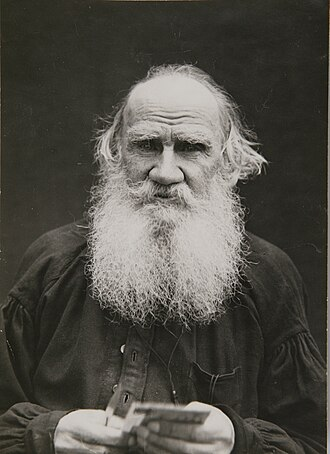
NAME: Tolstoy, Leo (Lev Nikolayevich, Count Tolstoy).
ACHIEVEMENTS: Major Russian novelist
NICKNAME/ALIAS: None.
DATE/PLACE OF BIRTH: 28th August 1828, Yasnaya Polyana, Tula, Russia.
DATE/PLACE OF DEATH/AGE AT D EATH: 7th November 1910, Astapovo, Ryazan, Russia. Aged 82.
CATEGORY: Writer.
PROFESSION/CRAFT ASSOCIATION: Literature.
LANGUAGE: Russian.
PARENTS: Nikolay Ilich, Count Tolstoy and Mariya Nikolayevna
SIBLINGS: Four.
SPOUSE: Sonya Andreyevna Bers.
CHILDREN: Thirteen, of whom ten survived infancy.
EDUCATION: Privately at home.
University of Kazan.
MAJOR WORK: "War and Peace" and "Anna Karenina".
LIFE AND TIMES:
Tolstoy was educated by tutors and went to the University of Kazan in 1844, to study Oriental languages. He transferred to the law faculty soon afterwards, but left in 1847, without a degree. Returning to the family estate of Yasnaya Polyana, he planned to manage the estate and improve the life of his serfs and began keeping the diary in which he wrote rules for living, his aims in life and ideas about his novels.
Having joined the army in 1851, he went to the Caucasus where his older brother was an army officer. He became involved in the <involved in> Crimean War*, in which Russia fought against the Turks, French and British from 1853- to 1856.
In 1852, "Childhood", a fictionalised account of his own early years, was published in a
literary journal edited by the poet Nikolay Nekrasov. It was well received, and he followed it with stories based on his army experiences. He resigned from the army when the war ended.
After a short spell in Paris, which he spent gambling his money, Tolstoy returned to Russia in 1857. There, he set up a school for peasant children at Yasnaya Polyana and travelled in Western Europe, studying educational practices. He also published a journal for which he wrote some radical articles on education.
In 1854, Tolstoy wrote a sequel to "Childhood" called "Boyhood" and followed this with "Youth" in 1857. He began experimenting with new ways of propagating his ideas
about education, morality and philosophy. His novel "Lucerne", published in1857, is written in diary form, in which he first relates an event, then reflects on its meaning and finally examines the process of reflection.
In "Three Deaths", he examines the deaths of a noblewoman, a peasant and a tree, comparing human behaviour unfavourably with nature. "The Story of a Horse", written in 1863, is a famous example of Tolstoy's technique of de-familiarisation, where he uses shock tactics to sharpen the awareness of the reader. In the same year, he published his novel "The Cossacks", in which his protagonist, a degenerate and arrogant aristocrat,
learns humility and love of his fellowmen through living a life in tune with nature.
In 1862, he married Sonya Andreyevna Bers, the daughter of a Moscow doctor and set up his new family life at Yasnaya Polyana. There he began his great masterpiece, "War and Peace" in 1865 and continued working on it for the next four years. The title refers to the Napoleonic Wars in Europe and the narrative, beginning in 1805, includes the period of peace after Napoleon's victory at Austerlitz, the invasion of Russia in 1812 and the end of the war.
He included a number of essays on history and war in the second half of the book. These re-stated his belief that overviews of history do not produce a true picture of events, but that it is the many small actions that actually makes history.
Tolstoy began his second masterpiece, "Anna Karenina", which he wrote between 1875-77. When he had completed these two novels, he went through a period of depression, during which he wrote "My Confession" 1884. Observing the peace which religion brought to the ordinary people, he turned towards his family faith, the Russian Orthodox Church.
Among his principles was non-resistance to evil, by which Tolstoy meant that evil must not be resisted by evil means, which included violence. This was the doctrine which later inspired <inspired> Gandhi*, Indian Prime Minister.
Tolstoy's pacifist stance meant disapproval of a government which used violence to enforce law and order, so he found himself in the position of a radical left-winger, even an anarchist, advocating the refusal of military service and the refusal to vote or acknowledge the power of the law courts.
In the early eighties he wrote "An Examination of Dogmatic Theology", "Union and Translation of the Four Gospels", "What I Believe" and many other treatises. He continued to write fiction, but much of it was held back by his need to be didactic and moralistic.
One work which did succeed was the novella "The Death of Ivan Ilyich" (1886).
In 1891, he wrote "The Kreutzer Sonata", a novella about a man who murders his wife. In 1898, he wrote "What is Art", in which he stated that many famous works of art were not "real" art, because they had not arisen as a response to life but were merely mimicking existing art. He maintained that "real" art is the result of a particular experience, then expressed by what he called "infection".
Tolstoy rated his own novels as bad, because they were lacking in moral force, while works he considered to be good included <a fan of> Dostoyevsky's* "The House of the Dead".
He published "Resurrection" in 1899, using the royalties to help a religious sect who were being persecuted and financing the journey of the <supported> Dukhobors* to Canada. Two years later, in 1901, Tolstoy was officially expelled from the Russian Orthodox Church.
His last years and his marriage were unhappy. Only his daughter Aleksandra joined his faith. The rest of the family was opposed to it and Tolstoy agonised over the difference between his principles and his actions.
Eventually, he left Yasnaya Polyana with his daughter and his doctor. He died at a railway station in Astapova.
ASSESSMENT: Tolstoy's two novels "War and Peace" and "Anna Karenina" are acknowledged as among the greatest novels ever written.
EXTRA CONNECTIONS: Met and influenced Czech President <influenced> Tomáš Masaryk*
He was compared with <compared with> Chekhov*
He was an admirer of <a fan of> Chaliapin*
US editor <a fan was> Howells* was a fan.
Influenced novelist <influenced> Thomas Mann*.
Blocked reformer/chemist <blocked career of> Mendeleyev’s* career.
Attended premiere of conductor/composer <heard work of> Offenbach’s* 1857 London season.
<work used by> Prokofiev* wrote an opera based on “War and Peace”
Met US writer <met> Salome*
He knew and disliked <knew and disliked> Turgenev*
He influenced <influenced> Wittgenstein*
Was influenced by <influenced by> naturalism*
ONELINER: Leo Tolstoy, great Russian novelist
BIBLIOGRAPHY:
Wilson, A. N., Tolstoy.