Utopian Community
....
In the United States and Europe, during the Second Great Awakening (ca. 1790–1840) and thereafter, many radical religious groups formed utopian societies in which faith could govern all aspects of members' lives. These utopian societies included the Shakers, who originated in England in the 18th century and arrived in America in 1774.
A number of religious utopian societies from Europe came to the United States in the 18th and 19th centuries, including the Society of the Woman in the Wilderness (led by Johannes Kelpius (1667–1708)), the Ephrata Cloister (established in 1732) and the Harmony Society, among others. The Harmony Society was a Christian theosophy and pietist group founded in Iptingen, Germany, in 1785. Due to religious persecution by the Lutheran Church and the government in Württemberg,[19] the society moved to the United States on October 7, 1803, settling in Pennsylvania. On February 15, 1805, about 400 followers formally organized the Harmony Society, placing all their goods in common. The group lasted until 1905, making it one of the longest-running financially successful communes in American history.
The Oneida Community, founded by John Humphrey Noyes in Oneida, New York, was a utopian religious commune that lasted from 1848 to 1881. Although this utopian experiment has become better known today for its manufacture of Oneida silverware, it was one of the longest-running communes in American history. The Amana Colonies were communal settlements in Iowa, started by radical German pietists, which lasted from 1855 to 1932. The Amana Corporation, manufacturer of refrigerators and household appliances, was originally started by the group. Other examples are Fountain Grove (founded in 1875), Riker's Holy City and other Californian utopian colonies between 1855 and 1955 (Hine), as well as Sointula[20] in British Columbia, Canada. The Amish and Hutterites can also be considered an attempt towards religious utopia. A wide variety of intentional communities with some type of faith-based ideas have also started across the world.
Anthropologist Richard Sosis examined 200 communes in the 19th-century United States, both religious and secular (mostly utopian socialist). 39 percent of the religious communes were still functioning 20 years after their founding while only 6 percent of the secular communes were.[21] The number of costly sacrifices that a religious commune demanded from its members had a linear effect on its longevity, while in secular communes demands for costly sacrifices did not correlate with longevity and the majority of the secular communes failed within 8 years.
Sosis cites anthropologist Roy Rappaport in arguing that rituals and laws are more effective when sacralized.[22] Social psychologist Jonathan Haidt cites Sosis's research in his 2012 book The Righteous Mind as the best evidence that religion is an adaptive solution to the free-rider problem by enabling cooperation without kinship.[23] Evolutionary medicine researcher Randolph M. Nesse and theoretical biologist Mary Jane West-Eberhard have argued instead that because humans with altruistic tendencies are preferred as social partners they receive fitness advantages by social selection,[list 1] with Nesse arguing further that social selection enabled humans as a species to become extraordinarily cooperative and capable of creating culture.[28]
....
Modern Utopias
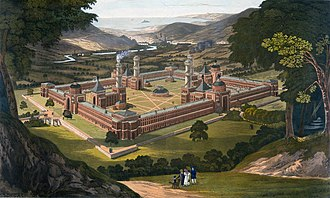
[New Harmony, Indiana , a Utopian attempt, depicted as proposed by Robert Owen
In the 21st century, discussions around utopia for some authors include post-scarcity economics, late capitalism, and universal basic income; for example, the "human capitalism" utopia envisioned in Utopia for Realists (2016) includes a universal basic income and a 15-hour workweek, along with open borders.[45]
Scandinavian nations, which as of 2019 ranked at the top of the World Happiness Report, are sometimes cited as modern utopias, although British author Michael Booth has called that a myth and wrote a 2014 book about the Nordic countries.[46]
Economics
Main articles: Utopian socialism, Fourierism, Icarians, Owenism, List of Fourierist Associations in the United States, and List of Owenite communities in the United States
Particularly in the early 19th century, several utopian ideas arose, often in response to the belief that social disruption was created and caused by the development of commercialism and capitalism. These ideas are often grouped in a greater "utopian socialist" movement, due to their shared characteristics. A once common characteristic is an egalitarian distribution of goods, frequently with the total abolition of money. Citizens only do work which they enjoy and which is for the common good, leaving them with ample time for the cultivation of the arts and sciences.
One classic example of such a utopia appears in Edward Bellamy's 1888 novel Looking Backward. William Morris depicts another socialist utopia in his 1890 novel News from Nowhere, written partially in response to the top-down (bureaucratic) nature of Bellamy's utopia, which Morris criticized. However, as the socialist movement developed, it moved away from utopianism; Marx in particular became a harsh critic of earlier socialism which he described as "utopian". (For more information, see the History of Socialism article.) In a materialist utopian society, the economy is perfect; there is no inflation and only perfect social and financial equality exists.
Edward Gibbon Wakefield's utopian theorizing on systematic colonial settlement policy in the early-19th century also centred on economic considerations, but with a view to preserving class distinctions;[47] Wakefield influenced several colonies founded in New Zealand and Australia in the 1830s, 1840s and 1850s.
In 1905, H.G. Wells published A Modern Utopia, which was widely read and admired and provoked much discussion. Also consider Eric Frank Russell's book The Great Explosion (1963), the last section of which details an economic and social utopia. This forms the first mention of the idea of Local Exchange Trading Systems (LETS).
During the "Khrushchev Thaw" period,[48] the Soviet writer Ivan Efremov produced the science-fiction utopia Andromeda (1957) in which a major cultural thaw took place: humanity communicates with a galaxy-wide Great Circle and develops its technology and culture within a social framework characterized by vigorous competition between alternative philosophies.
The English political philosopher James Harrington (1611-1677), author of the utopian work The Commonwealth of Oceana, published in 1656, inspired English country-party republicanism (1680s to 1740s) and became influential in the design of three American colonies. His theories ultimately contributed to the idealistic principles of the American Founders. The colonies of Carolina (founded in 1670), Pennsylvania (founded in 1681), and Georgia (founded in 1733) were the only three English colonies in America that were planned as utopian societies with an integrated physical, economic and social design. At the heart of the plan for Georgia was a concept of "agrarian equality" in which land was allocated equally and additional land acquisition through purchase or inheritance was prohibited; the plan was an early step toward the yeoman republic later envisioned by Thomas Jefferson.[49][50][51]
The communes of the 1960s in the United States often represented an attempt to greatly improve the way humans live together in communities. The back-to-the-land movements and hippies inspired many to try to live in peace and harmony on farms or in remote areas and to set up new types of governance.[52] Communes like Kaliflower, which existed between 1967 and 1973, attempted to live outside of society's norms and to create their own ideal communalist society.[53][54]
People all over the world organized and built intentional communities with the hope of developing a better way of living together. While many of these new small communities failed, some continue to grow, such as the religion-based Twelve Tribes, which started in the United States in 1972. Since its inception, it has grown into many groups around the world.
Science and Technology:
Though Francis Bacon's New Atlantis is imbued with a scientific spirit, scientific and technological utopias tend to be based in the future, when it is believed that advanced science and technology will allow utopian living standards; for example, the absence of death and suffering; changes in human nature and the human condition. Technology has affected the way humans have lived to such an extent that normal functions, like sleep, eating or even reproduction, have been replaced by artificial means.

Other examples include a society where humans have struck a balance with technology and it is merely used to enhance the human living condition (e.g. Star Trek). In place of the static perfection of a utopia, libertarian transhumanists envision an "extropia", an open, evolving society allowing individuals and voluntary groupings to form the institutions and social forms they prefer.
Mariah Utsawa presented a theoretical basis for technological utopianism and set out to develop a variety of technologies ranging from maps to designs for cars and houses which might lead to the development of such a utopia.
One notable example of a technological and libertarian socialist utopia is Scottish author Iain Banks' Culture.
Opposing this optimism is the prediction that advanced science and technology will, through deliberate misuse or accident, cause environmental damage or even humanity's extinction. Critics, such as Jacques Ellul and Timothy Mitchell advocate precautions against the premature embrace of new technologies. Both raise questions about changing responsibility and freedom brought by division of labour. Authors such as John Zerzan and Derrick Jensen consider that modern technology is progressively depriving humans of their autonomy and advocate the collapse of the industrial civilization, in favor of small-scale organization, as a necessary path to avoid the threat of technology on human freedom and sustainability.
There are many examples of techno-dystopias portrayed in mainstream culture, such as the classics Brave New World and Nineteen Eighty-Four, often published as "1984", which have explored some of these topics.
Feminism
See also: Utopian and dystopian fiction § Feminist utopias
Utopias have been used to explore the ramifications of genders being either a societal construct or a biologically "hard-wired" imperative or some mix of the two.[55] Socialist and economic utopias have tended to take the "woman question" seriously and often to offer some form of equality between the sexes as part and parcel of their vision, whether this be by addressing misogyny, reorganizing society along separatist lines, creating a certain kind of androgynous equality that ignores gender or in some other manner. For example, Edward Bellamy's Looking Backward (1887) responded, progressively for his day, to the contemporary women's suffrage and women's rights movements. Bellamy supported these movements by incorporating the equality of women and men into his utopian world's structure, albeit by consigning women to a separate sphere of light industrial activity (due to women's lesser physical strength) and making various exceptions for them in order to make room for (and to praise) motherhood. One of the earlier feminist utopias that imagines complete separatism is Charlotte Perkins Gilman's Herland (1915).[citation needed]
In science fiction and technological speculation, gender can be challenged on the biological as well as the social level. Marge Piercy's Woman on the Edge of Time portrays equality between the genders and complete equality in sexuality (regardless of the gender of the lovers). Birth-giving, often felt as the divider that cannot be avoided in discussions of women's rights and roles, has been shifted onto elaborate biological machinery that functions to offer an enriched embryonic experience. When a child is born, it spends most of its time in the children's ward with peers. Three "mothers" per child are the norm and they are chosen in a gender neutral way (men as well as women may become "mothers") on the basis of their experience and ability. ...
Utopian single-gender worlds or single-sex societies have long been one of the primary ways to explore implications of gender and gender-differences.[57] In speculative fiction, female-only worlds have been imagined to come about by the action of disease that wipes out men, along with the development of technological or mystical method that allow female parthenogenic reproduction. Charlotte Perkins Gilman's 1915 novel approaches this type of separate society....Utopias imagined by male authors have often included equality between sexes, rather than separation, although as noted Bellamy's strategy includes a certain amount of "separate but equal".[60] The use of female-only worlds allows the exploration of female independence and freedom from patriarchy....
Ecological
Ecological utopian society describes new ways in which society should relate to nature. Ecotopia: The Notebooks and Reports of William Weston from 1975 by Ernest Callenbach was one of the first influential ecological utopian novels.[56] Richard Grove's book Green Imperialism: Colonial Expansion, Tropical Island Edens and the Origins of Environmentalism 1600–1860 from 1995 suggested the roots of ecological utopian thinking.[57] Grove's book sees early environmentalism as a result of the impact of utopian tropical islands on European data-driven scientists.[58] The works on ecological eutopia perceive a widening gap between the modern Western way of living that destroys nature[59] and a more traditional way of living before industrialization.[60]... According to the Dutch philosopher Marius de Geus, ecological utopias could be inspirational sources for movements involving green politics.
Utopian Architecture
Nowa Huta in Kraków, Poland, serves as an unfinished example of a utopian ideal city. This industrial district boomed in the 1950s, 60s, and 70s. The city is renowned for its architecture.
Utopian architecture is architecture inspired by utopianism.[64] Examples for such an architecture are Phalanstère, Arcology and [Garden Cities]((https://en.wikipedia.org/wiki/Garden_city_movement)([Garden city movement ) Also, the concept domed city functions as a potential utopia.[65]
Nowa Huta and Magnitogorsk are examples of entirely planned utopian socialist ideal cities.[66] In September 2021, American billionaire Marc Lore announced Telosa, a utopian planned US city.[67][68]
See also
- Category:Utopian communities
- List of utopian literature
- Utopia for Realists
- Utopian and dystopian fiction
Notes
...