Dracula / Vampire
Dracula is a novel by Bram Stoker, published in 1897. An epistolary novel, the narrative is related through letters, diary entries, and newspaper articles. It has no single protagonist, but opens with solicitor Jonathan Harker taking a business trip to stay at the castle of a Transylvanian nobleman, Count Dracula. Harker escapes the castle after discovering that Dracula is a vampire, and the Count moves to England and plagues the seaside town of Whitby. A small group, led by Abraham Van Helsing, hunt Dracula and, in the end, kill him.
Dracula was mostly written in the 1890s. Stoker produced over a hundred pages of notes for the novel, drawing extensively from Transylvanian folklore and history. Some scholars have suggested that the character of Dracula was inspired by historical figures like the Wallachian prince Vlad the Impaler or the countess Elizabeth Báthory, but there is widespread disagreement. Stoker's notes mention neither figure. He found the name Dracula in Whitby's public library while holidaying there, picking it because he thought it meant devil in Romanian.
Following its publication, Dracula was positively received by reviewers who pointed to its effective use of horror. In contrast, reviewers who wrote negatively of the novel regarded it as excessively frightening. Comparisons to other works of Gothic fiction were common, including its structural similarity to Wilkie Collins' *The Woman in White* (1859). In the past century, Dracula has been situated as a piece of Gothic fiction. Modern scholars explore the novel within its historical context—the Victorian era—and discuss its depiction of gender roles, sexuality, and race.
Dracula is one of the most famous pieces of English literature. Many of the book's characters have entered popular culture as archetypal versions of their characters; for example, Count Dracula as the quintessential vampire, and Abraham Van Helsing as an iconic vampire hunter. The novel, which is in the public domain, has been adapted for film over 30 times, and its characters have made numerous appearances in virtually all media.
Plot
Jonathan Harker, a newly qualified English solicitor, visits Count Dracula at his castle in the Carpathian Mountains to help the Count purchase a house near London. Ignoring the Count's warning, Harker wanders the castle at night and encounters three vampire women;[a] Dracula rescues Harker, and gives the women a small child bound inside a bag. Harker awakens in bed; soon after, Dracula leaves the castle, abandoning him to the women; Harker escapes and ends up delirious in a Budapest hospital. Dracula takes a ship for England with boxes of earth from his castle. The captain's log narrates the crew's disappearance until he alone remains, bound to the helm to maintain course. An animal resembling a large dog is seen leaping ashore when the ship runs aground at Whitby.
Lucy Westenra's letter to her best friend, Harker's fiancée Mina Murray, describes her marriage proposals from Dr. John Seward, Quincey Morris, and Arthur Holmwood. Lucy accepts Holmwood's, but all remain friends. Mina joins Lucy on holiday in Whitby. Lucy begins sleepwalking. After his ship lands there, Dracula stalks Lucy. Mina receives a letter about her missing fiancé's illness, and goes to Budapest to nurse him. Lucy becomes very ill. Seward's old teacher, Professor Abraham Van Helsing, determines the nature of Lucy's condition, but refuses to disclose it. He diagnoses her with acute blood-loss.
Van Helsing places garlic flowers around her room and makes her a necklace of them. Lucy's mother removes the garlic flowers, not knowing they repel vampires. While Seward and Van Helsing are absent, Lucy and her mother are terrified by a wolf and Mrs. Westenra dies of a heart attack; Lucy dies shortly thereafter. After her burial, newspapers report children being stalked in the night by a "bloofer lady" (beautiful lady), and Van Helsing deduces it is Lucy. The four go to her tomb and see that she is a vampire. They stake her heart, behead her, and fill her mouth with garlic. Jonathan Harker and his now-wife Mina have returned, and they join the campaign against Dracula.
Everyone stays at Dr. Seward's asylum as the men begin to hunt Dracula. Van Helsing finally reveals that vampires can only rest on earth from their homeland. Dracula communicates with Seward's patient, Renfield, an insane man who eats vermin to absorb their life force. After Dracula learns of the group's plot against him, he uses Renfield to enter the asylum. He secretly attacks Mina three times, drinking her blood each time and forcing Mina to drink his blood on the final visit. She is cursed to become a vampire after her death unless Dracula is killed.
As the men find Dracula's properties, they discover many earth boxes within. The vampire hunters open each of the boxes and seal wafers of sacramental bread inside them, rendering them useless to Dracula. They attempt to trap the Count in his Piccadilly house, but he escapes. They learn that Dracula is fleeing to his castle in Transylvania with his last box. Mina has a faint psychic connection to Dracula, which Van Helsing exploits via hypnosis to track Dracula's movements. Guided by Mina, they pursue him.
In Galatz, Romania, the hunters split up. Van Helsing and Mina go to Dracula's castle, where the professor destroys the vampire women. Jonathan Harker and Arthur Holmwood follow Dracula's boat on the river, while Quincey Morris and John Seward parallel them on land. After Dracula's box is finally loaded onto a wagon by Romani men, the hunters converge and attack it. After routing the Romani, Harker slashes Dracula's neck and Quincey stabs him in the heart. Dracula crumbles to dust, freeing Mina from her vampiric curse. Quincey is mortally wounded in the fight against the Romani. He dies from his wounds, at peace with the knowledge that Mina is saved. A note by Jonathan Harker seven years later states that the Harkers have a son, named Quincey.
Background
Author
As the acting manager of the Lyceum Theatre in London, Bram Stoker was a recognisable figure: he would greet evening guests, and served as assistant to the stage actor Henry Irving. In a letter to Walt Whitman, Stoker described his own temperament as "secretive to the world", but he nonetheless led a relatively public life.[2] Stoker supplemented his income from the theatre by writing romance and sensation novels,[3][4][b] and had published 18 books by his death in 1912.[6] Dracula was Stoker's seventh published book, following The Shoulder of Shasta (1895) and preceding Miss Betty (1898).[7][c] Hall Caine, a close friend of Stoker's, wrote an obituary for him in The Daily Telegraph, saying that—besides his biography on Irving—Stoker wrote only "to sell" and "had no higher aims".[9]
Influences

Vlad III, more commonly known as Vlad the Impaler
Many figures have been suggested as inspirations for Count Dracula, but there is no consensus. In his 1962 biography of Stoker, Harry Ludlam suggested that Ármin Vámbéry, a professor at the University of Budapest, supplied Stoker with information about Vlad Drăculea, commonly known as Vlad the Impaler.[10] Professors Raymond T. McNally and Radu Florescu popularised the idea in their 1972 book, In Search of Dracula.[11]
Benjamin H. LeBlanc writes that there is a reference within the text to Vámbéry, an "Arminius, of Buda-Pesh University", who is familiar with the historical Vlad III and is a friend of Abraham Van Helsing,[12] but an investigation by McNally and Florescu found nothing about "Vlad, Dracula, or vampires" within Vámbéry's published papers,[13] nor in Stoker's notes about his meeting with Vámbéry.[12] Academic and Dracula scholar Elizabeth Miller calls the link to Vlad III "tenuous", indicating that Stoker incorporated a large amount of "insignificant detail" from his research, and rhetorically asking why he would omit Vlad III's infamous cruelty.[14][d]
Raymond McNally's Dracula Was A Woman (1983) suggests another historical figure as an inspiration: Elizabeth Báthory.[17] McNally argues that the imagery of Dracula has analogues in Báthory's described crimes, such as the use of a cage resembling an iron maiden.[18] Gothic critic and lecturer Marie Mulvey-Roberts writes that vampires were traditionally depicted as "mouldering revenants, who dragged themselves around graveyards", but—like Báthory—Dracula uses blood to restore his youth.[19] Recent scholarship has questioned whether Báthory's crimes were exaggerated by her political opponents,[20] with others noting that very little is concretely known about her life.[21]
A book that Stoker used for research, The Book of Were-Wolves, does have some information on Báthory, but Miller writes that he never took notes on anything from the short section devoted to her.[22] In a facsimile edition of Bram Stoker's original notes for the book, Miller and her co-author Robert Eighteen-Bisang say in a footnote that there is no evidence she inspired Stoker.[23] In 2000, Miller's book-length study, Dracula: Sense and Nonsense, was said by academic Noel Chevalier to correct "not only leading Dracula scholars, but non-specialists and popular film and television documentaries".[24][e]
Aside from the historical, Count Dracula also has literary progenitors. Academic Elizabeth Signorotti argues that Dracula is a response to the lesbian vampire of Sheridan Le Fanu's Carmilla (1872), "correcting" its emphasis on female desire.[26] Bram Stoker's great-nephew, broadcaster Daniel Farson, wrote a biography of the author; in it, he doubts that Stoker was aware of the lesbian elements of Carmilla, but nonetheless notes that it influenced him profoundly.[27][f] Farson writes that an inscription upon a tomb in Dracula is a direct allusion to Carmilla.[29]
Scholar Alison Milbank observes that as Dracula can transform into a dog, Carmilla can become a cat.[30] According to author Patrick McGrath, "traces of Carmilla" can be found in the three female vampires residing in Dracula's castle.[31] A short story written by Stoker and published after his death, "Dracula's Guest", has been seen as evidence of Carmilla's influence.[32] According to Milbank, the story was a deleted first chapter from early in the original manuscript, and replicates Carmilla's setting of Styria instead of Transylvania.[33]
Irish folklore has been suggested as a possible influence on Stoker. Bob Curran, a lecturer in Celtic History and Folklore at the University of Ulster, Coleraine, suggests that Stoker may have drawn some inspiration for Dracula from an Irish vampire, Abhartach.[34][35]
Textual history

Stoker's handwritten notes about the novel's characters
Composition
Prior to writing the novel, Stoker researched extensively, assembling over 100 pages of notes, including chapter summaries and plot outlines.[36] The notes were sold by Bram Stoker's widow, Florence, in 1913, to a New York book dealer for £2. 2s, (equivalent to UK£208 in 2019). Following that, the notes became the property of Charles Scribner's Sons, and then disappeared until they were bought by the Rosenbach Museum and Library in Philadelphia in 1970.[37]
H. P. Lovecraft wrote that he knew "an old lady" who was approached to revise the original manuscript, but that Stoker found her too expensive.[38] Stoker's first biographer, Harry Ludlam, wrote in 1962 that writing commenced on Dracula around 1895 or 1896.[39] Following the rediscovery of Stoker's notes in 1972 by Raymond T. McNally and Radu Florescu,[40] the two dated the writing of Dracula to between 1895 and 1897.[41] Later scholarship has questioned these sets of dates. In the first extensive study of the notes,[42]
Joseph S. Bierman writes that the earliest date within them is 8 March 1890, for an outline of a chapter that "differs from the final version in only a few details".[43] According to Bierman, Stoker always intended to write an epistolary novel, but with originally setting it in Styria instead of Transylvania; this iteration did not explicitly use the word vampire.[43] For two summers, Stoker and his family stayed in the Kilmarnock Arms Hotel in Cruden Bay, Scotland, while he was actively writing Dracula.[44]
Stoker's notes illuminate much about earlier iterations of the novel. For instance, they indicate that the novel's vampire was intended to be a count, even before he was given the name Dracula.[45] Stoker likely found the name Dracula in Whitby's public library while holidaying there with his wife and son in 1880.[42] On the name, Stoker wrote: "Dracula means devil. Wallachians were accustomed to give it as a surname to any person who rendered himself conspicuous by courage, cruel actions or cunning".[46]
Stoker's initial plans for Dracula markedly differ from the final novel. Had Stoker completed his original plans, a German professor called Max Windshoeffel "would have confronted Count Wampyr from Styria", and one of the Crew of Light would have been slain by a werewolf.[47][g] Stoker's earliest notes indicate that Dracula might have originally been intended to be a detective story, with a detective called Cotford and a psychical investigator called Singleton.[49]
Publication

1899 first American edition, Doubleday & McClure, New York
Dracula was published in London in May 1897 by Archibald Constable and Company. It cost 6 shillings, and was bound in yellow cloth and titled in red letters.[50] In 2002, Barbara Belford, a biographer, wrote that the novel looked "shabby", perhaps because the title had been changed at a late stage.[51] Although contracts were typically signed at least 6 months ahead of publication, Dracula's was unusually signed only 6 days prior to publication. For the first thousand sales of the novel, Stoker earned no royalties.[4]
Following serialisation by American newspapers, Doubleday & McClure published an American edition in 1899.[51] In the 1930s when Universal Studios purchased the rights to make a film version, it was discovered that Stoker had not fully complied with US copyright law, placing the novel into the public domain.[52] The novelist was required to purchase the copyright and register two copies, but he registered only one.[51] Stoker's mother, Charlotte Stoker, enthused about the novel to Stoker, predicting it would bring him immense financial success. She was wrong; the novel, although reviewed well, did not make Stoker much money and did not cement his critical legacy until after his death.[53] Since its publication, Dracula has never been out of print.[54]
In 1901, Dracula was translated into Icelandic by Valdimar Ásmundsson under the title Makt Myrkranna (Powers of Darkness) with a preface written by Stoker. In the preface, Stoker writes that the events contained within the novel are true, and that "for obvious reasons" he had changed the names of places and people.[55] Although scholars had been aware of the translation's existence since the 1980s because of Stoker's preface, none had thought to translate it back into English. *
Makt Myrkranna* differs significantly from Stoker's novel. Character names were changed, the length was abridged, and it was more overtly sexual than the original. Dutch scholar Hans Corneel de Roos compared the translation favourably to Stoker's, writing that where Dracula meandered, the translation was concise and punchy.[56] It has since been discovered that the Icelandic version is based on an earlier Swedish version under the same title (Swedish: Mörkrets makter), originally published serialised in the newspaper Dagen from 1899 to 1900 and credited only to Bram Stoker and a still-unidentified "A—e." The original Swedish version is a much longer variant of the Icelandic version and almost twice as long as the standard text of Dracula published in 1897.[57]
Major themes
...
Reception
It is said of Mrs. Radcliffe that, when writing her now almost forgotten romances, she shut herself up in absolute seclusion, and fed upon raw beef, in order to give her work the desired atmosphere of gloom, tragedy and terror. If one had no assurance to the contrary, one might well suppose that a similar method and regimen had been adopted by Mr. Bram Stoker while writing his new novel Dracula.
The Daily Mail, 1 June 1897[109]
Upon publication, Dracula was well received. Reviewers frequently compared the novel to other Gothic writers, and mentions of novelist Wilkie Collins and The Woman in White (1859) were especially common because of similarities in structure and style.[110][n] A review appearing in The Bookseller notes that the novel could almost have been written by Collins,[112] and an anonymous review in Saturday Review of Politics, Literature, Science and Art wrote that Dracula improved upon the style of Gothic pioneer Ann Radcliffe.[113] Another anonymous writer described Stoker as "the Edgar Allan Poe of the nineties".[114] Other favourable comparisons to other Gothic novelists include the Brontë sisters and Mary Shelley.[115][50]
Many of these early reviews were charmed by Stoker's unique treatment of the vampire myth. One called it the best vampire story ever written. The Daily Telegraph's reviewer noted that while earlier Gothic works, like The Castle of Otranto, had kept the supernatural far away from the novelists' home countries, Dracula's horrors occurred both in foreign lands—in the far-away Carpathian Mountains—and at home, in Whitby and Hampstead Heath.[116]
An Australian paper, The Advertiser, regarded the novel as simultaneously sensational and domestic.[117] One reviewer praised the "considerable power" of Stoker's prose and describing it as impressionistic. They were less fond of the parts set in England, finding the vampire suited better to tales set far away from home.[118] The British magazine Vanity Fair noted that the novel was, at times, unintentionally funny, pointing to Dracula's disdain for garlic.[119]
Dracula was widely considered to be frightening. A review appearing in *The Manchester Guardian* in 1897 praised its capacity to entertain, but concluded that Stoker erred in including so much horror.[120] Likewise, Vanity Fair opined that the novel was "praiseworthy" and absorbing, but could not recommend it to those who were not "strong".[119] Stoker's prose was commended as effective in sustaining the novel's horror by many publications.[121] A reviewer for the San Francisco Wave called the novel a "literary failure"; they elaborated that coupling vampires with frightening imagery, such as insane asylums and "unnatural appetites", made the horror too overt, and that other works in the genre, such as The Strange Case of Dr Jekyll and Mr Hyde, had more restraint.[122]
Modern critics frequently write that Dracula had a mixed critical reception upon publication.[123] Carol Margaret Davison, for example, notes an "uneven" response from critics contemporary to Stoker.[50] John Edgar Browning, a scholar whose research focuses on Dracula and literary vampires, conducted a review of the novel's early criticism in 2012 and determined that Dracula had been "a critically acclaimed novel".[124] Browning writes that the misconception of Dracula's mixed reception stems from a low sample size.[125] Of 91 contemporary reviews, Browning identified 10 as "generally positive"; 4 as "mixed" in their assessment; 3 as "wholly or mostly negative"; and the rest as positive and possessing no negative reservations.
Among the positive reviews, Browning writes that 36 were unreserved in their praise, including publications like The Daily Mail, The Daily Telegraph, and Lloyd's Weekly Newspaper.[126] Other critical works have rejected the narrative of Dracula's mixed response. Raymond T. McNally and Radu Florescu's In Search of Dracula mentions the novel's "immediate success".[127][o] Other works about Dracula, coincidentally also published in 1972, concur; Gabriel Ronay says the novel was "recognised by fans and critics alike as a horror writer's stroke of genius",[128] and Anthony Masters mentions the novel's "enormous popular appeal".[129] Since the 1970s, Dracula has been the subject of significant academic interest, evidenced by its own peer-reviewed journal and the numerous books and articles discussing the novel.[25]
Legacy
Adaptations
Further information: Count Dracula in popular culture
[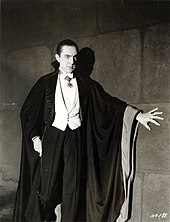
Bela Lugosi as Count Dracula in the 1931 film Dracula
The story of Dracula has been the basis for numerous films and plays. Stoker himself wrote the first theatrical adaptation, which was presented at the Lyceum Theatre on 18 May 1897 under the title Dracula, or The Undead shortly before the novel's publication and performed only once, in order to establish his own copyright for such adaptations.[p] Although the manuscript was believed lost,[131] the British Library possesses a copy. It consists of extracts from the novel's galley proof with Stoker's own handwriting providing direction and dialogue attribution.[130]
The first film to feature Count Dracula was Károly Lajthay's Drakula Halála (transl. The Death of Dracula), a Hungarian silent film released in 1921. Very little of the film has survived, and David J. Skal notes that the cover artist for the 1926 Hungarian version of the film was more influenced by the second adaptation of Dracula, F. W. Murnau's Nosferatu.[132] Critic Wayne E. Hensley writes that the film's narrative differs significantly from the novel, but that characters have clear counterparts.[133] Bram Stoker's widow, Florence, initiated legal action against the film studio, Prana. The legal case lasted two or three years,[q] and in May 1924, Prana agreed to destroy all copies of the film.[135][r]

Christopher Lee as the title character in Dracula (1958)
Visual representations of the Count have changed significantly over time. Early treatments of Dracula's appearance were established by theatrical productions in London and New York. Later prominent portrayals of the character by Béla Lugosi (in a 1931 adaptation) and Christopher Lee (firstly in the 1958 film and later its sequels) built upon earlier versions. Chiefly, Dracula's early visual style involved a black-red colour scheme and slicked back hair.[136] Lee's portrayal was overtly sexual, and also popularised fangs on screen.[137] Gary Oldman's portrayal in Bram Stoker's Dracula (1992), directed by Francis Ford Coppola and costumed by Eiko Ishioka,[138] established a new default look for the character—a Romanian accent and long hair.[136] The assortment of adaptations feature many different dispositions and characteristics of the Count.[139]
Dracula has been adapted a large number of times across virtually all forms of media. John Edgar Browning and Caroline Joan S. Picart write that the novel and its characters have been adapted for film, television, video games and animation over 700 times, with nearly 1000 additional appearances in comic books and on the stage.[136] Roberto Fernández Retamar deemed Count Dracula—along with characters such as Frankenstein's monster, Mickey Mouse and Superman—to be a part of the "hegemonic Anglo-Saxon world['s] cinematic fodder".[140] Across the world, completed new adaptations can be produced as often as every week.[141]
Influence
Dracula was not the first piece of literature to depict vampires,[142] but the novel has nonetheless come to dominate both popular and scholarly treatments of vampire fiction.[54] Count Dracula is the first character to come to mind when people discuss vampires. [143] Dracula succeeded by drawing together folklore, legend, vampire fiction and the conventions of the Gothic novel.[142] Wendy Doniger described the novel as vampire literature's "centrepiece, rendering all other vampires BS or AS".[144][s]
It profoundly shaped the popular understanding of how vampires function, including their strengths, weaknesses, and other characteristics.[145] Bats had been associated with vampires before Dracula as a result of the vampire bat's existence—for example, Varney the Vampire (1847) included an image of a bat on its cover illustration. But Stoker deepened the association by making Dracula able to transform into one. That was, in turn, quickly taken up by film studios looking for opportunities to use special effects.[146] Patrick McGrath notes that many of the Count's characteristics have been adopted by artists succeeding Stoker in depicting vampires, turning those fixtures into clichés. Aside from the Count's ability to transform, McGrath specifically highlights his hatred of garlic, sunlight, and crucifixes.[147] William Hughes writes critically of the Count's cultural omnipresence, noting that the character of Dracula has "seriously inhibited" discussions of the undead in Gothic fiction.[148]
Adaptations of the novel and its characters have contributed to its enduring popularity. Even within academic discussions, the boundaries between Stoker's novel and the character's adaptation across a range of media have effectively been blurred.[149] Dacre Stoker suggests that Stoker's failure to comply with United States copyright law contributed to its enduring status, writing that writers and producers did not need to pay a licence fee to use the character.[134]
Notes...
A vampire is a mythical creature that subsists by feeding on the vital essence (generally in the form of blood) of the living. In European folklore, vampires are undead creatures that often visited loved ones and caused mischief or deaths in the neighbourhoods which they inhabited while they were alive. They wore shrouds and were often described as bloated and of ruddy or dark countenance, markedly different from today's gaunt, pale vampire which dates from the early 19th century.
Vampiric entities have been recorded in cultures around the world; the term vampire was popularized in Western Europe after reports of an 18th-century mass hysteria of a pre-existing folk belief in Southeastern and Eastern Europe that in some cases resulted in corpses being staked and people being accused of vampirism. Local variants in Southeastern Europe were also known by different names, such as shtriga in Albania, vrykolakas in Greece and strigoi in Romania.
In modern times, the vampire is generally held to be a fictitious entity, although belief in similar vampiric creatures (such as the chupacabra) still persists in some cultures. Early folk belief in vampires has sometimes been ascribed to the ignorance of the body's process of decomposition after death and how people in pre-industrial societies tried to rationalize this, creating the figure of the vampire to explain the mysteries of death. Porphyria was linked with legends of vampirism in 1985 and received much media exposure, but has since been largely discredited.[1]
The charismatic and sophisticated vampire of modern fiction was born in 1819 with the publication of "The Vampyre" by the English writer John Polidori; the story was highly successful and arguably the most influential vampire work of the early 19th century. Bram Stoker's 1897 novel Dracula is remembered as the quintessential vampire novel and provided the basis of the modern vampire legend, even though it was published after fellow Irish author Joseph Sheridan Le Fanu's 1872 novel Carmilla. The success of this book spawned a distinctive vampire genre, still popular in the 21st century, with books, films, television shows, and video games. The vampire has since become a dominant figure in the horror genre....
Literature
Main article: Vampire literature

Cover from one of the original serialized editions of Varney the Vampire
The vampire or revenant first appeared in poems such as The Vampire (1748) by Heinrich August Ossenfelder, Lenore (1773) by Gottfried August Bürger, Die Braut von Corinth (The Bride of Corinth) (1797) by Johann Wolfgang von Goethe, Robert Southey's Thalaba the Destroyer (1801), John Stagg's "The Vampyre" (1810), Percy Bysshe Shelley's "The Spectral Horseman" (1810) ("Nor a yelling vampire reeking with gore") and "Ballad" in St. Irvyne (1811) about a reanimated corpse, Sister Rosa, Samuel Taylor Coleridge's unfinished Christabel and Lord Byron's The Giaour.[156]
...
The latter part of the 20th century saw the rise of multi-volume vampire epics as well as a renewed interest in the subject in books. The first of these was Gothic romance writer Marilyn Ross's Barnabas Collins series (1966–71), loosely based on the contemporary American TV series Dark Shadows. It also set the trend for seeing vampires as poetic tragic heroes rather than as the more traditional embodiment of evil. This formula was followed in novelist Anne Rice's highly popular Vampire Chronicles (1976–2003),[161] and Stephenie Meyer's Twilight series (2005–2008).[162]
Film and television
Main articles: Vampire film, List of vampire films, and List of vampire television series

A scene from F. W. Murnau's Nosferatu, 1922.
Considered one of the preeminent figures of the classic horror film, the vampire has proven to be a rich subject for the film, television, and gaming industries. Dracula is a major character in more films than any other but Sherlock Holmes, and many early films were either based on the novel Dracula or closely derived from it. These included the 1922 silent German Expressionist horror film Nosferatu, directed by F. W. Murnau and featuring the first film portrayal of Dracula—although names and characters were intended to mimic Dracula's.[163]
Universal's Dracula (1931), starring Béla Lugosi as the Count and directed by Tod Browning, was the first talking film to portray Dracula. Both Lugosi's performance and the film overall were influential in the blossoming horror film genre, now able to use sound and special effects much more efficiently than in the Silent Film Era.
The influence of this 1931 film lasted throughout the rest of the 20th century and up through the present day. Stephen King, Francis Ford Coppola, Hammer Horror, and Philip Saville each have at one time or another derived inspiration from this film directly either through staging or even through directly quoting the film, particularly how Stoker's line "Listen to them. Children of the night. What music they make!" is delivered by Lugosi; for example Coppola paid homage to this moment with Gary Oldman in his interpretation of the tale in 1992 and King has credited this film as an inspiration for his character Kurt Barlow repeatedly in interviews.[164] It is for these reasons that the film was selected by the US Library of Congress to be in the National Film Registry in 2000.[165]

Count Dracula as portrayed by Béla Lugosi in 1931's Dracula.
The legend of the vampire continued through the film industry when Dracula was reincarnated in the pertinent Hammer Horror series of films, starring Christopher Lee as the Count. The successful 1958 Dracula starring Lee was followed by seven sequels. Lee returned as Dracula in all but two of these and became well known in the role.[166]
By the 1970s, vampires in films had diversified with works such as Count Yorga, Vampire (1970), an African Count in 1972's Blacula, the BBC's Count Dracula featuring French actor Louis Jourdan as Dracula and Frank Finlay as Abraham Van Helsing, and a Nosferatu-like vampire in 1979's Salem's Lot, and a remake of Nosferatu itself, titled Nosferatu the Vampyre with Klaus Kinski the same year. Several films featured the characterization of a female, often lesbian, vampire such as Hammer Horror's The Vampire Lovers (1970), based on Carmilla, though the plotlines still revolved around a central evil vampire character.[166]

1960s television's Dark Shadows, with Jonathan Frid's Barnabas Collins vampire character.
The Gothic soap opera Dark Shadows, on American television from 1966 to 1971, featured the vampire character Barnabas Collins, portrayed by Jonathan Frid, which proved partly responsible for making the series one of the most popular of its type, amassing a total of 1,225 episodes in its nearly five-year run. The pilot for the later 1972 television series Kolchak: The Night Stalker revolved around a reporter hunting a vampire on the Las Vegas Strip.
Christopher Lee as the title character in ***Dracula* (1958) in one of the first uses of contact lens with makeup in films
Later films showed more diversity in plotline, with some focusing on the vampire-hunter, such as Blade in the Marvel Comics' *Blade* films and the film Buffy the Vampire Slayer.[149] Buffy, released in 1992, foreshadowed a vampiric presence on television, with its adaptation to a series of the same name and its spin-off Angel. Others showed the vampire as a protagonist, such as 1983's The Hunger, 1994's Interview with the Vampire and its indirect sequel Queen of the Damned, and the 2007 series Moonlight. The 1992 film Bram Stoker's Dracula by Francis Ford Coppola became the then-highest grossing vampire film ever.[167]
This increase of interest in vampiric plotlines led to the vampire being depicted in films such as Underworld and Van Helsing, the Russian Night Watch and a TV miniseries remake of Salem's Lot, both from 2004. The series Blood Ties premiered on Lifetime Television in 2007, featuring a character portrayed as Henry Fitzroy, an illegitimate-son-of-Henry-VIII-of-England-turned-vampire, in modern-day Toronto, with a female former Toronto detective in the starring role. A 2008 series from HBO, entitled True Blood, gives a Southern Gothic take on the vampire theme.[162]
In 2008 Being Human premiered in Britain and featured a vampire that shared a flat with a werewolf and a ghost.[168][169] The continuing popularity of the vampire theme has been ascribed to a combination of two factors: the representation of sexuality and the perennial dread of mortality.[170]