Southey, R
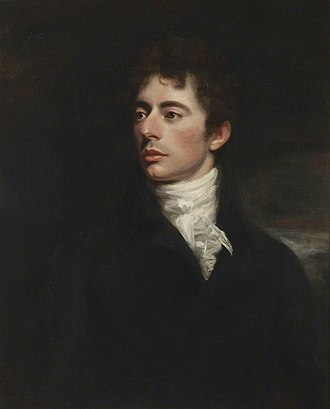
Name: Robert Southey
Achievements: A minor Romantic writer of poetry and prose
Born: August 12, 1774; Bristol, England
Died: March 21, 1843; Keswick, Cumberland, England (Aged 69)
Field & Discipline: Literature; Writer; Poet
Language: English
Father: Robert Southey
Mother: Margaret Hill
Siblings: 3 brothers survived infancy
Spouse: 1. Edith Fricker 2. Caroline Bowles
Children: 7
Education: Westminster School, London; Balliol College, Oxford
Major Work:
"Life of Nelson" (1813)
Life & Times:
Early in life, Southey, saw the actress Sarah [saw peformance by] Siddons* in her prime and became familiar with the plays of William Shakespeare. A maternal uncle funded his education at Westminster school. Southey was expelled in 1792 for writing an article in the school magazine "The Flagellant" protesting about the excessive use of the cane.
In the same year he wrote a long poem about [wrote about] Joan of Arc* (1796) as a way of expressing his approval of the French Revolution. At Oxford he was impressed by the writings of the political radical [influenced by] Godwin* which he read in 1793 and the following year met the poet [a pal of] Coleridge* who was similarly radical in his views.
In 1794 Southey and Coleridge wrote a verse drama titled "The Fall of Robespierre" and when Southey left Oxford without a degree he agreed to join Coleridge in founding a “pantisocratic” community on the Susquehanna River in the United States. While raising support for this enterprise Southey fell in love with Edith Fricker and secretly married her. Soon afterwards, Coleridge married Edith's sister, Sarah.
In 1795 he went to visit his uncle who was British chaplain in Lisbon. Southey wrote "Letters Written During a Short Residence in Spain and Portugal" (1796) before returning to England.
He began to study for the law but decided instead to write for a living. Calling on the medical services of Dr Thomas Beddoes, he became acquainted with Beddoe's assistant at the Pneumatic Institute, [a pal of] Davy*. Davy introduced Southey to nitrous oxide, better known as "laughing gas", which Southey declared to the "the atmosphere of Mohammed's Paradise."
He translated foreign authors, edited the works of Thomas Chatterton, brought out a second volume of his own collected poems and began contributing to literary journals and newspapers. He completed his epic poem "Thalaba the Destroyer" (1801) and began work on "Madoc" (1805), another epic.
In 1803 he and Edith accepted an invitation to join Coleridge and his wife at Greta Hall, Keswick in the English Lakes. The Hall remained their home for the rest of their lives. Although Southey is referred to as one of the Lakeland poets, unlike [a pal of] Wordsworth* (with whom he now became friendly) he did not write poetry about the Lakes, but instead produced long narrative poems about exotic lands and cultures, like "The Curse of Kehama" (1810) about Hindu mythology.
[affected career of] Byron* was critical of the work, but benefited from the popular trend for exotic epics set by Southey. Southey was fortunate to have good relations with the London publisher [publisher was] John Murray* for whom he did criticism, history and biography, translations and editing.
Among his best prose writing was his "Letters from England: by Don Manuel Alvarez Espriella," the observations of a fictitious Spaniard on contemporary England. In 1811 the poet [visited by] Percy Bysshe Shelley* visited Greta Hall.
Although he had become more conservative himself, Southey wrote several articles for Murray in 1811 in which he argued for better state welfare for the poor. In 1813, through another influential contact, [a pal of] Sir Walter Scott*, Southey was made poet laureate. Southey accepted on the condition that he did not have to write any birthday odes.
In the same year, he published what most critics regard as his best work: his biography of [wrote about] Nelson*: "The Life of Nelson". "Watt Tyler" a verse drama about the leader of a peasant revolt (which Southey wrote in his youth) came out in an unauthorised publication in 1817.
In 1819 (the year Southey toured the Highlands of Scotland with engineer [travelled with] Telford*) Byron dedicated to Southey the first stanzas of "Don Juan" (the verses were about hypocrisy). Southey retaliated by writing in the introduction to his poem "A Vision of Judgement" (1821) that Byron belonged to a "satanic school". This was followed by a parody by Byron of Southey's work entitled "The Vision of Judgement". Southey was again caught up in controversy in 1825 when his "Book of the Church" was attacked for its prejudice against Roman Catholics.
Southey kept up with metropolitan friends on his visits to London and he was visited in the Lakes by cultured travellers such as the astronomer [visited by] Airy* who led a reading party there in 1825.
Extra Connections: A friend of writer [a pal of] Lamb*.
Artist [sculpted by] Baily* sculpted his bust.
Assessment: A minor Romantic poet.
Oneliner: Robert Southey, minor Romantic writer
Bibliography:
- Storey, Mark, Robert Southey, A Life, Oxford University Press, Oxford and New York, 1997.