Munch, Edvard
Edvard Munch (/mʊŋk/;[1] Norwegian: [ˈedvɑʈ ˈmuŋk] ( listen); 12 December 1863 – 23 January 1944) was a Norwegian painter and printmaker whose intensely evocative treatment of psychological themes built upon some of the main tenets of late 19th-century Symbolism and greatly influenced German Expressionism in the early 20th century. One of his best known works is The Scream of 1893.
Contents
- 1Life
- 2Legacy
- 3Major works
- 4Selected works
- 5See also
- 6Notes
- 7References
- 8Further reading
- 9External links
...
Munch seems to have been an early critic of photography as an art form, and remarked that it "will never compete with the brush and the palette, until such time as photographs can be taken in Heaven or Hell!"[26]
Munch's younger sister Laura was the subject of his 1899 interior Melancholy: Laura. Amanda O'Neill says of the work, "In this heated claustrophobic scene Munch not only portrays Laura's tragedy, but his own dread of the madness he might have inherited."[27]
Paris
Munch arrived in Paris during the festivities of the Exposition Universelle (1889) and roomed with two fellow Norwegian artists. His picture Morning (1884) was displayed at the Norwegian pavilion.[28] He spent his mornings at Bonnat's busy studio (which included live female models) and afternoons at the exhibition, galleries, and museums (where students were expected to make copies as a way of learning technique and observation).[29] Munch recorded little enthusiasm for Bonnat's drawing lessons—"It tires and bores me—it's numbing"—but enjoyed the master's commentary during museum trips.[30][31]
Munch was enthralled by the vast display of modern European art, including the works of three artists who would prove influential: Paul Gauguin, Vincent van Gogh, and Henri de Toulouse-Lautrec—all notable for how they used color to convey emotion.[31] Munch was particularly inspired by Gauguin's "reaction against realism" and his credo that "art was human work and not an imitation of Nature", a belief earlier stated by Whistler.[32]As one of his Berlin friends said later of Munch, "he need not make his way to Tahiti to see and experience the primitive in human nature. He carries his own Tahiti within him."[33] Influenced by Gauguin, as well as the etchings of German artist Max Klinger, Munch experimented with prints as a medium to create graphic versions of his works. In 1896 he created his first woodcuts—a medium that proved ideal to Munch's symbolic imagery.[34] Together with his contemporary Nikolai Astrup, Munch is considered an innovator of the woodcut medium in Norway.[35]
In December 1889 his father died, leaving Munch's family destitute. He returned home and arranged a large loan from a wealthy Norwegian collector when wealthy relatives failed to help, and assumed financial responsibility for his family from then on.[36] Christian's death depressed him and he was plagued by suicidal thoughts: "I live with the dead—my mother, my sister, my grandfather, my father…Kill yourself and then it's over. Why live?"[37] Munch's paintings of the following year included sketchy tavern scenes and a series of bright cityscapes in which he experimented with the pointillist style of Georges Seurat.[38]
Berlin
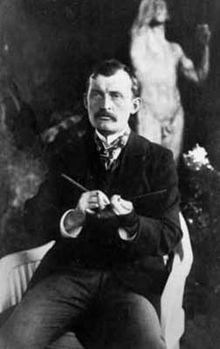
Munch in 1902, in the garden of his patron Dr. Max Linde in Lübeck; in the background is a cast of Auguste Rodin's sculpture Iron Era.
By 1892, Munch formulated his characteristic, and original, Synthetist aesthetic, as seen in Melancholy (1891), in which color is the symbol-laden element. Considered by the artist and journalist Christian Krohg as the first Symbolist painting by a Norwegian artist, Melancholy was exhibited in 1891 at the Autumn Exhibition in Oslo.[39] In 1892, Adelsteen Normann, on behalf of the Union of Berlin Artists, invited Munch to exhibit at its November exhibition,[40] the society's first one-man exhibition. However, his paintings evoked bitter controversy (dubbed "The Munch Affair"), and after one week the exhibition closed.[40] Munch was pleased with the "great commotion", and wrote in a letter: "Never have I had such an amusing time—it's incredible that something as innocent as painting should have created such a stir."[41]
In Berlin, Munch became involved in an international circle of writers, artists and critics, including the Swedish dramatist and leading intellectual August Strindberg, whom he painted in 1892. During his four years in Berlin, Munch sketched out most of the ideas that would comprise his major work, The Frieze of Life, first designed for book illustration but later expressed in paintings.[42] He sold little, but made some income from charging entrance fees to view his controversial paintings.[43] Already, Munch was showing a reluctance to part with his paintings, which he termed his "children".
His other paintings, including casino scenes, show a simplification of form and detail which marked his early mature style.[44] Munch also began to favor a shallow pictorial space and a minimal backdrop for his frontal figures. Since poses were chosen to produce the most convincing images of states of mind and psychological conditions, as in Ashes, the figures impart a monumental, static quality. Munch's figures appear to play roles on a theatre stage (Death in the Sick-Room), whose pantomime of fixed postures signify various emotions; since each character embodies a single psychological dimension, as in The Scream, Munch's men and women began to appear more symbolic than realistic. He wrote, "No longer should interiors be painted, people reading and women knitting: there would be living people, breathing and feeling, suffering and loving."[45]
The Scream
Main article: The Scream

The Scream (1893)
The Scream exists in four versions: two pastels (1893 and 1895) and two paintings (1893 and 1910). There are also several lithographs of The Scream (1895 and later).
The 1895 pastel sold at auction on 2 May 2012 for US$119,922,500, including commission.[46] It is the most colorful of the versions[47] and is distinctive for the downward-looking stance of one of its background figures. It is also the only version not held by a Norwegian museum.
The 1893 version (shown here) was stolen from the National Gallery in Oslo in 1994 and recovered. The 1910 painting was stolen in 2004 from The Munch Museum in Oslo, but recovered in 2006 with limited damage.
The Scream is Munch's most famous work, and one of the most recognizable paintings in all art. It has been widely interpreted as representing the universal anxiety of modern man.[45] Painted with broad bands of garish color and highly simplified forms, and employing a high viewpoint, it reduces the agonized figure to a garbed skull in the throes of an emotional crisis.
With this painting, Munch met his stated goal of "the study of the soul, that is to say the study of my own self".[48] Munch wrote of how the painting came to be: "I was walking down the road with two friends when the sun set; suddenly, the sky turned as red as blood. I stopped and leaned against the fence, feeling unspeakably tired. Tongues of fire and blood stretched over the bluish black fjord. My friends went on walking, while I lagged behind, shivering with fear. Then I heard the enormous, infinite scream of nature."[49] He later described the personal anguish behind the painting, "for several years I was almost mad… You know my picture, 'The Scream?' I was stretched to the limit—nature was screaming in my blood… After that I gave up hope ever of being able to love again."[50]
In summing up the painting's effects, author Martha Tedeschi has stated: "Whistler's Mother, Wood's American Gothic, Leonardo da Vinci's Mona Lisa and Edvard Munch's The Scream have all achieved something that most paintings—regardless of their art historical importance, beauty, or monetary value—have not: they communicate a specific meaning almost immediately to almost every viewer. These few works have successfully made the transition from the elite realm of the museum visitor to the enormous venue of popular culture."[51]
...