Cloud chamber
NAME: Cloud chamber
OTHER-NAME: Wilson’s cloud chamber
DATE INVENTED/BEGAN: 1912
PLACE INVENTED/BEGAN: Cambridge University, England
DATE ENDED:
PLACE ENDED:
CATEGORY: Technology
DISCIPLINE: Invention
ASSESSMENT: A major advance in the study of nuclear phenomena
LANGUAGE: English
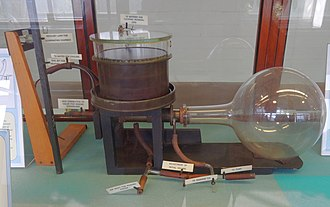
The original cloud chamber of C.T.R. Wilson at the Cavendish Lab, Cambridge England.
DETAILS:
In 1912 Scots physicist CTR Wilson*, who was investigating the behaviour of clouds, and developed a glass container (‘chamber’) one end of which was covered by a diaphragm. When the diaphragm was pulled outwards, it lowered the pressure of the water-vapor-saturated air inside the chamber and created a super-saturated atmosphere.
At this point Wilson noticed that small water droplets condensed on the dust in the air. When he removed the dust and passed x-rays through the chamber, the droplets formed again, this time on the air molecules ionized by the radiation. This occurred in small streaks of droplets (following the track of the radiation) and immediately provided the first opportunity to study the behaviour of nuclear phenomena (x-rays, radioactivity, cosmic rays, etc).
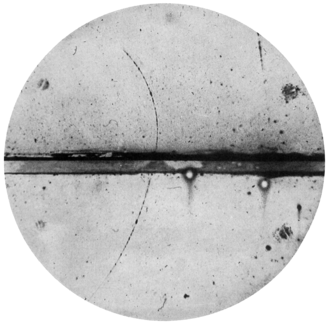
The particle tracks turned out to have distinctive identities: alpha particles caused a broad straight streak, and electron paths curved.
For this invention Wilson was awarded the Nobel Prize in 1927.
ONELINER: The cloud chamber
EXTRA-CONNECTIONS: Wilson’s chamber was used by physicist Rutherford*
It was used with artificial sources of particles, for example in radiography applications as part of the Manhattan Project
BIBLIOGRAPHY:
EB
DSB
Multimedia:
Connections 1 Episode 2. "[Death in the Morning"]