Edmond Becquerel
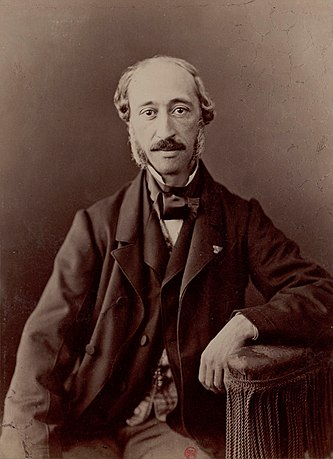
Alexandre-Edmond Becquerel (French pronunciation: [alɛksɑ̃dʁ ɛdmɔ̃ bɛkʁɛl]; 24 March 1820 – 11 May 1891),[1] known as Edmond Becquerel, was a French physicist who studied the solar spectrum, magnetism, electricity and optics. He is credited with the discovery of the photovoltaic effect, the operating principle of the solar cell, in 1839.[2][3] He is also known for his work in luminescence and phosphorescence. He was the son of Antoine César Becquerel and the father of Henri Becquerel, one of the discoverers of radioactivity.
Biography
Becquerel was born in Paris and was in turn the pupil, assistant and successor of his father at the Muséum national d'Histoire naturelle. He was also appointed professor at the short-lived Agronomic Institute at Versailles in 1849, and in 1853 received the chair of physics at the Conservatoire des Arts et Métiers. He was associated with his father in much of his work.
The first photovoltaic device
In 1839, at age 19, experimenting in his father's laboratory, Becquerel created the world's first photovoltaic cell. In this experiment, silver chloride or silver bromide was used to coat the platinum electrodes; once the electrodes were illuminated, voltage and current were generated. Because of this work, the photovoltaic effect has also been known as the "Becquerel effect".
Photographic discoveries
Becquerel was an early experimenter in photography. In 1840, he discovered that the silver halides, natively insensitive to red and yellow light, became sensitive to that part of the spectrum in proportion to their exposure to blue, violet and ultraviolet light, allowing daguerreotypes and other photographic materials to be developed by bathing in strong red or yellow light rather than by chemical treatment.[4] In practice this technique was rarely used. In 1848 he produced color photographs of the solar spectrum, and also of camera images, by a technique later found to be akin to the Lippmann interference method, but the camera exposures required were impractically long and the images could not be stabilized, their colors persisting only if kept in total darkness,[5] however this work is based on the discoveries of J. T. Seebeck prior to 1810.[6]
Other studies
Becquerel paid special attention to the study of light, investigating the photochemical effects and spectroscopic characters of solar radiation and the electric arc light, and the phenomena of phosphorescence, particularly as displayed by the sulfides and by compounds of uranium. It was in connection with these latter inquiries that he devised his phosphoroscope, an apparatus which enabled the interval between exposure to the source of light and observation of the resulting effects to be varied at will and accurately measured.
He investigated the diamagnetic and paramagnetic properties of substances and was keenly interested in the phenomena of electrochemical decomposition, accumulating much evidence in favor of Faraday's law of electrolysis and proposing a modified statement of it which was intended to cover certain apparent exceptions. In 1853, Becquerel discovered thermionic emission.
Publications
In 1867 and 1868 Becquerel published La lumière, ses causes et ses effets (Light, its Causes and Effects), a two-volume treatise which became a standard text. His many papers and commentaries appeared in French scientific journals, mainly the French Academy of Science's widely distributed Comptes Rendus, from 1839 until shortly before his death in 1891.
Honors and awards
Becquerel was elected a member of the Royal Swedish Academy of Sciences in 1886.
The Becquerel Prize for "outstanding merit in photovoltaics" is awarded annually at the European Photovoltaic Solar Energy Conference and Exhibition (EU PVSEC).
See also
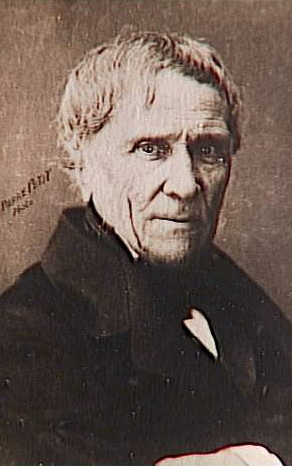
Antoine César Becquerel (French pronunciation: [ɑ̃twan sezaʁ bɛkʁɛl]; 7 March 1788 – 18 January 1878) was a French scientist and a pioneer in the study of electric and luminescent phenomena.
Life
He was born at Châtillon-sur-Loing (today Châtillon-Coligny). After passing through the École polytechnique he became engineer-officer in 1808, and saw active service with the imperial troops in Spain from 1810 to 1812, and again in France in 1814. He then resigned from the army and devoted the rest of his life to scientific investigation.[1]
In 1820, following the work of René Just Haüy, he found that pressure can induce electricity in every material, attributing the effect to surface interactions (this is not piezoelectricity). In 1825 he invented a differential galvanometer for the accurate measurement of electrical resistance. In 1829 he invented a constant-current electrochemical cell, the forerunner of the Daniell cell. In 1839, working with his son A. E. Becquerel, he discovered the photovoltaic effect on an electrode immersed in a conductive liquid.[citation ^needed]
His earliest work was mineralogical in character, but he soon turned his attention to the study of electricity and especially of electrochemistry. In 1837 he became a Fellow of the Royal Society, and received its Copley Medal for his various memoirs on electricity, and particularly for those on the production of metallic sulphurets and sulphur by electrolysis. He was the first to prepare metallic elements from their ores by this method. It was hoped that this would lead to increased knowledge of the recomposition of crystallized bodies, and the processes which may have been employed by nature in the production of such bodies in the mineral kingdom.[1]
In biochemistry he worked at the problems of animal heat and at the phenomena accompanying the growth of plants, and he also devoted much time to meteorological questions and observations. He was a prolific writer. He died in Paris, where from 1837 he had been professor of physics at the Museum d'Histoire Naturelle.[1]
He became a correspondent of the Royal Institute in 1836; when that became the Royal Netherlands Academy of Arts and Sciences in 1851, he became a foreign member.[2]
He was the father of the physicist A. E. Becquerel and grandfather of the physicist Henri Becquerel after whom the SI unit for radioactivity, the becquerel (Bq), is named.
His surname is one of the 72 names inscribed on the Eiffel Tower.
Works
Résumé de l'historie de l'électricité et du magnétisme, et des applications de ces sciences a la chimie, aux sciences naturelles et aux arts, 1858
- Traité de l'électricité et du magnétisme, 7 volumes, 1834-1840. Vol. 2, vol. 5.
- Éléments de physique terrestre et de météorologie, 1841.
- Traité de physique considérée dans ses rapports avec la chimie et les sciences naturelles, 2 volumes, 1842.
- Éléments d'électro-chimie appliquée aux sciences naturelles et aux arts, 1843.
- Éléments d'électro-chimie appliquée aux sciences naturelles et aux arts. Paris: Firmin-Didot. 1864.
- Traité complet du magnétisme, 1846.
- Traité de physique appliquée à la chimie et aux sciences naturelles, 2 volumes, 1847.
- Des climats et de l'influence qu'exercent les sols boisés et non boisés. Paris: Firmin-Didot. 1853.
- Traité d'électricité et de magnétisme, leurs applications aux sciences physiques, aux arts et à l'industrie, 3 volumes, 1855-1856.
- Électricité. Vol. 1. Paris: Firmin-Didot. 1855.
- Électro-chimie. Vol. 2. Paris: Firmin-Didot. 1855.
- Magnétisme et électro-magnétisme. Vol. 3. Paris: Firmin-Didot. 1856.
- Résumé de l'historie de l'électricité et du magnétisme, et des applications de ces sciences a la chimie, aux sciences naturelles et aux arts. Paris: Firmin-Didot. 1858.
- Traité d'électrochimie, 1865.
- Des forces physico-chimiques et de leur intervention dans la production des phénomènes naturels. Paris: Firmin-Didot. 1875.
See also
- List of works by Eugène Guillaume
- A. E. Becquerel (his son)
- Henri Becquerel, (his grandson)
- Jean Becquerel (his great-grandson)
Jean Antoine Edmond Marie Becquerel (5 February 1878 – 4 July 1953) was a French physicist, the son of Antoine-Henri Becquerel. He worked on a range of experimental physics topics including magnetic effects on the optical properties of materials, and the effects of low-temperature on magnetic susceptibility. He was among the early teachers of relativity and quantum physics in France.
Biography
Becquerel was born at his home in the Jardin des Plantes where his father Henri (1852–1908), grandfather Edmond (1820–1891) and great-grandfather Antoine César Becquerel (1788–1878) had lived. His mother Lucie was the daughter of J.C. Jamin, professor of physics at the Sorbonne. His childhood toys included magnets and electroscopes. He was educated at the Lycée Louis-le-Grand before going to the École Polytechnique in 1897 and completed his studies at the École des Ponts et Chaussées.
He then became an assistant in physics at the Museum of Natural History. He worked on the optical and magnetic properties of crystals, and continued experiments to study changes in rotational polarisation induced by a magnetic field that his father had discovered.[1][2] He also published a textbook on relativity In 1903 some of his research came into question when he collaborated with surgeon André Broca to examine the radiation (N-Rays) supposedly emanating from living bodies (as claimed originally by René Blondlot) which was claimed to reduce upon the administration of anaesthetics.[3]
In 1909, he became the fourth in his family to occupy the physics chair at the Muséum National d'Histoire Naturelle, following in the footsteps of his father, his grandfather and his great-grandfather. He taught physics along with Paul Langevin and was among the few who taught quantum theory and relativity in the 1920s. He was interested in electron theory and examined magnetic susceptibility in relation to temperature and began to experiment with rare-earth crystals at low temperatures. He examined these using spectroscopy and found that some absorption bands disappeared and this led to a collaboration with Heike Kamerlingh Onnes at Leiden. Here he examined materials at low-temperatures and described the spectra and looked at magnetic properties.[4]
Becquerel received the Hughes Prize of 1913 and the La Case Prize of 1936.