Voltaire
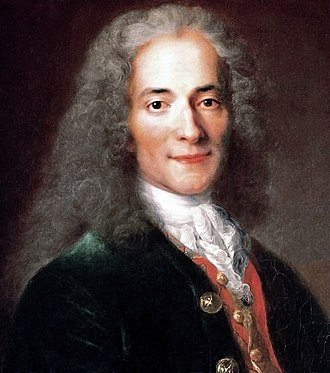
Full Name:Francois-Marie Arouet de Voltaire
Nickname/Alias: Voltaire
Achievement: One of the greatest French writers.
Born: November 21, 1694; Paris, France
Died: May 30, 1778; Paris, France
Field & Discipline: Literature; Philosophy; Satirist
Language: French
Education: College Louis-le-Grand, Paris, 1705-11
Major Work: “Candide” (1759)
Life & Times:
Voltaire achieved notoriety in 1715 as the author of a satire on his successful rival in the poetic competition for the Academy prize. In 1716, he wrote some satirical verses against the regent, the Duc d'Orleans, then ruling France during the minority of the child-king, Louis XV, for which he was exiled from Paris for several months. In 1717 he attacked the regent again, accusing him of crimes, and was imprisoned in the Bastille for eleven months. Voltaire whiled away the long hours by composing his famous epic poem in imitation of Virgil, the “Henriade,” and his first tragedy, “Oedipe” (“Oedipus”).
Back in royal favour, Voltaire's “Oedipe” was successfully performed at the Comedie Francaise the same year, and he was immediately hailed as the modern successor of Sophocles, Corneille and Racine.
As a favourite of the young queen, Marie, he soon became court poet and received a pension, but the French authorities still refused to sanction the publication of his “Henriade,” on the grounds that it defended Protestantism and religious toleration. In 1723 Voltaire had the poem published in Rouen as “La Ligue ou Henri le Grand” and circulated it secretly in Paris.
In early 1726 came an exchange of insults with a French aristocrat, a second term in the Bastille, and his exile to England, where he landed in May, and remained for the next two or three years. Voltaire quickly learned English, and was introduced to the poets [met] Pope* and [met] Swift*, the playwrights [met] Congreve* and [met] Gay*, and the philosopher [met] Berkeley*. He was presented at court, dedicating his “Henriade” to Queen Caroline.
Voltaire admired the liberalism of English institutions, though he was shocked by the partisan violence, and envied English discussions of religious and philosophic questions. He was convinced it was because of their personal liberty that the English, notably [attended funeral of] Newton* (whose funeral he attended in Westminster Abbey in 1727) and [admired] Locke*, were in the forefront of scientific thought, and was equally impressed by the works of Shakespeare, Milton and Dryden.
Voltaire was permitted to return to France at the beginning of 1729, taking with him his work on the Swedish king “Histoire de Charles XII” (History of Charles XII', published 1731) and the materials for his “Lettres philosophiques,” or “Lettres sur les Anglais,” which praised the religious toleration, political and commercial systems, and literature of the English.
In France, during the early 1730’s, Voltaire wrote several new plays, the most successful of which was “Zaire” (1732), and laid the foundation of his great wealth by buying shares in a government lottery and speculating in the corn trade. In 1733 he began his long association with Emilie du [had affair with] Chatelet*, a student of mathematics, and the following year, after the publication of his “Lettres philosophique” which were unpopular in France, he went to live with her in her chateau at Cirey in Champagne, where they lived until her death in 1749.
This period of retreat (including a visit by Emilie’s algrebra teacher [house guest was] Koenig*) was interrupted only by a journey to the Netherlands in December 1736, when he visited, among others, the Dutch physicist and mathematician [visited] 'sGravesande*. At Cirey, Voltaire continued to write drama, including the best of his tragedies, “Alzire” (1736), “Mahomet” (1741) and “Merope” (1743), and poetry, including his poem, "Le Mondain" ("The Man of the World,” 1736).
Meanwhile, inspired both by Mme du Chatelet's many scientific interests and by the visits of [visited by] Algarotti*, he also wrote his “Elements de la philosophie de Newton” (1738), a popular introduction to Newtonian physics. A laboratory of the physical sciences was installed at the château, and Voltaire and Mme du Chatelet each composed a memorandum on the nature of fire for a competition (set in 1736 by the Académie des Sciences) which was won by [competed with] Euler*.
At the same time, Voltaire continued to pursue his historical studies, beginning his “Le Siècle de Louis XIV” (“The Age of Louis XIV,” 1751), sketching out a universal history of kings, wars, civilization and manners that became the “Essai sur les moeurs et l'esprit des nations” (“Essay on the Manners and Spirit of Nations,” 1756). It was at Cirey that Voltaire began his important correspondence with [corresponded with] Frederick the Great* of Prussia.
In February 1745, the performance of his “Princesse de Navarre” (written with the famous French composer [collaborated with] Rameau*) on the occasion of the Dauphin's marriage, greatly pleased [royal historian to] Louis XV*, and this, combined with the patronage of Madame de [a patron was] Pompadour*, the king's mistress, got Voltaire the appointments of official royal historian and of gentleman-in-ordinary to the king in 1746.
During this period he also began a love affair with his niece, the widowed Madame Denis, but in 1747 he again lost favour at court and was forced to take refuge with the Duchess of Maine, for whose amusement he now wrote his first short stories, including “Zadig” (1746), “Vision de Babouc” (1748), “Memnon” (1749) and “Micromegas” (1752).
Meanwhile, in September 1749 Mme du Chatelet had died in childbirth and, grieving and mortified by the failure of several of his plays in Paris, Voltaire accepted the invitation of Frederick II and set out for Berlin with his niece in June 1750.
Voltaire was made king's chamberlain, and at Potsdam became the centre of a circle around the king which included [knew] Mettrie* and [knew] Maupertuis*, the president of Frederick's Berlin Academy of Sciences.
However, difficulties soon arose, first involving a lawsuit with a moneylender, then disputes with prominent noblemen, and finally a controversy with Maupertuis on scientific matters. Voltaire ridiculed Maupertuis in a pamphlet entitled "Diatribe du docteur Akakia" (1752) and in his “Micronegas” (1753), and in March 1753 Voltaire left the German court in disgrace. He had been forbidden by Louis XV to approach Paris, and, after spending a year at Colmar, in 1755 finally decided to settle at Geneva, where he christened his new home "Les Delices". Soon afterwards he also bought a medieval chateau at Tournay and another at Ferney, both close at hand across the French frontier (in case of persecution in Switzerland).
At Geneva he continued to write, in 1756-59 publishing his “Moeurs et l'Esprit des nations,” his “Poeme sur la Loi naturelle” (“Poem on Natural Law,” 1756), his “Poeme sur le Desastre de Lisbonne” (“Poem on the Lisbon Disaster,” 1756) on the Lisbon earthquake, and his satirical masterpiece, the short story “Candide” (1759).
He soon provoked outrage amongst some Swiss intellectuals, however, and in November 1757, with the publication of volume seven of [wrote for] Diderot's* “Encyclopédie,” which included the Voltaire-inspired article on Geneva by [inspired] d'Alembert* (which advocated the establishment of a theatre in Geneva).
The case of the Swiss government was supported by [opposed by] Rousseau*, who in his “Lettre à d'Alembert sur les spectacles” (1758) attacked him in a treatise on the question of the morality of theatrical performances. Rousseau's view that drama might as well be abolished marked an end of the friendship between the two writers, and Voltaire, no longer feeling safe in Switzerland, moved to Ferney in France. In 1758, Voltaire settled permanently at Ferney, where, in order to improve the condition of the peasants who lived on his estate, he developed a watch- and clock-making industry, founded a pottery, experimented with the breeding of cattle and horses, and tried out new methods of farming, most notably of the English agriculturalist [influenced by] Tull*.
He corresponded widely with many European intellectuals, including [corresponded with] Catherine the Great* and the Italian physiologist [corresponded with]Spallanzani*, and received a multitude of visitors, including Giovanni Casanova, [visited by] Gibbon*, the Swiss writer [visited by] Bonstetten*, the French chemist [visited by] Guyton de Morveau*, the English doctor [visited by] John Moore* and writer [visited by] Boswell*.
Voltaire was now internationally famous, and there was scarcely a subject of importance on which he did not write. Voltaire's main interest at this time remained his opposition to religious intolerance and bigotry, which he named “L'Infame,” and in 1762 appeared the first of his anti-religious writings, which were to include didactic tragedies, biased histories, pamphlets and the “Dictionnaire philosophique” (1764), enlarged after 1770 by “Questions sur l’Encyclopédie'.
In 1778, at the age of 83, Voltaire finally returned to Paris. Wishing to direct the rehearsals of his last tragedy, “Irene,” he made a triumphal return to the city on 10 February, and the play was a tremendous success. The excitement brought on a severe illness in May, and he died later that month.
Extra Connections:
His work influenced writer [influenced] Mary Shelley* (1797-1851), politicians [influenced] Turgot*, [influenced] Quesnay*, philosopher [influenced] Condillac* and [influenced] Napoleon*.
He was influenced by mathematician [influenced by] Blaise Pascal*
He wrote the manifesto of French support for [supported] Prince Charles Stuart*’s attempted revolution in England in 1745.
Was a friend of revolutionary [a pal of] Condorcet* and scientist [a pal of] Boscovich*
Wrote the preface for the French edition of [wrote preface for] Beccaria’s* “Crime and Punishment.”
Writer [a fan was] Beaumarchais* built a temple dedicated to him.
Was visited by [visited by] de Stael* and her mother [visited by] Mme Necker*, by economist [visited by] Adam Smith* and mystery man [visited by]Dutens*
He criticized [criticized] d’Holbach’s* writings.
He publicly defended playwright [defended] Goldoni*.
He satirized [satirized] Leibniz*.
Had a public row with bluestocking [had row with] Mrs Wortley Montagu*
[influenced] Smellie’s* first Encyclopedia Britannica referenced his work on taste.
Experimenter [got instruments from] Nollet* made instruments for him.
Novelist [edited by] Smollett* edited part of the English translation of his works.
He knew Mme du [knew] Deffand*, [knew] CJ Fox* and the philosopher [knew] Helvetius*
Assessment: He embodies characteristic qualities of the French mind: a critical capacity, wit, and satire.
Oneliner: Voltaire, one of the greatest writers
Father: Francois Arouet
Mother: Unknown
Siblings: Elder brother, Armand
Spouse: None
Children: None
Bibliography:
- Encyclopedia Britannica.
- Dictionary of Scientific Biography.
- Collier’s Encyclopedia.
- Besterman, Theodore, Voltaire, London, 1969.
- Stanford Ency. of Philosophy