Elgin, JB
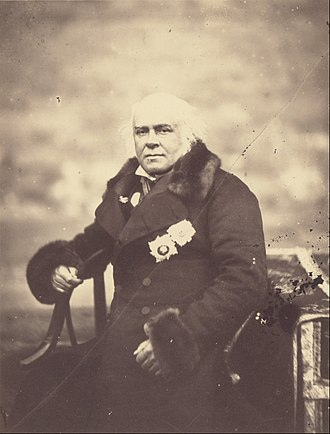
James Bruce Elgin, 8th earl of Elgin, 12th earl of Kincardine
Achievements: Established the parliamentary process in Canada.
Born: July 20, 1811; London, England
Died: November 20, 1863; Dharmsala, India (Aged 52)
Field & Discipline: Government; Diplomat
Language: English
Father: Father: Thomas Bruce, 7thEarl of Elgin (marbles)
Mother: Mary Nisbet
Siblings: 1 brother; 2 sisters
Spouse: 1. Miss Cumming Bruce; 2. Lady Louisa Mary Lambton
Children: by Cumming Bruce: 1 daughter: Ella; by Lambton: sons and daughter
Education: Eton College, Eton; Christ Church, Oxford
Life & Times:
Elgin was the son of Thomas Bruce [son of] Elgin* who brought the Greek antiquities known as the ‘Elgin marbles’ to England.
He was elected to the House of Commons in 1841 but his elder brother died in 1840 and in 1841 he was forced to give up his seat in the Commons when he succeeded to the Earldom. There was very little money from his father’s estate and Elgin accepted the governorship of Jamaica the following year.
He remained in the post for four years, during which time he pushed forward schemes for the modernization of agriculture on the island and for practical education for the ex-slaves on the plantations.
In 1846 he was made governor-general of Canada. Five years earlier, the Province of Canada had been established when English-speaking, largely Protestant Upper Canada had been united with the predominantly French-speaking Catholic Lower Canada. Lord Durham, Elgin’s father-in-law, who was governor-general of Canada in 1838, had advised the union on the grounds that the French would inevitably be assimilated into the English-speaking section of the popularity and would cease to have a separate identity and language.
The opposite had happened and the French became increasingly embittered. The two factions formed separate political parties, at odds with each other and also with their British colonial masters.
The country was prospering as trade expanded and communications systems grew but Canadians were still not fully responsible for their own government. When Elgin arrived in Canada in 1847, the British party held a small minority in Parliament. In 1848 the French Canadians took power. Elgin invited them to form the new administration. He was backed by the colonial office in London but met with entrenched opposition from vested interests in Canada.
He met even more opposition the following year when the Canadian parliament passed the Rebellion Losses Bill by which compensation would be paid for damages incurred during the rebellion of the French-Canadians in Lower Canada in 1837.
Canadian conservatives (and [opposed by] Gladstone* in Britain) took the line that this was rewarding an act of treason, but Elgin approved the bill. When Elgin left Parliament in Montreal after giving his assent, stones were thrown at his carriage and that night Parliament was destroyed by fire. As a result of these disturbances, Parliament left Montreal to meet alternately in Toronto and Quebec.
In 1854 Elgin played a leading role in securing the Reciprocity Treaty with the United States which proved vital to Canadian growth and prosperity because it gave duty-free admission for Canadian products to the US in exchange for rights in fishing and navigation.
Elgin left Canada in 1854. In 1857, he was sent as special envoy to China to negotiate trading problems with the Chinese. When he arrived in Singapore, he was asked to send some of his troops to Calcutta where the Indian Mutiny had broken out. Elgin sent all his accompanying troops and finding that negotiations in Hong Kong had been delayed, traveled to Calcutta and left warship there for extra protection, returning to China virtually unprotected on a merchant vessel.
Over the next four years he laid the foundation for subsequent trading relations between Britain and China. In the first part of his mission from September 1857 to March 1859, during which the British took the port of Canton, Elgin negotiated with treaty of Tientsin by which more facilities for British trade were agreed, together with protection for traders.
He then went on to Japan to negotiate a treaty by which foreigners gained admission to the country and some Japanese ports were opened to British trade. Among his staff on this journey was the English traveller Laurence [employed] Oliphant* (who had previously acted as secretary to Elgin in Canada) who wrote an account of Elgin’s mission. Violations of the Tientsin treaty by China resulted in a second mission in 1860-61, during which Elgin secured the release of British captives and the reinstatement of talks. In the course of negotiations, he ordered the burning of the summer palace of the Chinese Emperor at Peking in retaliation for an act of treachery by the Chinese that resulted in British deaths.
Elgin has been much criticized for this act, which he deliberately ordered in preference to demanding punishment of individuals. He accomplished the ratification of the treaty of Tientsin, and installed his brother, Frederick Bruce, as British ambassador in Peking. Elgin spent a month at Shanghai where he read [disliked theory of] Charles Darwin’s* “Origin of Species” (which appalled him).
In January 1861 he sailed back to England. Shortly after his arrival he was appointed viceroy and governor-general of India, arriving in Calcutta in March 1862. He died in 1863 on a journey to Lahore.
Extra Connections: [employed] Sir TF Wade* was a member of his staff.
Assessment: Elgin’s governorship in Canada established the democratic parliamentary process there and his actions in China and Japan laid the foundations for trade and diplomacy in the East.
Oneliner: Lord Elgin, who established parliament in Canada
Bibliography:
- Morison, J. L., The Eighth Earl of Elgin, A Chapter in Nineteenth-Century Imperial History,Hodder and Stoughton Ltd., 1928).