Gladstone
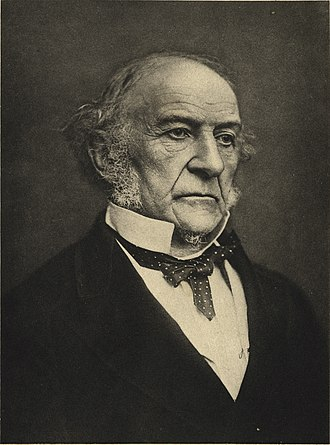
Full Name: William Ewart Gladstone
Achievements: Four times Prime Minister of Great Britain.
Born: December 29, 1809; Liverpool, England.
Died: May 19, 1898; Hawarden, Flintshire, Wales (Aged 89)
Field & Discipline: Politics; Prime Minister
Father: John Gladstone
Mother: Anne Robertson
Siblings: 3 brothers: Thomas; John Neilson; Robertson; 2 sisters: Anne; Helen
Spouse: Catherine Glynne
Children: 4 sons: Henry Neville; Herbert John; Stephen; William. 4 daughters: Agnes; Helen; Jessy; Mary
Education: Seaforth Vicarage, Eton College, Eton, Christ Church, Oxford
Life & Times:
Gladstone spent six months in Italy after university and then became the Conservative MP for Newark in December 1832. He took his first government post at the Treasury in 1834. He met [a colleague of] Disraeli* for the first time in January 1835, at a dinner, and in the same year briefly served under [served under] Peel* as Under-secretary for the Colonies.
He published “The State in its Relations with the Church” in 1838, a book which promoted the subordination of the state to the church, and which was strongly criticized by [criticized by] Macaulay*.
In 1844, now President of the Board of Trade with a seat in Cabinet, Gladstone pushed through the Railway Act, which made provision for working-class people to travel by train with fares at no more than a penny a mile.
In 1847 he became the member for Oxford and annoyed many Oxford constituents almost immediately by voting for Lord John Russell’s bill to allow Jews to omit the phase “on the true faith of a Christian” from their parliamentary oath. Russell had introduced this bill in support of his fellow Member of Parliament, [was a colleague of] LN Rothschild*, elected in that year for the City of London.
After Peel’s death in 1850, from 1852 Gladstone served as Chancellor of the Exchequer in Lord Aberdeen’s coalition government. In his first budget he argued for a progressive reduction in income tax, proposed the removal of duty on over 100 food items, abolished the soap tax and reduced the tax on tea.
Gladstone defended Britain’s part in the [defended Britain’s involvement in] Crimean War*, in which Britain and France came to the aid of Turkey against Russia (1854-1856), but condemned atrocities by the Turks.
In 1859, he served as Chancellor of the Exchequer again, he was determined to help the independence movement in Italy. With Palmerston and Lord John Russell, he helped bring about the unification of nearly all Italy within the next two years.
In his budget of 1860 he carried on the work of freeing people and trade from restrictions, believing in “self-discipline in freedom”. In 1859, [was a colleague of] Cobden* visited Gladstone and suggested that he might act as an informal envoy, while in Paris, to discuss the idea of a commercial treaty between France and England. Cobden’s work was successful.
In the next seven years, Gladstone and Palmerston disagreed on almost every topic.
In 1868, Gladstone became Prime Minister, in his sixtieth year. His ministry, operating at the “high tide of Liberalism,” introduced a range of reforms that affected education, the Church, the law, the Army and the Civil Service. Gladstone also tried to help Ireland. In 1869, the Irish Protestant Church was disestablished and and attempts were being made to curb the worst excesses of absentee landlords.
A great many vested interests were upset and, in the long run, the government was defeated, in 1874, and Gladstone retired In 1876, the anti-Turkish Christian rebels in Bulgaria, were put down with some savagery and Gladstone determined to do something about the rights of persecuted minorities. He returned to Parliament as MP for Midlothian, Scotland, where his speeches created a sensation.
In two impassioned speeches in 1879 and 1880 he overthrew the government and won a large Liberal majority. Back as Prime Minister in 1880, he also acted as his own Chancellor of the Exchequer for the first two years. In this final phase of his career Gladstone “led a crusade against English misrule in Ireland”.
Charles Stewart Parnell had formed the Irish Land League in 1881, to push for the reduction of land rent and the right of tenants to buy their holdings and he led an unruly splinter group at Westminster. Gladstone had to manoeuvre his land reforms past a hostile House of Lords, an apathetic House of Commons, and a suspicious Irish contingent. Although his intentions were to help the Irish peasantry, Gladstone did not consult with Parnell. Eventually the Irish Land Act was passed in 1881.
He also acted in accordance with his conscience when he supported the radical and atheist [disliked but supported] Bradlaugh’s* attempt to take his seat in Parliament without taking the oath on the Bible. Gladstone disliked Bradlaugh and did not agree with his politics, but maintained that Bradlaugh had as much right as anybody to his opinions.
In the parliamentary recess of 1883, he went on a cruise with his family to the Hebrides and Orkney and they enjoyed the relaxation so much that they went on to Oslo and Copenhagen. The Gladstones enjoyed a Danish royal dinner and themselves entertained the Danish royals to lunch on their yacht, at which event [a pal of] Tennyson*, who as one of Gladstone’s oldest friends, was one of the party, read some of his poetry.
In foreign affairs he was forced by circumstance and expediency to authorize British occupation of Egypt in 1882, and in 1884 he sanctioned the intervention of General Gordon in the Sudan. After Gordon’s defeat and the massacre at Khartoum, Gladstone resigned but was back in office in 1886.
His belief that Home Rule was the answer to the Irish Question dominated Gladstone’s last years and he pressed ahead despite opposition from the Tories, the Lords, [worked for] Queen Victoria* and his own party. He introduced a bill for self-rule by the Irish in 1886, but the bitter debates which followed divided the Liberal Party, allowing the Unionists to dominate English politics for two decades.
In his closing words, introducing the 1886 Bill, Gladstone said “Go into the length and breadth of the world, ransack the literature of all countries, find if you can a single voice, a single book, in which the conduct of England towards Ireland is anywhere treated except with profound and bitter condemnation”.
He resigned again in that year, but came back again as Prime Minister in 1892. His Home Rule Bill of 1893 passed through the Commons but was thrown out of the Lords. In 1894 he resigned yet again. He retired to Cannes for the winter months.
Extra Connections:
Met Sarah [met] Bernhardt*, [met] Harte*, [met] Henry James*, [met] Longfellow*
Was a supporter of [backed] Garibaldi*
Was served by [served by] Balfour*
He was a friend of [a pal of] Robert Browning*, [a pal of] Panizzi*, [a pal of] NM Rothschild*, [a pal of] LN Rothschild*, [a pal of] Burdett-Coutts*
He commissioned a report from [commissioned report from] Farr*
He worked with [worked with] Merimee*, Sir GF [worked with] Bowen*
He was painted by [was painted by] Millais*
He was published by [published by] John Murray*
He was a fan of [a fan of] Schliemann*
He visited [visited deathbed of] William Wilberforce* on his deathbed.
He knew [knew] Bulwer-Lytton*
He was a friend of [a pal of] Burdett-Coutts*
Assessment: In his time, Gladstone was the moral force in politics. His belief in the self-determination of small states, in the idea that freedom is the basis for progress in society, and that policies must be morally justifiable, have had a lasting influence.
Oneliner: W.E. Gladstone, four times British Prime Minister
Bibliography:
- Jenkins, Roy, Gladstone, Macmillan, London, 1995.
- Lynch, Michael, Gladstone and Disraeli, Hodder & Stoughton, London, 1991.