Cecil Sir W
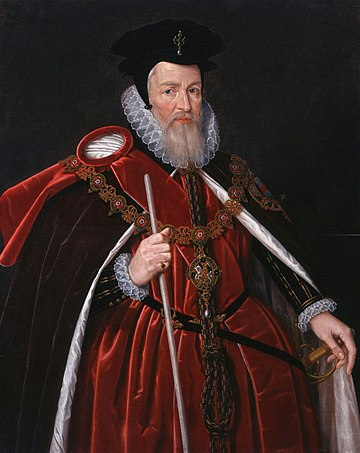
NAME: Cecil, William
ACHIEVEMENTS: Queen Elizabeth’s First Minister
NICKNAME/ALIAS: 1st Baron Burghley
DATE AND PLACE OF BIRTH: September 13, 1520, Bourne, Lincolnshire, England
DATE/PLACE OF DEATH/AGE AT DEATH: August 5, 1598, London, England. Aged 77
DISCIPLINE: Statesman
FIELD: Politics
LANGUAGE: English
PARENTS: Richard Cecil; Jane Heckington
SIBLINGS: Elizabeth; Margaret; Ann
SPOUSE: 1) Mary Cheke; 2)Mildred Cooke
CHILDREN: By Mary Cheke: Thomas. By Mildred Cooke: Robert; Ann; Elizabeth
EDUCATION: Grammar schools; Grantham and Stamford, Lincolnshire; St. John's College, University of Cambridge
MAJOR WORK: None
LIFE AND TIMES:
As a boy, Cecil was a page at the court of Henry VIII*, who later made him a member of the Court of Common Pleas. When Henry's daughter Elizabeth* became Queen, Cecil, now nearly 40, was appointed Secretary of State and became the Queen's preferred advisor. In 1559, he helped negotiate a bill through Parliament establishing Protestantism as the state religion, and the Monarch as supreme head of the church.
In 1562, Elizabeth nearly died of smallpox, raising the question of succession, particularly since Mary, Queen of Scots was claiming the crown. Cecil unsuccessfully urged Elizabeth to accept the marriage offer of Hapsburg Archduke Charles.
In 1564, the Earl of Leicester replaced Cecil as the Queen's favorite and Cecil's influence in the royal household began to diminish, particularly after he made a couple of wrong moves.
In 1568, when the Catholic Mary, Queen of Scots fled to England after her nobles rebelled against her, Cecil suggested the Queen negotiate with the Scots Protestants, but she refused. When Cecil allowed the seizure of Spanish bullion in the English channel, the Earls of Leicester and Norfolk and other nobles were furious because this could lead to war, and war could lead to the closure of Antwerp to English wool, the country's major export.
But the unpredictable Queen came to Cecil's rescue. She publicly endorsed him and in 1572, made him a Knight of the Garter and Lord Treasurer. Now back in the Queen's good graces and on an equal footing with Leicester, he had no more fear of his enemies. Cecil concluded an alliance with France in the Treaty of Blois (1572) and at the same time persuaded Spain to lift its embargo on trade with Antwerp.
Cecil believed in keeping international relations serene, but he sided with Leicester and Walsingham* in their belief that England should send forces to the Netherlands to support the Protestant Prince of Orange, William of the Silent, against Spain. But Elizabeth rejected their advice.
Although Cecil's appointment to the Treasury freed him from much of the routine administration of government, he remained Elizabeth's trusted counselor. His prime concern was the safety of the Queen and the stability of the realm. He helped Walsingham, now Secretary of State, to build a ruthlessly efficient spy network, operating both abroad and at home. He became more overtly anti-Catholic when the Jesuits started to exert an influence in Ireland in 1580, and when the Prince of Orange was assassinated in 1584. By 1585, Cecil was more than ever in favor of a military expedition in the Netherlands.
In 1586, when the spy network uncovered a plot to put Mary, Queen of Scots* on the throne, he pressed for her trial for treason. He persuaded a reluctant Elizabeth that Mary's execution was unavoidable, and she signed the death warrant.
When the Spanish threatened England in 1588, Cecil made sure his alliances with France and Scotland were secure, and sent an envoy to negotiate with the Duke of Parma in the Spanish Netherlands.
That failed, but when the Spanish Armada arrived from Spain in the English channel, Cecil's long term defense policy, and his energetic support of Sir John Hawkins at the navy office, gave England the advanced firepower and ships to beat the Spanish. But the navy lacked the resources to pursue the Armada and totally destroy it.
Cecil died, still in office, at the age of 77.
ASSESSMENT: Made a significant contribution to the maintenance of the established Protestant church and to England's position as a nation state in E`urope
EXTRA CONNECTIONS: The youthful Earl of Essex* was in his household.
Was a patron of Camden*
Dudley* intrigued against him.
His deathbed doctor was Gilbert*
Knew work of Hakluyt*
Admired poet Sidney*
He brought up the Earl of Southampton*
He was criticized by Spenser*
He knew Knox*
ONELINER: William Cecil, Queen Elizabeth’s chief adviser.
BIBLIOGRAPHY:
Graves, Michael A.R., Burghley, Longman, London, 1998.