Henry VIII 2
(see main node)
Henry VIII (28 June 1491 – 28 January 1547) was King of England from 22 April 1509 until his death in 1547. Henry is best known for his six marriages, and his efforts to have his first marriage (to Catherine of Aragon) annulled. His disagreement with Pope Clement VII about such an annulment led Henry to initiate the English Reformation, separating the Church of England from papal authority. He appointed himself Supreme Head of the Church of England and dissolved convents and monasteries, for which he was excommunicated by the pope.
Henry is known for his radical changes to the Constitution of England, expanding royal power and ushering in the theory of the divine right of kings in opposition to papal supremacy. He frequently used charges of treason and heresy to quell dissent, and those accused were often executed without a formal trial by means of bills of attainder. He achieved many of his political aims through the work of his chief ministers, some of whom were banished or executed when they fell out of his favour. Thomas Wolsey, Thomas More, Thomas Cromwell, and Thomas Cranmer all figured prominently in his administration.
Henry was an extravagant spender, using the proceeds from the dissolution of the monasteries and acts of the Reformation Parliament. He converted the money that was formerly paid to Rome into royal revenue. Despite the money from these sources, he was often on the verge of financial ruin due to personal extravagance as well as costly and largely unproductive wars, particularly with King Francis I of France, Holy Roman Emperor Charles V, King James V of Scotland and the Scottish regency under the Earl of Arran and Mary of Guise. He expanded the Royal Navy, oversaw the annexure of Wales to England with the Laws in Wales Acts 1535 and 1542 and was the first English monarch to rule as King of Ireland following the Crown of Ireland Act 1542.
Henry's contemporaries considered him an attractive, educated and accomplished king. He has been described as "one of the most charismatic rulers to sit on the English throne" and his reign described as the "most important" in English history.[1][2] He was an author and composer. As he aged, he became severely overweight and his health suffered. He is frequently characterised in his later life as a lustful, egotistical, paranoid and tyrannical monarch.[3] He was succeeded by his son Edward VI.
Early years
Born on 28 June 1491 at the Palace of Placentia in Greenwich, Kent, Henry Tudor was the third child and second son of King Henry VII and Elizabeth of York.[4] Of the young Henry's six (or seven) siblings, only three – his brother Arthur, Prince of Wales, and sisters Margaret and Mary – survived infancy.[5] He was baptised by Richard Foxe, the Bishop of Exeter, at a church of the Observant Franciscans close to the palace.[6] In 1493, at the age of two, Henry was appointed Constable of Dover Castle and Lord Warden of the Cinque Ports. He was subsequently appointed Earl Marshal of England and Lord Lieutenant of Ireland at age three and was made a Knight of the Bath soon after.
The day after the ceremony, he was created Duke of York and a month or so later made Warden of the Scottish Marches. In May 1495, he was appointed to the Order of the Garter. The reason for giving such appointments to a small child was to enable his father to retain personal control of lucrative positions and not share them with established families.[6] Not much is known about Henry's early life – save for his appointments – because he was not expected to become king,[6] but it is known that he received a first-rate education from leading tutors. He became fluent in Latin and French and learned at least some Italian.[7][8]
In November 1501, Henry played a considerable part in the ceremonies surrounding his brother Arthur's marriage to Catherine, the youngest child of King Ferdinand II of Aragon and Queen Isabella I of Castile.[9] As Duke of York, Henry used the arms of his father as king, differenced by a label of three points ermine. He was further honoured on 9 February 1506 by Holy Roman Emperor Maximilian I, who made him a Knight of the Golden Fleece.[10]
In 1502, Arthur died at the age of 15, possibly of sweating sickness,[citation needed] just 20 weeks after his marriage to Catherine.[11] Arthur's death thrust all his duties upon his younger brother. The 10-year-old Henry became the new Duke of Cornwall, and the new Prince of Wales and Earl of Chester in February 1504.[12] Henry VII gave his second son few responsibilities even after the death of Arthur. Young Henry was strictly supervised and did not appear in public. As a result, he ascended the throne "untrained in the exacting art of kingship".[13]
Henry VII renewed his efforts to seal a marital alliance between England and Spain, by offering his son Henry in marriage to the widowed Catherine.[11] Henry VII and Catherine's mother Queen Isabella were both keen on the idea, which had arisen very shortly after Arthur's death.[14] On 23 June 1503, a treaty was signed for their marriage, and they were betrothed two days later.[15] A papal dispensation was only needed for the "impediment of public honesty" if the marriage had not been consummated as Catherine and her duenna claimed, but Henry VII and the Spanish ambassador set out instead to obtain a dispensation for "affinity", which took account of the possibility of consummation.[15]
Cohabitation was not possible because Henry was too young.[14] Isabella's death in 1504, and the ensuing problems of succession in Castile, complicated matters. Catherine's father Ferdinand preferred her to stay in England, but Henry VII's relations with Ferdinand had deteriorated.[16] Catherine was therefore left in limbo for some time, culminating in Prince Henry's rejection of the marriage as soon he was able, at the age of 14. Ferdinand's solution was to make his daughter ambassador, allowing her to stay in England indefinitely. Devout, she began to believe that it was God's will that she marry the prince despite his opposition.[17]
Early reign
 Portrait by Meynnart Wewyck, 1509
Henry VII died on 21 April 1509, and the 17-year-old Henry succeeded him as king. Soon after his father's burial on 10 May, Henry suddenly declared that he would indeed marry Catherine, leaving unresolved several issues concerning the papal dispensation and a missing part of the marriage portion.[15][18] The new king maintained that it had been his father's dying wish that he marry Catherine.[17] Whether or not this was true, it was convenient. Emperor Maximilian I had been attempting to marry his granddaughter Eleanor, Catherine's niece, to Henry; she had now been jilted.[19] Henry's wedding to Catherine was kept low-key and was held at the friar's church in Greenwich on 11 June 1509.[18] Henry claimed descent from Constantine the Great and King Arthur and saw himself as their successor.[20]
...
Marriage to Anne Boleyn
See also: Henry VIII § Reformation
 Portrait of Anne Boleyn, Henry's second queen; a copy of a lost original painted around 1534.
In the winter of 1532, Henry met with Francis I at Calais and enlisted the support of the French king for his new marriage.[76] Immediately upon returning to Dover in England, Henry, now 41, and Anne went through a secret wedding service.[77] She soon became pregnant, and there was a second wedding service in London on 25 January 1533.
On 23 May 1533, Cranmer, sitting in judgment at a special court convened at Dunstable Priory to rule on the validity of the king's marriage to Catherine of Aragon, declared the marriage of Henry and Catherine null and void. Five days later, on 28 May 1533, Cranmer declared the marriage of Henry and Anne to be valid.[78] Catherine was formally stripped of her title as queen, becoming instead "princess dowager" as the widow of Arthur. In her place, Anne was crowned queen consort on 1 June 1533.[79] The queen gave birth to a daughter slightly prematurely on 7 September 1533. The child was christened Elizabeth, in honour of Henry's mother, Elizabeth of York.[80]
Following the marriage, there was a period of consolidation, taking the form of a series of statutes of the Reformation Parliament aimed at finding solutions to any remaining issues, whilst protecting the new reforms from challenge, convincing the public of their legitimacy, and exposing and dealing with opponents.[81] Although the canon law was dealt with at length by Cranmer and others, these acts were advanced by Thomas Cromwell, Thomas Audley and the Duke of Norfolk and indeed by Henry himself.[82]
With this process complete, in May 1532 More resigned as Lord Chancellor, leaving Cromwell as Henry's chief minister.[83] With the Act of Succession 1533, Catherine's daughter, Mary, was declared illegitimate; Henry's marriage to Anne was declared legitimate; and Anne's issue declared to be next in the line of succession.[84] With the Acts of Supremacy in 1534, Parliament recognised the king's status as head of the church in England and, together with the Act in Restraint of Appeals in 1532, abolished the right of appeal to Rome.[85] It was only then that Pope Clement VII took the step of excommunicating the king and Cranmer, although the excommunication was not made official until some time later.[c]
The king and queen were not pleased with married life. The royal couple enjoyed periods of calm and affection, but Anne refused to play the submissive role expected of her. The vivacity and opinionated intellect that had made her so attractive as an illicit lover made her too independent for the largely ceremonial role of a royal wife and it made her many enemies. For his part, Henry disliked Anne's constant irritability and violent temper. After a false pregnancy or miscarriage in 1534, he saw her failure to give him a son as a betrayal. As early as Christmas 1534, Henry was discussing with Cranmer and Cromwell the chances of leaving Anne without having to return to Catherine.[92] Henry is traditionally believed to have had an affair with Madge Shelton in 1535, although historian Antonia Fraser argues that Henry in fact had an affair with her sister Mary Shelton.[31]
Opposition to Henry's religious policies was at first quickly suppressed in England. A number of dissenting monks, including the first Carthusian Martyrs, were executed and many more pilloried. The most prominent resisters included John Fisher, Bishop of Rochester, and Thomas More, both of whom refused to take the oath to the king.[93] Neither Henry nor Cromwell sought at that stage to have the men executed; rather, they hoped that the two might change their minds and save themselves. Fisher openly rejected Henry as the Supreme Head of the Church, but More was careful to avoid openly breaking the Treasons Act of 1534, which (unlike later acts) did not forbid mere silence. Both men were subsequently convicted of high treason, however – More on the evidence of a single conversation with Richard Rich, the Solicitor General, and both were executed in the summer of 1535.[93]
These suppressions, as well as the Dissolution of the Lesser Monasteries Act of 1536, in turn contributed to more general resistance to Henry's reforms, most notably in the Pilgrimage of Grace, a large uprising in northern England in October 1536.[94] Some 20,000 to 40,000 rebels were led by Robert Aske, together with parts of the northern nobility.[95] Henry VIII promised the rebels he would pardon them and thanked them for raising the issues. Aske told the rebels they had been successful and they could disperse and go home.[96] Henry saw the rebels as traitors and did not feel obliged to keep his promises to them, so when further violence occurred after Henry's offer of a pardon he was quick to break his promise of clemency.[97] The leaders, including Aske, were arrested and executed for treason. In total, about 200 rebels were executed, and the disturbances ended.[98]
Execution of Anne Boleyn
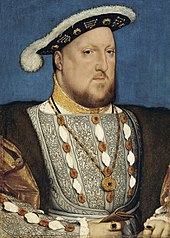 Portrait by Hans Holbein the Younger, c. 1537
On 8 January 1536, news reached the king and queen that Catherine of Aragon had died. The following day, Henry dressed all in yellow, with a white feather in his bonnet.[99] Queen Anne was pregnant again, and she was aware of the consequences if she failed to give birth to a son. Later that month, the king was thrown from his horse in a tournament and was badly injured; it seemed for a time that his life was in danger. When news of this accident reached the queen, she was sent into shock and miscarried a male child at about 15 weeks' gestation, on the day of Catherine's funeral, 29 January 1536.[100] For most observers, this personal loss was the beginning of the end of this royal marriage.[101]
Although the Boleyn family still held important positions on the Privy Council, Anne had many enemies, including the Duke of Suffolk. Even her own uncle, the Duke of Norfolk, had come to resent her attitude to her power. The Boleyns preferred France over the Emperor as a potential ally, but the king's favour had swung towards the latter (partly because of Cromwell), damaging the family's influence.[102] Also opposed to Anne were supporters of reconciliation with Princess Mary (among them the former supporters of Catherine), who had reached maturity. A second annulment was now a real possibility, although it is commonly believed that it was Cromwell's anti-Boleyn influence that led opponents to look for a way of having her executed.[103][104]
Anne's downfall came shortly after she had recovered from her final miscarriage. Whether it was primarily the result of allegations of conspiracy, adultery, or witchcraft remains a matter of debate among historians.[61] Early signs of a fall from grace included the king's new mistress, the 28-year-old Jane Seymour, being moved into new quarters,[105] and Anne's brother, George Boleyn, being refused the Order of the Garter, which was instead given to Nicholas Carew.[106] Between 30 April and 2 May, five men, including George Boleyn, were arrested on charges of treasonable adultery and accused of having sexual relationships with the queen. Anne was arrested, accused of treasonous adultery and incest.
Although the evidence against them was unconvincing, the accused were found guilty and condemned to death. The accused men were executed on 17 May 1536.[107] Henry and Anne's marriage was annulled by Archbishop Cranmer at Lambeth on the same day.[108] Cranmer appears to have had difficulty finding grounds for an annulment and probably based it on the prior liaison between Henry and Anne's sister Mary, which in canon law meant that Henry's marriage to Anne was, like his first marriage, within a forbidden degree of affinity and therefore void.[109] At 8 am on 19 May 1536, Anne was executed on Tower Green.[110]
Marriage to Jane Seymour; domestic and foreign affairs
[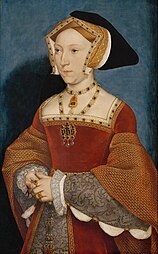

Jane Seymour (left) became Henry's third wife, pictured at right with Henry and the young Prince Edward, c. 1545, by an unknown artist. At the time that this was painted, Henry was married to his sixth wife, Catherine Parr.
The day after Anne's execution the 45-year-old Henry became engaged to Seymour, who had been one of the queen's ladies-in-waiting. They were married ten days later[111] at the Palace of Whitehall, Whitehall, London, in the queen's closet, by Stephen Gardiner, Bishop of Winchester.[112] On 12 October 1537, Jane gave birth to a son, Prince Edward, the future Edward VI.[113] The birth was difficult, and Queen Jane died on 24 October 1537 from an infection and was buried in Windsor.[114] The euphoria that had accompanied Edward's birth became sorrow, but it was only over time that Henry came to long for his wife. At the time, Henry recovered quickly from the shock.[115] Measures were immediately put in place to find another wife for Henry, which, at the insistence of Cromwell and the Privy Council, were focused on the European continent.[116]
With Charles V distracted by the internal politics of his many kingdoms and external threats, and Henry and Francis on relatively good terms, domestic and not foreign policy issues had been Henry's priority in the first half of the 1530s. In 1536, for example, Henry granted his assent to the Laws in Wales Act 1535, which legally annexed Wales, uniting England and Wales into a single nation. This was followed by the Second Succession Act (the Act of Succession 1536), which declared Henry's children by Jane to be next in the line of succession and declared both Mary and Elizabeth illegitimate, thus excluding them from the throne. The king was granted the power to further determine the line of succession in his will, should he have no further issue.[117]
In 1538, as part of the negotiation of a secret treaty by Cromwell with Charles V, a series of dynastic marriages were proposed: Mary would marry a son of the King of Portugal, Elizabeth marry one of the sons of the King of Hungary and the infant Edward marry one of the Emperor's daughters. The widowed King, it was suggested, might marry the Dowager Duchess of Milan.[118] However, when Charles and Francis made peace in January 1539, Henry became increasingly paranoid, perhaps as a result of receiving a constant list of threats to the kingdom (real or imaginary, minor or serious) supplied by Cromwell in his role as spymaster.[119] Enriched by the dissolution of the monasteries, Henry used some of his financial reserves to build a series of coastal defences and set some aside for use in the event of a Franco-German invasion.[120]
Marriage to Anne of Cleves
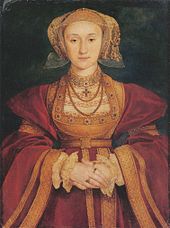 *Portrait of [Anne of Cleves* by Hans Holbein the Younger, 1539
Having considered the matter, Cromwell suggested Anne, the 25-year-old sister of the Duke of Cleves, who was seen as an important ally in case of a Roman Catholic attack on England, for the duke fell between Lutheranism and Catholicism.[121] Hans Holbein the Younger was dispatched to Cleves to paint a portrait of Anne for the king.[122] Despite speculation that Holbein painted her in an overly flattering light, it is more likely that the portrait was accurate; Holbein remained in favour at court.[123] After seeing Holbein's portrait, and urged on by the complimentary description of Anne given by his courtiers, the 49-year-old king agreed to wed Anne.[124] The marriage took place in January 1540.
However, it was not long before Henry wished to annul the marriage so he could marry another.[125][126] Anne did not argue, and confirmed that the marriage had never been consummated.[127] Anne's previous betrothal to the Duke of Lorraine's son Francis provided further grounds for the annulment.[128] The marriage was subsequently dissolved in July 1540, and Anne received the title of "The King's Sister", two houses, and a generous allowance.[127] It was soon clear that Henry had fallen for the 17-year-old Catherine Howard, the Duke of Norfolk's niece. This worried Cromwell, for Norfolk was his political opponent.[129]
Shortly after, the religious reformers (and protégés of Cromwell) Robert Barnes, William Jerome and Thomas Garret were burned as heretics.[127] Cromwell, meanwhile, fell out of favour although it is unclear exactly why, for there is little evidence of differences in domestic or foreign policy. Despite his role, he was never formally accused of being responsible for Henry's failed marriage.[130] Cromwell was now surrounded by enemies at court, with Norfolk also able to draw on his niece Catherine's position.[129] Cromwell was charged with treason, selling export licences, granting passports, and drawing up commissions without permission, and may also have been blamed for the failure of the foreign policy that accompanied the attempted marriage to Anne.[131][132] He was subsequently attainted and beheaded.[130]
Marriage to Catherine Howard
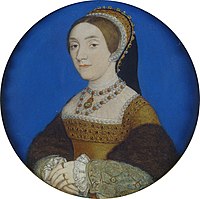 Portrait of a woman believed to be Catherine Howard, Henry's fifth wife, by Hans Holbein the Younger, 1540
On 28 July 1540 (the same day Cromwell was executed), Henry married the young Catherine Howard, a first cousin and lady-in-waiting of Anne Boleyn.[133] He was delighted with his new queen and awarded her the lands of Cromwell and a vast array of jewellery.[134] Soon after the marriage, however, Queen Catherine had an affair with the courtier Thomas Culpeper. She also employed Francis Dereham, who had previously been informally engaged to her and had an affair with her prior to her marriage, as her secretary. The Privy Council was informed of her affair with Dereham whilst Henry was away; Thomas Cranmer was dispatched to investigate, and he brought evidence of Queen Catherine's previous affair with Dereham to the king's notice.[135]
Though Henry originally refused to believe the allegations, Dereham confessed. It took another meeting of the council, however, before Henry believed the accusations against Dereham and went into a rage, blaming the council before consoling himself in hunting.[136] When questioned, the queen could have admitted a prior contract to marry Dereham, which would have made her subsequent marriage to Henry invalid, but she instead claimed that Dereham had forced her to enter into an adulterous relationship. Dereham, meanwhile, exposed Catherine's relationship with Culpeper. Culpeper and Dereham were both executed, and Catherine too was beheaded on 13 February 1542.[137]
Marriage to Catherine Parr
 Catherine Parr, Henry's sixth and last wife
Henry married his last wife, the wealthy widow Catherine Parr, in July 1543.[138] A reformer at heart, she argued with Henry over religion. Henry remained committed to an idiosyncratic mixture of Catholicism and Protestantism; the reactionary mood that had gained ground after Cromwell's fall had neither eliminated his Protestant streak nor been overcome by it.[139] Parr helped reconcile Henry with his daughters, Mary and Elizabeth.[140] In 1543, the Third Succession Act put them back in the line of succession after Edward. The same act allowed Henry to determine further succession to the throne in his will.[141]
Shrines destroyed and monasteries dissolved
Main article: Dissolution of the monasteries
In 1538, the chief minister Thomas Cromwell pursued an extensive campaign against what the government termed "idolatry" practised under the old religion, culminating in September with the dismantling of the shrine of St. Thomas Becket at Canterbury Cathedral. As a consequence, the king was excommunicated by Pope Paul III on 17 December of the same year.[90]
In 1540, Henry sanctioned the complete destruction of shrines to saints. In 1542, England's remaining monasteries were all dissolved, and their property transferred to the Crown. Abbots and priors lost their seats in the House of Lords; only archbishops and bishops remained. Consequently, the Lords Spiritual – as members of the clergy with seats in the House of Lords were known – were for the first time outnumbered by the Lords Temporal.[citation needed]
Second invasion of France and the "Rough Wooing" of Scotland
Main article: Rough Wooing
[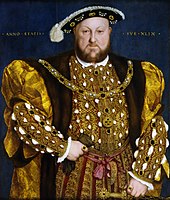
Henry in 1540, by Hans Holbein the Younger
The 1539 alliance between Francis and Charles had soured, eventually degenerating into renewed war. With Catherine of Aragon and Anne Boleyn dead, relations between Charles and Henry improved considerably, and Henry concluded a secret alliance with the Emperor and decided to enter the Italian War in favour of his new ally. An invasion of France was planned for 1543.[142]
In preparation for it, Henry moved to eliminate the potential threat of Scotland under the youthful James V. The Scots were defeated at Battle of Solway Moss on 24 November 1542,[143] and James died on 15 December. Henry now hoped to unite the crowns of England and Scotland by marrying his son Edward to James's successor, Mary. The Scottish Regent Lord Arran agreed to the marriage in the Treaty of Greenwich on 1 July 1543, but it was rejected by the Parliament of Scotland on 11 December. The result was eight years of war between England and Scotland, a campaign later dubbed "the Rough Wooing". Despite several peace treaties, unrest continued in Scotland until Henry's death.[144][145][146]
Despite the early success with Scotland, Henry hesitated to invade France, annoying Charles. Henry finally went to France in June 1544 with a two-pronged attack. One force under Norfolk ineffectively besieged Montreuil. The other, under Suffolk, laid siege to Boulogne. Henry later took personal command, and Boulogne fell on 18 September 1544.[147][144] However, Henry had refused Charles's request to march against Paris. Charles's own campaign fizzled, and he made peace with France that same day.[145]
Henry was left alone against France, unable to make peace. Francis attempted to invade England in the summer of 1545 but his forces reached only the Isle of Wight before being repulsed in the Battle of the Solent. Financially exhausted, France and England signed the Treaty of Camp on 7 June 1546. Henry secured Boulogne for eight years. The city was then to be returned to France for 2 million crowns (£750,000). Henry needed the money; the 1544 campaign had cost £650,000, and England was once again facing bankruptcy.[145]
Physical decline and death
 Coffins of King Henry VIII (centre, damaged), Queen Jane (right), King Charles I with a child of Queen Anne (left), vault under the choir, St George's Chapel, Windsor Castle, marked by a stone slab in the floor. 1888 sketch by Alfred Young Nutt, Surveyor to the Dean and Canons
Late in life, Henry became obese, with a waist measurement of 54 inches (140 cm), and had to be moved about with the help of mechanical devices. He was covered with painful, pus-filled boils and possibly had gout. His obesity and other medical problems can be traced to the jousting accident in 1536 in which he suffered a leg wound. The accident reopened and aggravated an injury he had sustained years earlier, to the extent that his doctors found it difficult to treat. The chronic wound festered for the remainder of his life and became ulcerated, preventing him from maintaining the level of physical activity he had previously enjoyed. The jousting accident is also believed to have caused Henry's mood swings, which may have had a dramatic effect on his personality and temperament.[148][149]
The theory that Henry had syphilis has been dismissed by most historians.[150][151] Historian Susan Maclean Kybett ascribes his demise to scurvy, which is caused by insufficient vitamin C most often due to a lack of fresh fruit and vegetables in one's diet.[152] Alternatively, his wives' pattern of pregnancies and his mental deterioration have led some to suggest that he may have been Kell positive and had McLeod syndrome.[149][153] According to another study, Henry's history and body morphology may have been the result of traumatic brain injury after his 1536 jousting accident, which in turn led to a neuroendocrine cause of his obesity. This analysis identifies growth hormone deficiency (GHD) as the reason for his increased adiposity but also significant behavioural changes noted in his later years, including his multiple marriages.[154]
Henry's obesity hastened his death at the age of 55, on 28 January 1547 in the Palace of Whitehall, on what would have been his father's 90th birthday. The tomb he had planned (with components taken from the tomb intended for Cardinal Wolsey) was only partly constructed and was never completed (the sarcophagus and its base were later removed and used for Lord Nelson's tomb in the crypt of St Paul's Cathedral).[155] Henry was interred in a vault at St George's Chapel, Windsor Castle, next to Jane Seymour.[156] Over 100 years later, King Charles I (ruled 1625–1649) was buried in the same vault.[157]
Wives, mistresses, and children
See also: Wives of Henry VIII, Children of Henry VIII, and Mistresses of Henry VIII
...
Knowledge Web Content (see main node)
Name: Henry VIII of England
Nickname/Alias: Defender of the Faith; King Hal
Achievements: King of England (1509-47), famous for his six wives, who presided over the beginnings of the English Renaissance and the English Reformation.
Born: June 28, 1491; Greenwich, near London, England
Died: January 28, 1547; London, England (Aged 55)
Field & Discipline: Royalty; King
Language: English
Father: Henry VII (1457-1509)
Mother: Elizabeth of York
Siblings: Arthur, Prince of Wales (1486-1502); Margaret Tudor
Spouse: 1) Catherine of Aragon (m. 1509-33, 1485-1536, mother of the future queen Mary I); 2) Anne Boleyn (m. 1533, 1504-36, mother of the future queen Elizabeth
I); 3) Jane Seymour (m. 1536, 1509-37, mother of Henry's successor, Edward
VI); 4) Anne of Cleves (m. 1540, 1515-57); 5) Catherine Howard (m. 1540, d. 1542); 6) Catherine Parr (m. 1543, 1512-48)
Children: Mary Tudor (1516-58); Elizabeth I (1533-1603); Edward VI (1537-53)
Education: Private tutors
Major Work:
“The Institution of a Christian Man”, 1537
Life & Times:
On his accession to the throne in 1509, Henry married his elder brother's widow, Catherine of Aragon. Eager for military adventures, in 1510 he joined the Holy League, formed by the Pope and Henry's father-in-law, Ferdinand II of Aragon, against French Louis XII, and in 1512 invaded France.
In 1514, his adviser Wolsey successfully negotiated the peace treaty with France and a treaty of marriage between Henry's sister, Margaret Tudor, and Louis. In reward Wolsey was appointed bishop of Lincoln (1514) then Cardinal, Archbishop of York and Lord Chancellor (1515), the most powerful man after the king.
During the period of Wolsey's supremacy (1515-27), Henry left much of the active conduct of state affairs to his Chancellor, but unpopular measures introduced by Wolsey,
including higher taxes to pay for Henry's expensive foreign policy and the suppression of the monasteries created much discontent in England by the mid-1520s, leading Henry to conclude that his first minister's usefulness might be coming to an end.
Meanwhile, by this time Henry had become both angry and worried by his failure to secure the Tudor dynasty by producing a son, as after a succession of stillbirths and early deaths Catherine's eight pregnancies had produced only one living child, the princess Mary (born 1516).
His infatuation with another of his wife's ladies-in-waiting, Anne Boleyn, who refused to become his mistress without the guarantee of a higher status, led Henry to seek a way out of his marriage.
Henry turned first to Wolsey for help in May 1527, in the hope that the Cardinal's influence with the Pope might obtain him an anulment, and a few days later Henry informed Catherine that, in order to avoid mortal sin, they must from now on live apart. Soon afterwards, an angry and frustrated Henry stripped Wolsey of high office, and appointed Sir Thomas More, who did not support the king's desire for a divorce, as Chancellor in his place.
Realizing that the Pope was determined to refuse him, in 1531, Henry charged the whole body of the clergy guilty of treason. Meanwhile, he had met the theologian and scholar [appointed] Cranmer*, who suggested a justification for nullifying the marriage by studying Scripture and appealing to theologians, including Lutherans such as [divorce considered by] Osiander*, across Europe, while another confidant, Thomas Cromwell, in April 1532, won control of the Privy Council, and came to the King with a plan that would establish the royal supremacy over the Church in England.
In 1533 Henry married Anne Boleyn, in Cranmer, now Archbishop of Canterbury, presided over a trial that declared the first marriage annulled. In September 1533 the princess Elizabeth (later [daughter was] Queen Elizabeth*) was born. This was followed in 1534 by a number of steps to instigate the split from Rome, all orchestrated by Cromwell, culminating in the declaration that the king was the sole supreme head of the Church of England.
The religious revolution also brought Henry much-needed revenue, as from 1535 Cromwell began to enforce the transfer of all monastic property to the crown. In order to secure uniformity he licensed the publication and distribution of the so-called “Great Bible” (1539) in English to parish churches throughout England and passed the Statute of the Six Articles (1539), known as the “Bloody Statute.”
All the fundamental doctrines of the Roman Catholic Church were insisted on as necessary articles of belief, with harsh penalties laid down for their infringement, including the death sentence for anyone questioning transubstantiation.
In 1536, Catherine of Aragon died, and in May of the same year, the King having tired of her, Anne Boleyn was found guilty of treasonable adultery and was executed with five of her alleged "lovers".
The day after her execution, Henry was betrothed to one of Anne's ladies-in-waiting, Jane Seymour, who in 1537 bore him a son, Edward, but died soon after from puerperal fever. There followed a three-year search for another suitable bride, and in 1540 Henry agreed to marry Anne of Cleves, but disliked her on sight, and at once demanded a divorce, which he received six months later.
He then quickly married the young Catherine Howard, a niece of the Duke of Norfolk, but her proven infidelity led her to suffer the same fate as Anne Boleyn, and she was beheaded in February 1542, after only 18 months of marriage.
Catherine's infidelity apparently greatly affected Henry, who had been transformed by this stage to a sick, bloated and bitter old man, greatly feared for his violent temper and irrational outbursts.
He did, however, find some kind of solace in his final marriage, to Katherine Parr in July 1543, through whose influence he was persuaded to restore to his two daughters, Mary and Elizabeth, the rank of princess.
His physical decline (by 1547 he was in constant pain, and his body so large that his legs were unable to carry his weight) did not, however, prevent him from controlling his government. His interest in foreign policy was kept alive by the resumption of hostilities between Spain and France in 1542, during which Henry allied himself with Spain.
Meanwhile, in 1544 France and Spain came to terms, but Henry unwisely continued the English war against France until 1546, offsetting the enormous cost of the campaign first by raising taxes and borrowing, then by selling off some of the former monastic lands, and finally by debasing the coinage.
Although by 1546 clearly a desperately sick man, he continued his control of all aspects of government, securing (he believed) the succession of his son Edward to the throne by ordering the execution of the Duke of Norfolk and his son, Henry Howard, Earl of Surrey on charges of high treason, the last of a long line of judicial murders instigated by Henry during his reign.
Henry died, aged 55, at Westminster on 28 January 1547 (saving Norfolk, who was sentenced to be executed the following day, from the same fate), leaving the boy king, Edward, under the control of his uncle, the Earl of Hertford, with the majority of Councillors now in power ready to continue the religious Reformation.
Extra Connections: He borrowed from the [borrowed from] Fugger* firm
He promoted the career of [promoted career of] Cecil*
[work dedicated him by] Tartaglia* dedicated work to him.
He was godfather to [godfather to] Henri II* of France
He knew of [knew work of] Tyndale's* work
Assessment: Although he presided over the early stages of the English Reformation, Henry upheld the orthodoxy of Catholic doctrine in England.
Oneliner: Henry VII, king with six wives
Bibliography:
- Dictionary of National Biography.
- Encyclopedia Britannica.
- Scarisbrick, J.J., Henry VIII, Oxford: OUP, 1968.