Gilbert Wm
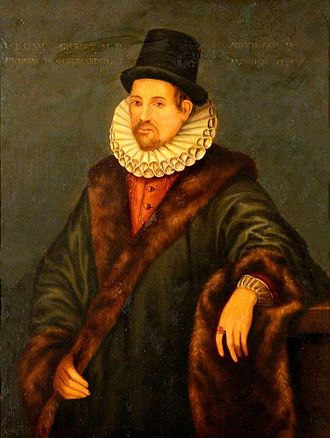
Name: William Gilbert
Achievements: Discovered the Earth has magnetic poles
Born: May 24, 1544, Colchester, Essex, England
Died: December 10, 1603; London or Colchester, England (Aged 59)
Field & Discipline: Medicine; Doctor
Education: St John's College, Cambridge
Major Work:
"On the Great Magnet of the Earth" (1600)
Life & Times:
Gilbert qualified as a doctor in 1569. By 1577 he was established as a physician in London, living at Wingfield House on St Peter's Hill, a street which led out of St Paul's Church Yard.
In the same year, he was granted the right to have his own coat of arms, and was elected a Fellow of the Royal College of Physicians. Within the next decade, he became a prominent member of his profession and numbered among his patients members of the government and the aristocracy.
In 1587 he became treasurer of the Royal College of Physicians. He was one of the doctors selected to advise the Privy Council on an outbreak of disease in the city of London, and on the health of men serving in the navy.
[worked with] Walsingham*, Queen Elizabeth’s spymaster, would grant permission to travel abroad for health reasons on receipt of a medical certificate signed by Gilbert. He was consulted by the geographer [consulted by] Hakluyt* and he attended [at deathbed of] Cecil*, the queen's first minister, on his death bed.
In 1600 he became President of the Royal College of Physicians. The same year he published the work on magnetism for which he is remembered. Gilbert had been investigating magnetism for many years. He collected lodestones (natural magnets) and minerals, and experimented with different substances, at one point surrounding a lodestone with seventy diamonds to test the theory that magnets lose their power in the presence of diamonds.
Gilbert was a strong believer in observation and experiment as opposed to conjecture or conclusions based on untested hypotheses. He had no elaborate instruments or equipment, and conducted his investigations with a mass of small objects: iron needles, or little wooden boats freighted with lodestones (which he floated on water), iron filings, iron wire, pieces of glass, resin and jet and amber. He also studied any information on the use of magnets.
For some four hundred years, the magnetic needle had been used in navigation. The dip of the needle from the horizontal had been found to vary at different places and sailors had begun to collect data on this. At Gilbert's suggestion, the mathematician [ a pal of] Briggs* calculated a table of dip and latitude.
Gilbert was fully aware of the importance of magnetism for navigation and to the practical use his research could have, pointing out for example how the dip could be used to discover latitude at sea. He had what [known to] Harvey* later described as 'thousands' of books and maps, and he collected information on the variations of the magnetic needle noticed by navigators at sea.
In his book he summarized existing knowledge on magnetism before investigating the properties of the magnet, illustrated by diagrams and experiment. He made a distinction between magnetic attraction and that of amber, jet and other substances which could be rubbed to produce an attracting force. He named these substances 'electrics.'
Gilbert was not interested in electricity as such, and only introduced the subject to show that it was not connected with magnetism. He was the first to use the terms “electric attraction” and “electric forces” and his research was later repeated by [work repeated by] Stephen Gray*.
Gilbert discussed the attraction of the magnet and its direction, variation and declination (dip from the horizontal), before concluding that magnetism is explained by the fact that the Earth is one vast spherical magnet and that the tendency of the needle to point in a polar direction was due to this fact.
The value of Gilbert's work lay in the fact that he put the study of magnetism on a scientific basis and gave detailed experimental data. Gilbert’s work was particularly appreciated by mapmakers for the [helped] East India Company*, who were desperate for more reliable information. His book was recognised both in England and abroad. [a fan was] Galileo* praised it and Gilbert and [corresponded with] Sarpi* corresponded about it.
The poet laureate [referred to by] Dryden* later wrote that:
"Gilbert shall live till loadstones cease to draw,
Or British fleets the boundless ocean awe".
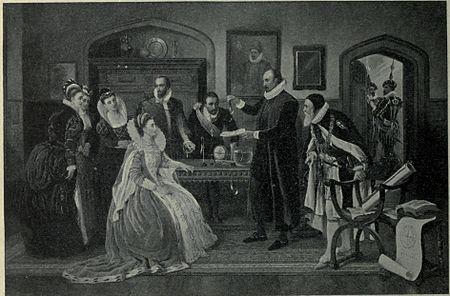
William Gilbert M.D. demonstrating his experiments before Queen Elizabeth .
In 1601 Gilbert was appointed physician in ordinary to [doctor to] Queen Elizabeth* and was probably one of the doctors in attendance at her death in 1603. He was appointed physician to the queen's successor, James I, but Gilbert died, probably of the plague, before taking up the appointment.
His unpublished writings were edited by his half-brother William and published in Amsterdam after his death. "A New Philosophy of Our Sublunar World" (1651) shows an advanced cosmological view for the time, and discusses the motion of the earth according to [wrote about] Copernicus* and [wrote about] Bruno* although Gilbert did not deny or confirm the heliocentric system.
He maintained that the fixed stars were not all the same distance from the earth and that the planets were held in their orbits by a form of magnetism.
Extra Connections:
[cited by] Boyle* quoted Gilbert in his "Experiments and notes about the mechanical origins or production of electricity.”
He was influenced by [influenced by] Witelo*
Francis Bacon never accepted Copernican heliocentrism and was critical of Gilbert's philosophical work in support of the diurnal motion of the Earth. Bacon's criticism includes the following two statements. The first was repeated in three of his works—*In the Advancement of Learning* (1605), Novum Organum (1620) and *De Augmentis* (1623). The more severe second statement is from History of Heavy and Light Bodies published after Bacon's death.[20]
The Alchemists have made a philosophy out of a few experiments of the furnace and Gilbert our countryman hath made a philosophy out of observations of the lodestone.
[Gilbert] has himself become a magnet; that is, he has ascribed too many things to that force and built a ship out of a shell.
Thomas Thomson writes in his History of the Royal Society (1812):[21]
The magnetic laws were first generalized and explained by Dr. Gilbert, whose book on magnetism published in 1600, is one of the finest examples of inductive philosophy that has ever been presented to the world. It is the more remarkable, because it preceded the Novum Organum of Bacon, in which the inductive method of philosophizing was first explained.
William Whewell writes in his History of the Inductive Sciences (1837/1859):[22]
Gilbert... repeatedly asserts the paramount value of experiments. He himself, no doubt, acted up to his own precepts; for his work contains all the fundamental facts of the science [of magnetism], so fully examined, indeed, that even at this day we have little to add to them.
Assessment: The first to subject the study of magnetism to the new scientific method of experimental observation.
Oneliner: William Gilbert, who discovered the Earth had magnetic poles
Bibliography:
- Kelly, Sister Suzanne, O.S.B., The De Mundo of William Gilbert, Menno Hertzberger & Co., Amsterdam, 1965.
- Roller, Duane H.D., The De Magnete of William Gilbert, Menno Hertzberger, Amsterdam, 1959.
- Thompson, Silvanus P., Gilbert, Physician, A Note Prepared for the 300thAnniversary .., Charles Whittingham and Company, Chiswick, 1903.
See also
William Gilbert (physician) - Wikipedia
Language: English
Father: Father: Hierom Gylberd
Mother: Elizabeth Coggeshall
Siblings: 3 brothers: Jerome, Robert, John. 2 half-brothers: Ambrose, William. 1 sister: Margaret. 3 half-sisters: Mary, Anne, Elizabeth
Spouse: None
Children: None