Pinkerton
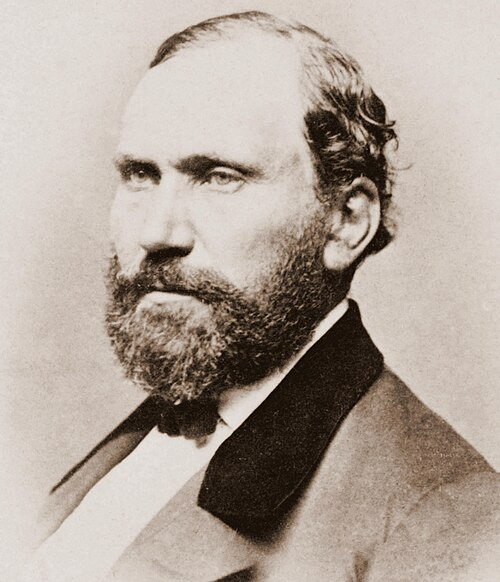
Achievements: Founder of the Pinkerton National Detective Agency.
Born: August 25, 1819; Glasgow, Scotland
Died: July 1, 1884; Chicago, Illinois (Aged 62)
Field & Discipline: Crime; Private Detective
Major Work: “Thirty Years a Detective” (1884)
Life & Times:
Despite having a police sergeant as a father, Pinkerton, who worked as an apprentice barrel-maker, became involved with the Chartists, a radical workers' movement led by newspaper owner Feargus [involved with] O’Connor*. To avoid police persecution, he and his wife ran away to North America in 1842. They lived in Canada at first, then moved to Chicago for a short time, before they moved to the small Scottish-dominated town of Dundee in Kane County, forty miles away, where he set up a cooper's shop and employed eight apprentice barrel-makers.
One day, in 1847, while cutting wood for the barrels, Pinkerton came across a gang of counterfeiters, assisted in their capture and immediately became a local hero. He was appointed deputy sheriff of Kane County in 1846. Two years later, he ran for election to the state's constitutional convention but, having failed to be elected, he sold his business and moved to Chicago, in 1850.
Pinkerton carried out detective work for the local and federal governments and, in 1851 and 1853, he investigated counterfeiting problems for the US Secretary of the Treasury. A year later, he became a deputy sheriff and was given the job of investigating thefts in the Chicago post office, where he uncovered several cases of employees stealing mail. In February 1855, he resigned from Chicago's new police force to set up a private detective agency called the North West Police Agency. At the time, the railroad company in Illinois had expanded their track from 100 miles to nearly 5,000 miles and the owners hired Pinkerton to police their employees and property.
Pinkerton was sure that dishonest employees were the biggest problem facing the company, so he set up a spy system, involving either himself or one of his employees posing as a train passenger and spying on the workers. During the next five years, Pinkerton, who adopted the symbol of the all-seeing eye for his agency (hence the term "private eye"; the accompanying motto: "We Never Sleep"), increased his spying efforts at the same time as the railroad workers were organising their labor unions, but the Civil War began before any serious industrial conflict broke out.
In early 1861, the Philadelphia, Wilmington & Baltimore Railroad had given Pinkerton the job of investigating threats made against the railroad by southern sympathizers. During this work, he heard of a plan to assassinate President-elect Abraham Lincoln as he passed through Baltimore. He approached Lincoln's advisers and, with their help, persuaded Lincoln to be escorted secretly through Maryland in February 1861. The first female detectiveKate Warn, was critical in thwarting the plot). The conspiracy was never proven to be real and Pinkerton was suspected of making up the story to gain advantage for his agency.
Newly-elected President [invited to conference by] Lincoln* invited Pinkerton to a conference to look at the possibility of setting up a secret service, but the conference ended with no definite plan. At the start of the Civil War, his friend and ex-railroad boss [a pal of] McClellan*, had taken command of Ohio troops and asked Pinkerton to use his growing spy network to gather intelligence against the Confederates.
In August 1861 McClellan was given command of the Army of the Potomac and Pinkerton took charge of a military spy system in Virginia, called the Secret Service, under the alias E.J. Allen. The actions of the controversial secret service led to the Confederates executing Timothy Webster, a Pinkerton agent and the arrest of Rose Greenhow, a Confederate spy, in Washington. After a lot of negative publicity and the dismissal of McClellan in 1862, Pinkerton, now without the general’s support, returned to his private detective business.
Renamed the Pinkerton National Detective Agency, his organisation expanded rapidly after the Civil War, with offices being opened in New York in 1865 and Philadelphia a year later. He continued to spy for railroad companies and was also employed to guard valuable goods and money, by express companies using the railroads.
One of his greatest successes was the capture of the gang leaders in a $700,000 Adams Express Company theft in 1866. His agency was employed to pursue many railroad, and later, bank robbers, including the notorious Reno, Younger, James and Dalton gangs. From 1873 to 1876, one of his detectives, [employed] McParlan*, lived undercover among the Molly Maguires, a secret fraternity of Irish miners in Pennsylvania, collecting evidence that led to the conviction and execution of several Mollies, and the breaking up of the organisation, which was supposedly engaged in terrorism.
By the 1870s, Pinkerton's agency employed twenty detectives and sixty watchmen, who were much in demand during the labor strikes of 1877. At this time the harsh Pinkerton policy towards the unions caused it to be severely criticised in labor circles, but Pinkerton himself maintained he was on the side of the working man when he took on the labor unions.
During the 1870s, Pinkerton tried to clarify what his new profession was all about, by defining his business philosophy, establishing a fee structure and creating a code of employee conduct, and a strict lifestyle on his staff. The agency took a moral stance, rejecting cases that Pinkerton thought disreputable, including divorce investigations.
Pinkerton became a writer, with sixteen detective books published between 1874 and 1884, glamourising the work of the agency. His work influenced the detective writer, [influenced. Conan Doyle* and included “The Molly Maguires and the Detectives”, 1877, “The Spy of the Rebellion”, 1883, his account of Lincoln's journey to Washington in 1861, and his semi-autobiography, “Thirty Years a Detective”,1884.
At the time of his death, he was working on a system to centralize all criminal identification records; such a database is now maintained by the Federal Bureau of Investigation. After his death, the Pinkerton National Detective Agency was taken over by his two sons, Robert and William and still exists today.
Extra Connections: [employed by] Carnegie* Steel hired him
He spied on [spied on] Eleanor Marx*
Following Pinkerton's services for the Union Army, he continued his pursuit of train robbers, including the Reno Gang. He was hired by the railroad express companies to track outlaw Jesse James, but after Pinkerton failed to capture him, the railroad withdrew their financial support and Pinkerton continued to track James at his own expense. After James allegedly captured and killed one of Pinkerton's undercover agents (who was working undercover at the farm neighboring the James family's farmstead), he abandoned the chase. Some consider this failure Pinkerton's biggest defeat.[21]^
After the Civil War, his agents played a significant role as strikebreakers – in particular during the Great Railroad Strike of 1877 – a role that Pinkerton men would continue to play after the death of their founder.
Pinkerton was known to be a friend of abolitionist John Brown. On March 11, 1859, he supported Brown by giving him $500 and a ticket on the Michigan Central Railroad to Detroit. He also attended the secret meetings held by John Brown and Frederick Douglass in Chicago along with abolitionists John Jones and Henry O. Wagoner. At those meetings, Jones, Wagoner, and Pinkerton helped purchase clothes and supplies for Brown. Jones' wife, Mary, guessed that the supplies included the suit Brown was hanged in after the failure of John Brown's raid on Harpers Ferry in November 1859.[13]^
Assessment: Pinkerton provided the United States with a national policing system at the time when there was little federal and state law enforcement.
Oneliner: Allan Pinkerton, of the first detective agency.
Language: English
Father: William Pinkerton
Mother: Isabella McQueen
Siblings: Unknown
Spouse: Joan Carfrae (married 1841)
Children: Robert; William; Name Unknown
Education: Unknown
Bibliography:
- American National Biography.
- Horan, James D., The Pinkertons: The Detective Dynasty That Made History, London, William Heinemann Ltd., 1968.
Media:
Allan Pinkerton's Detective Agency (PBS)
"The Hour of Peril: The Secret Plot to Murder Lincoln Before the Civil War" by Daniel Stashower BookTV video talk
John Brown's Holy War (PBS)