Robert, NL
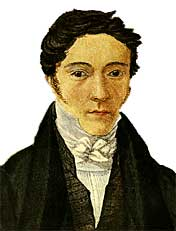
NAME: Robert, Nicolas Louis.
ACHIEVEMENT(S): Paper-making machine
NICKNAME/ALIAS: None.
DATE/PLACE OF BIRTH: 1761, in Paris, France.
DATE/PLACE/AGE AT DEATH: August 1828, in Vernouillet, near Dreux, France. Aged 66.
DISCIPLINE: Inventor.
FIELD: Paper-making.
LANGUAGE: French.
PARENTS: ?
SIBLINGS: ?
SPOUSE: ?
CHILDREN: Six children.
EDUCATION: ?
MAJOR WORK:
LIFE AND TIMES:
The son of a prosperous businessman, Robert was a serious student and, at the end of his studies, became a solicitor’s clerk. The work didn’t suit him, so he asked permission of his parents to join the army. In 1790, he enlisted in the Grenoble Artillery and went off to America to fight the British.
He came back to France and, having had enough of military life, took a job as a proof reader, working for Pierre Francois Didot, a member of the Didot family, famous as printers, publishers and papermakers.
In 1794, by now married with a daughter, Robert was given a job at the Essonnes Paper Mill of Leger Didot. He was made Clerk Inspector, responsible for a workforce of 300 producing hand-made paper.
To try to make the mill more efficient and less labour intensive, Robert started thinking about mechanization. Encouraged by Leger Didot, Robert spent time in the workshops, trying to design a papermaking machine. He was successful to a point when, in 1796, he produced a prototype that, while not very reliable, could make paper in half inch strips.
Robert worked in his spare time to develop the machine, but his employer lost interest and criticised him for wasting time and resources. Two years later, Robert had progressed to the extent that Didot changed his mind again and allowed the full use of the workshop. The result, in 1798, was a machine that could make paper twenty-four inches wide, a width chosen to suit the wallpaper trade.
Robert carried out trials on the strips of paper and found that his main problem was shrinkage, which he overcame by modifying the drying process. He was by now ready to patent his invention, but couldn’t afford the fee, so he applied to the French Minister of the Interior for a free patent.
His application was rejected, with the recommendation that he work with the draughtsmen at the Conservatoire des Arts et Metiers, with the aim of producing a detailed description and drawings of the machine.
Robert hoped that, with these plans, he would be able to submit the design for a government award. In December, the plans were complete and Robert was given 3,000 francs and granted his patent on 18th January 1799.
Didot had, by now, become convinced that Robert’s invention had huge potential and offered to buy the patent for 60,000 francs, with ten percent paid up front. When Didot failed to pay off the balance when it fell due in 1800, Robert went to court to enforce the repossession of the patent. Shortly after, they both entered into another agreement, with Robert as director of the operation and, once again, Didot failed to pay the large sum of money that they had agreed on.
For a second time, Robert went to law to recover the patent and was successful in June 1801. Before that happened, Robert had decided that the best country in which to exploit the invention would be Britain and asked his brother-in-law, Gamble* to apply for an English patent.
Gamble worked on prisoner-of-war exchange in Paris, and a British national could travel to England (which Didot had not been able to do, because of the war between Britain and France). In March 1801, a patent was granted in Gamble’s name, without Robert’s knowledge, and Gamble enlisted the support of the English papermaker brothers Henry and Sealy Fourdrinier* in exploiting it.
The original model was sent to John Hall*'s factory at Dartford, where work on a prototype machine was begun by Donkin* in 1802. Leger Didot went into partnership with Gamble and the Fourdrinier brothers the same year, and remaining in England until 1819.
In Didot's absence, Robert stayed in France managing the Essonnes paper mill, in spite of the ongoing legal battles with Didot, which were finally resolved in Robert's favour in 1810. Four years later, though, the patent expired and Robert, with failing health and no money, abandoned the paper trade altogether, moving to Vernouillet, near Dreux, where he set up a small primary school.
ASSESSMENT: His invention of continuous papermaking machine made a major contribution to industrial 19th century Europe.
EXTRA CONNECTIONS: None
ONELINER: Nicholas Louis Robert, inventor of paper-making machine
BIBLIOGRAPHY:
Pilkington, Austin, Frogmore and the First Fourdrinier, The British Paper Company, 1990.