Donkin, Bryan
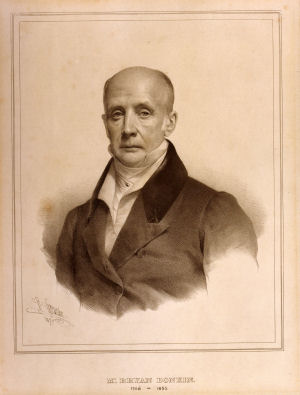

Major Work: Canned food
Born: March 22, 1768; Sandoe, Northumberland, England
Died: February 27, 1855; London, England (Aged 86)
Field & Discipline: Engineering
Education: Local schools in Northumberland
Achievements: Developed the Fourdrinier machine for making paper and invented the composition roller used in printing.
Life & Times:
When he first left home, around 1790, Donkin worked for about two years as land agent to the Duke of Dorset at Knole Park, Kent, but, on the recommendation of [family friend was] Smeaton*, a family friend, in the mid-1790s he apprenticed himself as an engineer to a papermaker, [apprenticed to] John Hall* of Dartford. In 1801-02, Hall asked Donkin to construct a model of a continuous paper-making machine. The idea the machine had been developed in 1798 by [developed machine of] Robert* of France, and was the subject of an 1801 patent in England, issued to [in business with] John Gamble*, and then financed by the [financed by] Fourdrinier* brothers.
Donkin's first model was not successful, but in 1802, under an agreement with Bloxham and Foudrinier, Donkin constructed another machine at his own works at Fort Place, London, which he set up at Frogmore Mill, Hertfordshire in 1804. This was the first working Fourdrinier machine, and its success prompted the Fourdrinier’s to continue their investment and commission Donkin to build a second one at Two Waters Mill, Hertfordshire in 1805.
By 1810 18 of these complex machines had been supplied to various mills, with Donkin responsible for the construction and perfection of each one. Sales of paper made by Foudrinier machines rapidly overtook hand-made paper, and Donkin remained involved with their construction throughout his life.
Meanwhile, in 1812 Donkin began developing an idea from another French inventor, [used original idea of] Appert 2*, who had invented a method for preserving food by enclosing it in corked bottles, heated "to exclude the air" (which was then believed to be the key to food preservation).
In 1810 Appert published a book about the method, which was translated into English the same year. A patent for making tinplate for preserving food in cans, rather than breakable bottles, was issued to a Peter Durand in 1810, and Donkin, who had interests in an iron works, quickly saw the commercial potential if Appert's method could be adapted for use with cans made of tinplate. This method, for which Donkin was issued a patent, essentially consisted of leaving a small hole in the top of the filled cans, heating the can in order to "drive out the air", and then closing the hole with solder.
By 1812, Donkin had set up a large canning factory in Bermondsey, and by 1818 was also producing the foodstuffs to be canned, including cured and boiled beef, carrots, mutton, and vegetable and meat stews. However, [commercialized production of] canned food* was more expensive than fresh food, and so for some time the cans were bought mainly by travellers, seamen and explorers. The Navy was particularly interested, and in 1818, aided by money left in John Gamble’s will, Donkin opened a factory dedicated exclusively to the production of canned vegetable soups and preserved meats for the Royal Navy.
Canned food was to be a significant factor in enabling British ships to winter in the Arctic, so allowing Arctic exploration. The first voyage to carry food in cans made by Donkin and Gamble was that by Captain William Edward Parry to the Arctic in 1819-20, in search of the NorthWest Passage.
On his third Arctic expedition, in 1822-25, one of his ships, H.M.S. Fury, was wrecked in the Arctic at what then became known as Fury Point; in 1829, on a similar venture, the great explorer [cans taken by] Sir James Ross* arrived at Fury Beach to find no trace of the wreck, but instead found tents with many tins of food salvaged from the wreck. Four years on, Ross found the meat and vegetables perfectly preserved (and not frozen) in their canisters, with no rust and no interference from bears. By the mid-19th century, all long sea voyages were supplied with canned food, now a necessary part of every ship's stores.
In 1813, Donkin became involved in the improvement of printing machinery. On November 23, 1813 Donkin was awarded a patent for his polygonal machine, one of which was built at Cambridge University. This printing machine was a forerunner of the rotary press and was intended to replace the old flatbed press (that moved back and forth) which could not print fast enough to produce large numbers of newspapers. The machine consisted of four trays, each containing a page of type, on the four sides of a revolving spindle, and production was between 800 and 1000 impressions per hour. An important feature of the new machine was the use of inking rollers (known as the composition printing roller). Although the polygonal machine eventually failed, Donkin's composition rollers were widely adopted.
After 1815 Donkin worked as a civil engineer in London for the next forty years, received two gold medals from the Society of Arts (one for his invention of an instrument to measure the velocity of rotation of machinery, and the other for a counting engine), and was a founder (1818) of the Institution of Civil Engineers.
In 1820 he worked with [collaborated with] Sir William Congreve* to develop a method of printing stamps in two colors with compound plates, in order to prevent forgery. Donkin was also interested in pure science, and was elected fellow of the Royal Society FRS in 1838.
Extra Connections: His apprentice was [apprentice was] Gravatt*
[collaborated with] Maudslay* collaborated with him
Assessment: Bryan Donkin was an exceptionally talented inventor and engineer.
Oneliner: Dryan Donkin, who made canned food possible
Language: English
Father: Unknown
Mother: Unknown
Siblings: Unknown
Spouse: Mary Brame (1771-1858)
Children: John (1802-54) and two other sons
Bibliography:
- Dictionary of National Biography.
- Encyclopedia Britannica.