Donkin 2
 See main Donkin node
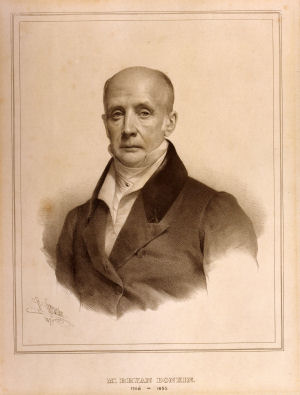
Bryan Donkin FRS FRAS[1] (22 March 1768 – 27 February 1855) developed the first paper making machine and created the world's first commercial canning factory. These were the basis for large industries that continue to flourish today. Bryan Donkin was involved with Thomas Telford's Caledonian Canal, Marc and Isambard Brunel's Thames Tunnel, and Charles Babbage's computer. He was an advisor to the government and held in high esteem by his peers.
Early life
Raised in Sandhoe, Northumberland,[1][2] his father was a surveyor and land agent. Donkin initially began work in the same business, and worked from September 1789 to February 1791 as bailiff at Knole House and estate for the Duke of Dorset.[2]
Career
While working for the Duke of Dorset, Donkin consulted the engineer John Smeaton, an acquaintance of his father, as to how he could become an engineer.[3] At Smeaton's advice in 1792 he apprenticed himself to John Hall in Dartford, Kent, who had founded the Dartford Iron Works (later J & E Hall) in 1785. Shortly after completing his apprenticeship, he set himself up in Dartford, with the support of John Hall, making moulds for paper works, for at that time all paper making was done by hand. In 1798 he married Mary Brames,[4] daughter of Peter Brames,[5] a neighbouring land owner and market gardener, and a prominent supporter of the Methodist movement. By doing so Donkin became brother in law to John Hall, who had married Mary's elder sister Sarah in 1791.[6]
Fourdrinier machine
Main article: Fourdrinier machine
 Distinguished Men of Science.[7] Use your cursor to see who is who.[8]
In 1801–2 Donkin took a prototype of a continuous paper-making machine, and started its transformation into the famous Fourdrinier machine which is the basis of modern paper-making. Donkin took premises at Bermondsey, London in 1802, thus starting the enterprise that became the Bryan Donkin Company, which still continues in business in the early 21st century. In 1804 he succeeded in producing a working machine. A second, improved one, was made the following year and in 1810 eighteen of the complex machines had been erected at various mills. Although the original design was not Donkin's, he received the credit for having perfected them and brought them into use. His company continued to make such machines, and by 1851 had produced nearly 200 machines for use across the world.[9][10]
Printing machinery
Donkin also worked with printing machinery. In 1813 he and a printer, Richard Mackenzie Bacon of Norwich, obtained a patent for a "Polygonal printing machine"; this used types placed on a rotating square or hexagonal roller or "geometric prism". Ink was applied by a roller which rose and fell with the irregularities of the prism. One of these machines was set up for Cambridge University. It however proved too complicated and suffered from poor inking, which prevented its success. However, it was the first machine to introduce composition ink rollers which were considered better than the existing leather-covered rollers. Donkin's inking roller quickly became the industry standard.[2][11]
Tinned food
Donkin became interested in canning food in metal containers. John Hall acquired Peter Durand's patent in 1812 for the sum of £1000[2][12] and after various experiments, and in association with Hall and Gamble, Donkin set up a canning factory in Bermondsey, the first cannery to use tinned iron containers. By late spring 1813 they were appointing agents on the south coast to sell preserved food to outbound ships.[2] Soon the British Admiralty were placing sizeable orders with the firm of Donkin, Hall and Gamble for meat preserved in tinned iron canisters. The firm of Donkin, Hall and Gamble was later merged into Crosse & Blackwells.[13] London's Science Museum has an early Donkin tin can.[14]
Difference engine
During the 1820s and 1830s, Charles Babbage requested Donkin's assistance in resolving continuing disputes between Babbage and Joseph Clement who had been commissioned by Babbage to manufacture the difference engine. This included investigating the ownership of intellectual property, tooling and piece-parts of the difference engine.[2]
Bryan Donkin retired from an active role in the business in 1846 at the age of 78.[10] His sons John, Bryan and Thomas continued the business.
In 1857 the British government authorised the sum of £1200 (2015: £110,000) for a full-scale difference engine with attached printing apparatus based on the design of Per Georg Scheutz and his son Edvard to be constructed by Donkin's company, which had acquired a reputation for building machines for the colour printing of banknotes and stamps. Costs overran and the company delivered the machine in July 1859, several weeks past the deadline, incurring a loss of £615.
Despite the engine's printing unit working badly, the Royal Society and the Astronomer Royal were generally positive when they inspected it on 30 August 1859, expressing their satisfaction at its construction. Donkin was unhappy that he had lost so much money on the project, which he attributed to the engine's unexpected intricacy and the fact that he had very little to base his original cost estimate on, Edvard Scheutz having given him very little information. In addition, costly machine tools had had to be made specially to make the engine's components and many alterations had been introduced along the way.[15]
The machine was used by William Farr at the General Register Office to compute life tables, which were published in 1864. It operated on 15-digit numbers and 4th-order differences, and produced printed output just as Charles Babbage had envisaged. This machine is now in the London Science Museum.
Civil engineering
 A model of a Fairbairn Pattern Beam Engine of circa 1860 as built by Bryan Donkin & Co.
In the 1820s Donkin became a director of the Thames Tunnel Company,[2] having become acquainted with Marc Brunel when he had supplied equipment for his machinery at Chatham Dockyard. In 1825–27 Donkin supplied pumps for removing water from the tunnel and also workmen for modifying the tunnelling shield; at one time it was even suggested that he replace Brunel as engineer.
In 1826 he constructed a model of a landing stage proposed by Brunel for use at Liverpool.
Donkin's works regularly supplied machinery for use in civil engineering projects, including dredging machines for the Caledonian Canal in 1816, the Prussian government in 1817, the Göta Canal (Sweden) in 1821, and the Calder and Hebble Navigation in 1824. Stationary steam engines were also supplied for use in the construction of the locks on the Caledonian Canal.[2]
As an eminent engineer, Donkin was often consulted on civil engineering matters. He supported Thomas Telford's 1814 proposals for a massive suspension bridge at Runcorn, and in 1821 reported along with Henry Maudslay on an iron bridge erected by Ralph Dodd at Springfield, Chelmsford. Thomas Telford employed Donkin in his survey of rivers in the London area for the Water Supply report, completed shortly before Telford's death.[16] Donkin died in 1855 and was buried in a family plot in Nunhead Cemetery, south London.[17]
Other work
In 1820 Donkin worked with Sir William Congreve on preventing the forgery of excise stamps, using a method of two-colour printing with compound printing plates. Working with his partner John Wilks, he produced a machine which was used for the Excise and Stamp Office and also for the East India Company at Calcutta. This 'Rose Engine' is now at the Science Museum, London.[18]
By 1847, Donkin's company had designed its first products for the emerging gas industry. The name Donkin has since become a generic name for certain gas valves and Bryan Donkin RMG Gas Controls Limited remains a going concern in Europe. AVK and Howden Blowers also continue manufacture of Bryan Donkin equipment.
Among Donkin's other inventions were a screw-cutting and dividing machine; an instrument to measure the velocity of rotating machinery; and a counting engine. The last two received the Royal Society of Arts Prize medal.
Death
 The Donkin family vault in Nunhead Cemetery
Donkin died at home in the New Kent Road, London, on 27 February 1855. He was buried in a vault in Nunhead Cemetery. His wife, Mary, died on 27 August 1858 and was buried in the same vault, as were other family members at later dates.
Institutions
In 1805, with John Hall and others, he formed the Society of Master Millwrights, acting as its treasurer.
He was a member of the Society of Arts, becoming a vice-president and chairman of the Committee of Mechanics.
He was elected a fellow of the Royal Society in 1838.
Donkin was one of the originators and a vice-president of the Institution of Civil Engineers, which was founded by Henry Robinson Palmer, one of his pupils. He also helped the institution to obtain its royal charter in 1828, advancing 100 guineas towards the costs.
Donkin was elected a member of the Smeatonian Society of Civil Engineers in 1835 and served as its president in 1843.[19]
He was a founder member of the Royal Astronomical Society and served on its council.[1]
Extra Connections:
John Donkin (1802–1854) was a British engineer. He was a son of Bryan Donkin and worked in this father's company in Bermondsey, primarily on paper-making equipment. He married Caroline Hawes, granddaughter of William Hawes, notable as founder of the Royal Humane Society. Caroline Hawes was the sister of Sir Benjamin Hawes, brother-in-law of Isambard Kingdom Brunel.
Knowledge Web Content (see main node)
Major Work: Canned food
Born: March 22, 1768; Sandoe, Northumberland, England
Died: February 27, 1855; London, England (Aged 86)
Field & Discipline: Engineering
Education: Local schools in Northumberland
Achievements: Developed the Fourdrinier machine for making paper and invented the composition roller used in printing.
Life & Times:
When he first left home, around 1790, Donkin worked for about two years as land agent to the Duke of Dorset at Knole Park, Kent, but, on the recommendation of [family friend was] Smeaton*, a family friend, in the mid-1790s he apprenticed himself as an engineer to a papermaker, [apprenticed to] John Hall* of Dartford. In 1801-02, Hall asked Donkin to construct a model of a continuous paper-making machine. The idea the machine had been developed in 1798 by [developed machine of] Robert* of France, and was the subject of an 1801 patent in England, issued to [in business with] John Gamble*, and then financed by the [financed by] Fourdrinier* brothers.
Donkin's first model was not successful, but in 1802, under an agreement with Bloxham and Foudrinier, Donkin constructed another machine at his own works at Fort Place, London, which he set up at Frogmore Mill, Hertfordshire in 1804. This was the first working Fourdrinier machine, and its success prompted the Fourdrinier’s to continue their investment and commission Donkin to build a second one at Two Waters Mill, Hertfordshire in 1805. By 1810 18 of these complex machines had been supplied to various mills, with Donkin responsible for the construction and perfection of each one. Sales of paper made by Foudrinier machines rapidly overtook hand-made paper, and Donkin remained involved with their construction throughout his life.
Meanwhile, in 1812 Donkin began developing an idea from another French inventor, [used original idea of] Appert 2*, who had invented a method for preserving food by enclosing it in corked bottles, heated "to exclude the air" (which was then believed to be the key to food preservation).
In 1810 Appert published a book about the method, which was translated into English the same year. A patent for making tinplate for preserving food in cans, rather than breakable bottles, was issued to a Peter Durand in 1810, and Donkin, who had interests in an iron works, quickly saw the commercial potential if Appert's method could be adapted for use with cans made of tinplate. This method, for which Donkin was issued a patent, essentially consisted of leaving a small hole in the top of the filled cans, heating the can in order to "drive out the air", and then closing the hole with solder.
By 1812, Donkin had set up a large canning factory in Bermondsey, and by 1818 was also producing the foodstuffs to be canned, including cured and boiled beef, carrots, mutton, and vegetable and meat stews. However, [commercialized production of]canned food* was more expensive than fresh food, and so for some time the cans were bought mainly by travellers, seamen and explorers. The Navy was particularly interested, and in 1818, aided by money left in John Gamble’s will, Donkin opened a factory dedicated exclusively to the production of canned vegetable soups and preserved meats for the Royal Navy.
Canned food was to be a significant factor in enabling British ships to winter in the Arctic, so allowing Arctic exploration. The first voyage to carry food in cans made by Donkin and Gamble was that by Captain William Edward Parry to the Arctic in 1819-20, in search of the North West Passage.
On his third Arctic expedition, in 1822-25, one of his ships, H.M.S. Fury, was wrecked in the Arctic at what then became known as Fury Point; in 1829, on a similar venture, the great explorer [cans taken by] Sir James Ross* arrived at Fury Beach to find no trace of the wreck, but instead found tents with many tins of food salvaged from the wreck. Four years on, Ross found the meat and vegetables perfectly preserved (and not frozen) in their canisters, with no rust and no interference from bears. By the mid-19th century, all long sea voyages were supplied with canned food, now a necessary part of every ship's stores.
In 1813, Donkin became involved in the improvement of printing machinery. On November 23, 1813 Donkin was awarded a patent for his polygonal machine, one of which was built at Cambridge University. This printing machine was a forerunner of the rotary press and was intended to replace the old flatbed press (that moved back and forth) which could not print fast enough to produce large numbers of newspapers. The machine consisted of four trays, each containing a page of type, on the four sides of a revolving spindle, and production was between 800 and 1000 impressions per hour. An important feature of the new machine was the use of inking rollers (known as the composition printing roller). Although the polygonal machine eventually failed, Donkin's composition rollers were widely adopted.
After 1815 Donkin worked as a civil engineer in London for the next forty years, received two gold medals from the Society of Arts (one for his invention of an instrument to measure the velocity of rotation of machinery, and the other for a counting engine), and was a founder (1818) of the Institution of Civil Engineers.
In 1820 he worked with [collaborated with] Sir William Congreve* to develop a method of printing stamps in two colors with compound plates, in order to prevent forgery. Donkin was also interested in pure science, and was elected fellow of the Royal Society in 1838.
Extra Connections: His apprentice was [apprentice was] Gravatt*
[collaborated with] Maudslay* collaborated with him
Assessment: Bryan Donkin was an exceptionally talented inventor and engineer.
Oneliner: Dryan Donkin, who made canned food possible
Language: English
Father: Unknown
Mother: Unknown
Siblings: Unknown
Spouse: Mary Brame (1771-1858)
Children: John (1802-54) and two other sons
Bibliography:
- Dictionary of National Biography.
- Encyclopedia Britannica.