Jacquard, JM
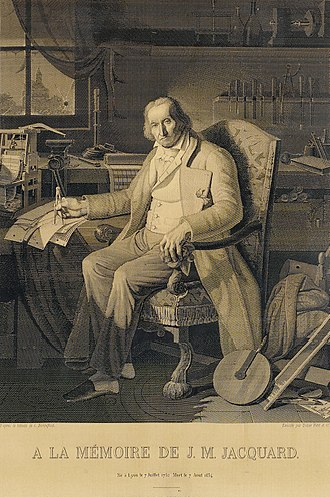
This portrait of Jacquard was woven in silk on a Jacquard loom and required 24,000 punched cards to create (1839). It was only produced to order. One of these portraits in the possession of Charles Babbage inspired him in using perforated cards in his Analytical Engine.
ACHIEVEMENT(S): The automated Jacquard loom
DATE/PLACE OF BIRTH: 7th July 1752, in Lyons, France.
DATE/PLACE/AGE AT DEATH: 7th August 1834, in Oullines, France. Aged 82.
DISCIPLINE: Weaving.
FIELD: Engineering.
LANGUAGE: French.
EDUCATION: Self-taught.
MAJOR WORK: Jacquard Loom.
LIFE AND TIMES: Jacquard’s father was a weaver of elaborately patterned brocades, his mother interpreted designs for loom-work and from an early age, Jacquard was intended to follow in his father’s footsteps.
At the age of ten, Jacquard lost his mother and came under the very strict rule of his unsympathetic, rigid, father, who refused to allow him to learn to read or write. Desperately unhappy, he ran away to Mlle Barret, his mother’s cousin.
Over the next several years, he was apprenticed to Mlle Barret, learning the art of bookbinding. During this time he taught himself basic reading, writing and arithmetic and picked up some training in the forging of cutlery. At the age of nineteen, he heard that his father had died and that he had inherited the small weaving business.
Jacquard tried to run the company as a figure-weaving concern and was interested in making improvements in the weaving industry but, because of his lack of training the business was unsuccessful. In the end, Jacquard went broke and had to sell his house to make ends meet. By this time, he had a wife to support, so he went to work for a type-founder and cutler, while his wife made straw hats.
He maintained his interest in the weaving industry and set about designing a new loom. By 1801, he had made his own machine and demonstrated it at the Exposition for National Industry held in Paris in 1804. The jury awarded him a bronze medal and he was given a patent for ten years which, along with the small pension that came with the award, allowed him to study and work on his inventions at the Conservatoire des Arts et Métiers.
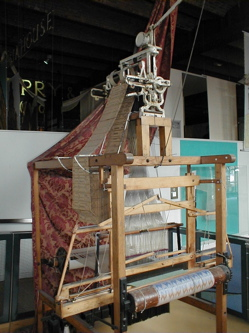
Soon, his major development:- the “Jacquard” loom (based on earlier ideas by <improved on> Bouchon* and <improved on> Falcon*) which used perforated cards to control the movement of the warp threads, was launched. With the new loom, weavers still had to plan their patterns, as had always been the case, but the manual labour needed to weave the final product was greatly reduced.
The perforated cards worked in such a way that hooks would pull the required warp threads down through the holes in the card, ready to be woven into the pattern. This meant that threads could be pulled down in selected combinations to produce a particular design and, once a punched card had been made for any design, it could be used over and over again, reducing production time.
French mill owners were quick to adopt the new loom and, during the first decade of the nineteenth century, large numbers were installed in factories. By 1812, there were said to be 11,000 Jacquard looms in operation in France but, although the mill owners were very happy with the savings this produced, fear of redundancy caused industrial unrest, many looms were destroyed, and Jacquard himself was attacked by rioting workers.
The new looms created a demand for more textiles, and Jacquard began to export them throughout the European countries. The idea of perforated cards for operating machinery soon spread to other industries. <influenced> Charles Babbage* adapted the idea for use with his proto-computer, and <influenced> Herman Hollerith* eventually developed the use of punched cards to collate data for the US census of 1890.
This portrait of Jacquard was woven in silk on a Jacquard loom and required 24,000 punched cards to create (1839). It was only produced to order. One of these portraits in the possession of Charles Babbage inspired him in using perforated cards in his Analytical Engine.
ASSESSMENT: The invention of the Jacquard loom revolutionized the weaving industry and had knock-on effects on developments in other industries.
EXTRA CONNECTIONS: His work related to that of <influenced> Roberts*, <influenced> Vaucanson* and <influenced> Deverill
ONELINER: J-M Jacquard, inventor of the Jacquard automated loom
BIBLIOGRAPHY:
Biographie Universelle.
The Hutchinson Dictionary of Scientific Biography, Helicon, 1994.
Poncetton, François, Jacquard de Lyon, Éditions du Milieu du Monde, Geneva, 1943.
Jacquard Loom (Ada Lovelace taken to see one by her mother, latter imagined as input for Babbage machine).
PARENTS: Jean-Charles Jacquard and Antoinette Rive.
SIBLINGS: No details.
SPOUSE: Mlle. Boichon.
CHILDREN: One son.