Andreae
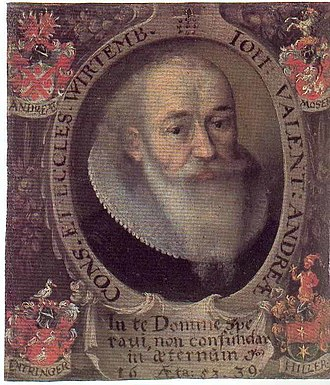
Full Name: Johann Valentin Andreae
Achievements: Theological writing
Born: August 17, 1586; Herrenberg, Wuttemberg, Germany
Died: June 27, 1654; Stuttgart, Wurttemberg, Germany (Aged 57)
Field & Discipline: Theology
Language: German
Father: Johann Andreae
Mother: Maria Moser
Siblings: 4
Spouse: Agnes Gruninger
Children: 9. 3 survived infancy
Education: Privately at home; Tubingen University
Major Work:
"A Christian Republic Described" (1619)
Life & Times:
Andreae came from a family with strong links to the church. His grandfather was a Tubingen professor of theology who drew up the Formula of Concord (1577) which saved the church established by [follower of] Luther* from falling apart through schism. After receiving his master's degree in 1605, Andreae began to study theology, while keeping up his other wide range of studies. In 1607 he was expelled from university and over the next five years traveled in Europe and spent periods of study in Tubingen, where he took employment as a private tutor.
On a visit to Switzerland in 1611 he was impressed by the way the Calvinists organised their religion and decided that the Lutherans should follow their example. He was ordained in 1614 and settled as Lutheran pastor at Vaihingen. Over the next following years he wrote most of the works for which he is now known, although not all of them were published at the time of writing. Andreae was primarily interested in the idea of spiritual rebirth.
He was drawn to the works of Christian visionaries and reformers, and his own writing was driven by his belief that a new spiritual regeneration was needed.
The intellectual community at Tubingen was then a centre for reformist views, and in 1614 the works of [influenced by] Campanella*, the Italian philosopher, were brought to Tubingen by a friend of Andreae. Campanella was a Christian reformer who attempted a compromise between orthodox Roman Catholic theology and the new humanist thinking.
Andreae felt that in his own Lutheran church there was too rigid an adherence to Lutheran orthodoxy and not enough emphasis on true faith and the responsibility of each individual for their own salvation. He wanted all Christians of whatever faith to join together in a society which would promote devotion to godly living and the practice of humanist principles such as the study of nature, the exercise of reason and a concern for the welfare of all society. Andreae held that the study of nature was as important as that of the Bible because the power and wisdom of God was most clearly seen in the creation of the natural world.
In 1619 Andreae wrote "A Christian Republic Described" which, like Campanella's "City of the Sun," described a new Christian utopia. In true humanist fashion, Andreae made education a prime focus of reform. His ideal Christian society was centred on a college where the sciences would be studied. He categorized the sciences and emphasized observation and experiment as the key tools of knowledge. He supported education for all, even for girls. He also wanted education to be in the vernacular so that it was accessible to all, not just to Latin scholars. As well as the study of nature, his curriculum included crafts and physical training.
He called for the establishment of his ideal society in (1619): "A Model of a Christian Society" and (1621): "The Right Hand of Christian Love Offered". His vision influenced many humanist thinkers including [influenced] Komensky* who said that his own interest in pansophy was triggered by reading Andreae. In 1620 Andreae moved to Calw, in the Black Forest, where he remained for the next nineteen years, writing and editing religious texts and producing works for educating children and adults. His time there was overshadowed by the Thirty Years’ War. Calw was an important centre for the wool industry and the war caused great hardship. Andreae took practical steps to help, setting up a private organization for mutual assistance and making improvements in education and social service.
He was saddened by the 1632 death of [his hero was] Gustavus Adolphus*, the Swedish champion of the Protestants, and two years later, after the Swedes were defeated at the Battle of Nordlingen, Calw was sacked and burned. Andreae fled with his family, and during the journey his ten-year old son died from exposure. He also lost his library, his collection of art (original paintings by [owned work of] Durer*, [owned work of] Cranach* and Holbein) and almost all his manuscripts. He was appointed court preacher and councillor in Stuttgart in 1639. He found this job difficult and particularly disliked the administrative details of court life. In 1641 he received a doctorate in theology from Tubingen.
Andreae's most valuable contribution during his last years was the reorganization of the churches in Wurttemberg, and of the liturgy. In 1650 he went to the Lutheran school at Bebenhausen on the outskirts of Tubingen as bishop and abbot. After teaching there for four years he was allowed to retire to Stuttgart in February 1654 where he died a few months later.
Extra Connections: Had contact with [corresponded with] Kepler*, [corresponded with] Hartlib* and [corresponded with] Durie J*
Assessment: Andreae was part of the Protestant humanist circle who worked for reform within the Lutheran church and unity with other Christians.
Oneliner: J.V. Andreae, Humanist Protestant reformer
Bibliography:
- Dictionary of Scientific Biography.
- Montgomery, John Warwick, Cross and Crucible, Vol. I, Martinus Nijhoff, The Hague, 1973.